



Using both valved and non-valved bends to explore the entire instrument
With
PT Gazell
What's in the course
10 lessons (0h 50m) · 1 free
01. How to focus and refine our bending technique
5:35
02. Getting our heads around valved bends
Free lesson4:59
03. Another half-valved bending exercise
5:09
04. 3 valved bending exercises
4:45
05. Using both valved and non-valved bends to explore the entire instrument
You are here3:54
06. Using a valve blow bend inside a melody (My Romance)
6:05
07. Utilizing the extra emotion that the Gazell method provides
6:59
08. 5th position minor as an alternative to 3rd position minor
5:07
09. Learn the head of the song “Sugar” in 5th position minor
3:40
10. Learning a solo for “Sugar” and how to play the full song
4:11
Lesson transcript
Music Lesson 3: Exploring Valved and Non-Valved Bends
Hi, everybody. Welcome back!
In this lesson, we're going to be using both valved and non-valved bends to explore the entire range of the instrument.
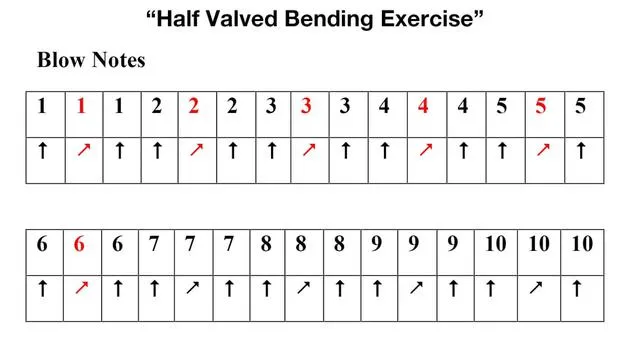
Chromatic Scale Practice
I don't know of a better way to do this than to practice our chromatic scale. We'll see what it's like to play:
- Regular notes
- Bent regular notes
- Valved bent notes
Our objective is to:
- Play the scale accurately
- Stay on pitch with the bends
- Make everything sound as even as possible between regular notes, regular bends, and half valve bends.
Starting the Chromatic Scale
Let's go ahead and play the chromatic scale in three different octaves, starting on hole one. This is in first position, so we're playing an A flat on an A flat harmonica.
Here we go:
- Octave 1
Now we'll start where we left off and we'll play Octave 2. Make sure you follow along on your PDF on the tab that I've sent and understand how I'm achieving those notes.
Now we'll finish on the top octave, noting that we have to get two blow bends out of hole 10.
Cool! Now let me play the whole chromatic scale again from start to finish, starting at the bottom and working my way all the way up.
Don't be afraid to practice that and try it at different speeds. You can also go from back to front, start at the top and work your way back down. All these things help us familiarize ourselves with where the notes are on the harmonica. It will help down the road, I promise.
Leapfrog Exercise
The next exercise is called the Leapfrog Exercise. This is similar to what a trumpet player might do to practice their intervals. It moves us from the two draw note all the way up to the end of the harmonica.
This is great practice because it keeps us moving and requires us to use:
- Regular notes
- Valved bending
- Conventional bending
Let's give it a try. Follow along on your PDF!
10 lessons
0h 50m of structured video lessons
Advanced video features
Slow down, loop a passage, follow along
Mobile, tablet & desktop
Practise wherever you are
100% satisfaction guarantee
30-day money-back guarantee
Meet your guru
Meet your guru
PT Gazell has earned his position as a master of the diatonic harmonica. After years as the sought-after side man and session player for some of Nashville's greatest, PT discovered half-valving and his music literally soared to new heights.
No other player combines his phrasing, melodic style, song choices and improvisational abilities the way he does - in the end, it is a style all his own. Using his own signature instrument, the Gazell Method diatonic manufactured by Seydel, PT proves that the harmonica is capable of far more than most of us believe.
Dig it!
In his courses, PT teaches half-valving straight from the source - so you can get started with the Gazell Method, master valved bends, and bring them into your own songs.







