



Soloing using the root note of blues progression chords

With
Mat Walklate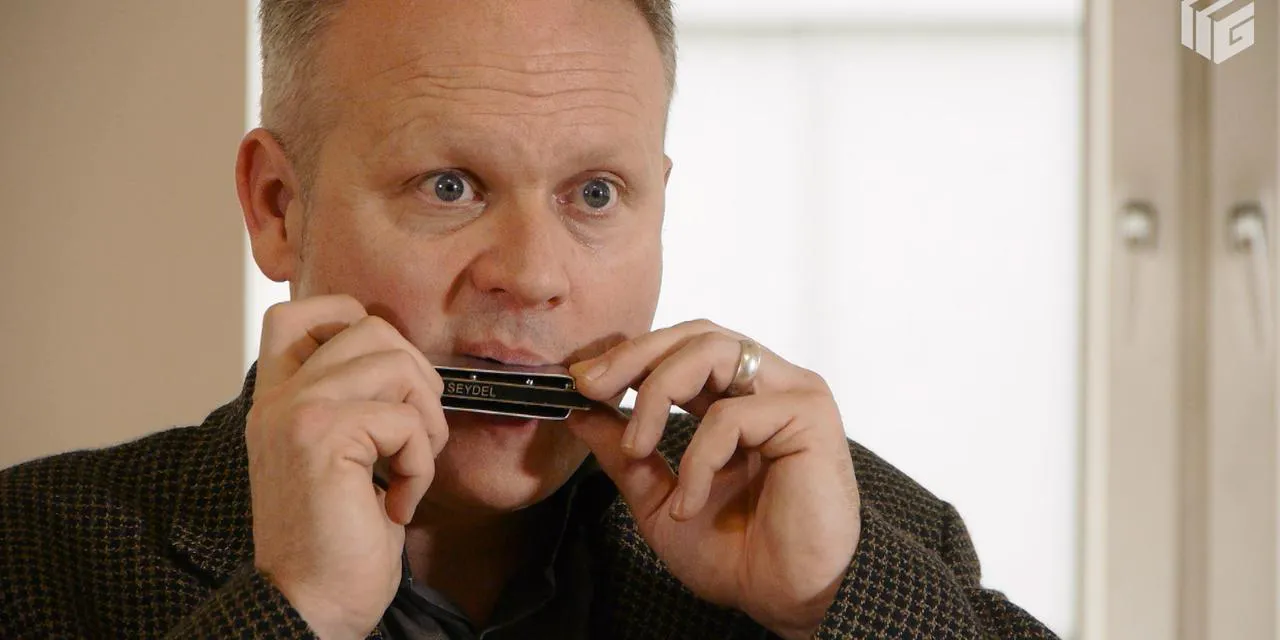
What's in the course
11 lessons (1h 4m) · 2 free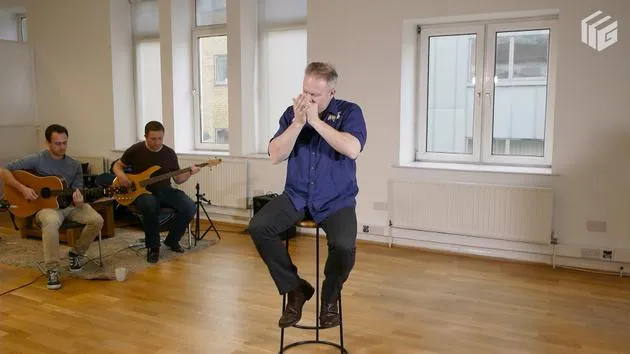
01. Playing the blues, a demonstration
Free lesson2:14
02. G blues scale review
2:31
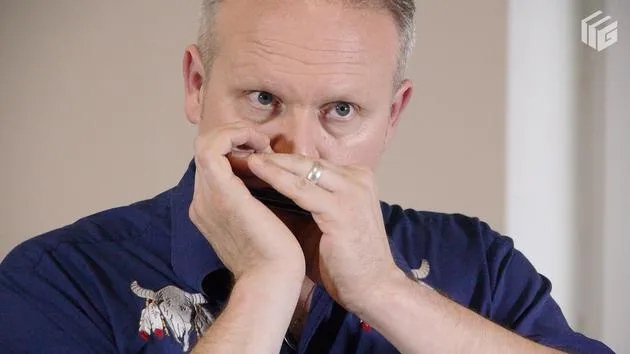
03. Note bending for additional notes
9:12
04. Simple 12 bar solo
3:50
05. Soloing using the root note of blues progression chords
You are here5:57
06. Vibrato
6:37
07. Developing more interesting solos
7:43
08. Advanced tongue blocking
10:22
09. First position blues scales
5:48
10. Third position blues scales
6:22
11. BONUS: Learn how to play Ian Dury's "Sex & Drugs & Rock & Roll" on the blues harmonica
Free lesson3:36
Lesson transcript
Constructing a Solo on the Diatonic Harmonica
Hello, my name is Matt. In this lesson, we're going to be looking at constructing a solo on the diatonic harmonica using the root notes of the chords that the accompaniment is playing.
Overview
- Instruments: Guitars, bass, piano, etc.
- Chords Involved: Only three chords
- Root Notes on Harmonica:
- 2 draw: G (most common)
- 4 blow: C
- 4 draw: D
The 12 Bar Blues
For the first four bars of a simple 12-bar blues, we have:
- Bars 1-4: G (2 draw)
- Bars 5-6: C (4 blow)
- Bars 7-8: G (2 draw)
- Bar 9: D (4 draw)
- Bar 10: C (4 blow)
- Bars 11-12: G (2 draw)
If you just play the root notes, it can be extremely dull. However, you can start to embroider it, adding one or two extra notes to add character.
Adding Additional Notes
- If you play just the root notes, it's pretty dull.
- By incorporating adjacent notes (notes next door), you can create something more interesting.
Remember, it's all based around the root notes of the chords.
The Importance of Listening
- It's not strictly necessary to count; the more you listen to 12-bar blues, the more you'll anticipate chord changes.
- Most blues follows the 12-bar pattern. Keep listening to what other harmonica players are doing.
By doing this, you'll develop a better understanding of when to change and how to make your playing sound more interesting.
Practical Application
Now, let's put this into practice!
- I will go back to the pub and drag the band out again.
- We'll play two 12-bar progressions, and I will construct two solos based on the root notes of the chords, keeping it straightforward.
After a count of four...
1, 2, 3, 4!
Adding Bends
As you learn to make successful bends on the harmonica, you can add these to your playing as well. Bends provide more options and directions to explore, allowing you to create interesting riffs.
Examples of bends included with root notes:
- 2 draw
- 4 blow
- 4 draw
Once you master those note bends, you can incorporate them into any other formula used to construct a solo.
For instance, in the previous lesson using the blues scale, you can add bends to enhance its lyrical quality.
Final Thoughts
Bends can be difficult, but they are worth persevering with as they open up many more possibilities in your playing. Happy practicing!
11 lessons
1h 4m of structured video lessons
Advanced video features
Slow down, loop a passage, follow along
Mobile, tablet & desktop
Practise wherever you are
100% satisfaction guarantee
30-day money-back guarantee
Meet your guru
Meet your guru
Mat Walklate is a Manchester-based harmonica player and teacher working in blues and folk, who also plays flute, whistle and uilleann pipes and sings. He won the British Blues Harmonica Championship in 1992 and the All-Britain Fleadh Cheoil on harmonica in 1993, and is a Seydel-endorsed artist.
Over a thirty-year career he has toured Europe with bands including The Moochers and the Irish-music group The House Devils, recorded and mixed some fourteen albums between 2001 and 2021 - among them Sea of Blues and Traditional Harmonica - and now performs in a duo with singer-guitarist Alex Haynes and alongside blues scholar Dr Tom Attah. He teaches harmonica at Leeds Conservatoire and privately.
On MusicGurus his courses take you from your first notes on a C harmonica - embouchure, the cross-harp position, bending and your first improvisation - through to fluent blues playing, with vibrato, alternative positions and the phrasing that makes a solo sing.







