



G blues scale review

With
Mat WalklateReview of how to play the G blues scale on the C harmonica
What's in the course
11 lessons (1h 4m) · 2 free
01. Playing the blues, a demonstration
Free lesson2:14
02. G blues scale review
You are here2:31
03. Note bending for additional notes
9:12
04. Simple 12 bar solo
3:50
05. Soloing using the root note of blues progression chords
5:57
06. Vibrato
6:37
07. Developing more interesting solos
7:43
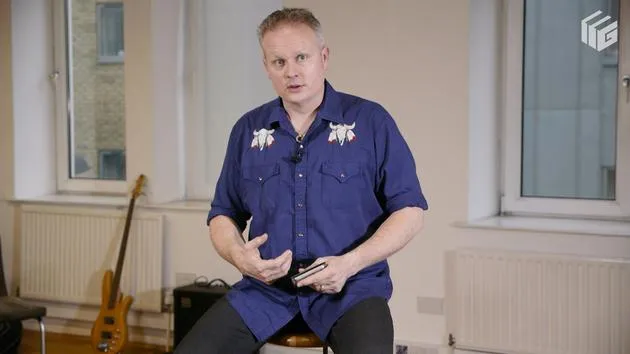
08. Advanced tongue blocking
10:22
09. First position blues scales
5:48
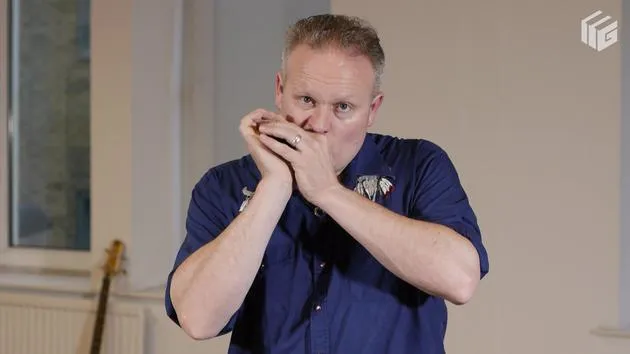
10. Third position blues scales
6:22
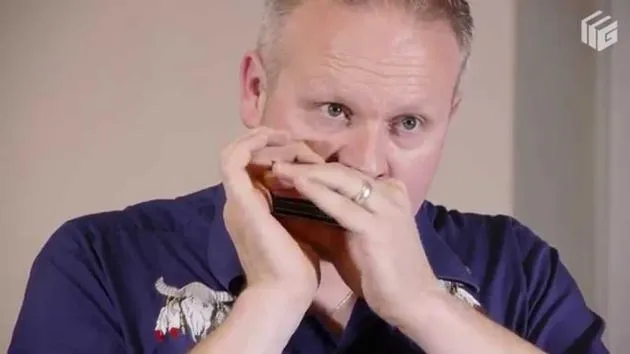
11. BONUS: Learn how to play Ian Dury's "Sex & Drugs & Rock & Roll" on the blues harmonica
Free lesson3:36
Lesson transcript
Tips and Tricks for Playing Blues on the Diatonic Harmonica
Hello, my name's Matt, and I'm going to be showing you a few tips and tricks on the diatonic harmonica to improve your blues playing.
Understanding Key Positions
This harmonica is in the key of C. Interestingly, the easiest way to play blues on a C harmonica isn't in the key of C, it's actually in the key of G.
The Blues Scale
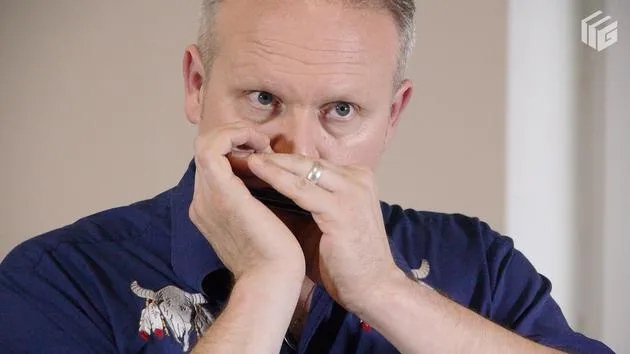
Every diatonic harmonica has a blues scale hidden in there purely by accident. This scale typically goes from:
- 2 Draw
- 3 Draw
- 4 Blow
- 4 Draw
- 5 Draw
- 6 Blow
You would play it like this to embody the essence of blues harmonica solos. Playing in this way is known as second position or cross harp.
Recap of the Blues Scale
To recap, on the scale that spans from 2 to 6, all the notes on the harmonica are at your disposal, and we can use those to construct solos.
Strong and Weak Notes
- Strong Draw Notes: The draw notes in the first six holes are typically stronger when playing blues in second position.
- Weak Blow Notes: Some of the blow notes are not quite as strong.
Rule of Thumb
As a basic rule of thumb:
- If you can't think of what to play and your mind goes completely blank, breathe in.
- Breathing in while using the first six holes is usually a safer option than breathing out.
Expanding the Blues Scale
The blues scale continues all the way up to the top. For instance, you can go from number nine to number six, like so.
Two Octaves
This gives you access to two octaves and a bit of the blues scale. You can further enhance your playing by adding bent notes.
- Bent Notes: You can bend many of the notes down in pitch, which provides additional notes to expand your palate.
Ultimately, the basic skeleton or framework to focus on is that foundational blues scale, as discussed.
11 lessons
1h 4m of structured video lessons
Advanced video features
Slow down, loop a passage, follow along
Mobile, tablet & desktop
Practise wherever you are
100% satisfaction guarantee
30-day money-back guarantee
Meet your guru
Meet your guru
Mat Walklate is a Manchester-based harmonica player and teacher working in blues and folk, who also plays flute, whistle and uilleann pipes and sings. He won the British Blues Harmonica Championship in 1992 and the All-Britain Fleadh Cheoil on harmonica in 1993, and is a Seydel-endorsed artist.
Over a thirty-year career he has toured Europe with bands including The Moochers and the Irish-music group The House Devils, recorded and mixed some fourteen albums between 2001 and 2021 - among them Sea of Blues and Traditional Harmonica - and now performs in a duo with singer-guitarist Alex Haynes and alongside blues scholar Dr Tom Attah. He teaches harmonica at Leeds Conservatoire and privately.
On MusicGurus his courses take you from your first notes on a C harmonica - embouchure, the cross-harp position, bending and your first improvisation - through to fluent blues playing, with vibrato, alternative positions and the phrasing that makes a solo sing.







