



Simple 12 bar solo

With
Mat WalklateMat Walklate builds a simple 12-bar blues solo on harmonica from just four notes of the blues scale, stretching and repeating them to create tension.
What's in the course
11 lessons (1h 4m) · 2 free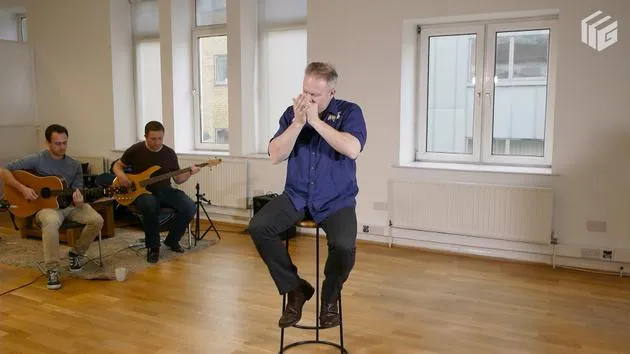
01. Playing the blues, a demonstration
Free lesson2:14
02. G blues scale review
2:31
03. Note bending for additional notes
9:12
04. Simple 12 bar solo
You are here3:50
05. Soloing using the root note of blues progression chords
5:57
06. Vibrato
6:37
07. Developing more interesting solos
7:43
08. Advanced tongue blocking
10:22
09. First position blues scales
5:48
10. Third position blues scales
6:22
11. BONUS: Learn how to play Ian Dury's "Sex & Drugs & Rock & Roll" on the blues harmonica
Free lesson3:36
Lesson transcript
Developing Solos Using the Blues Scale
Hello, my name's Matt. This lesson involves trying to develop solos using the blues scale. Just to remind you, in case you've forgotten, the blues scale consists of six notes in total.
Constructing a Solo
One way of constructing a solo is to take four notes from that scale and create a riff.
- Imagine this:
- If you had the six notes written on cards, shuffled them, and scattered them in front of you,
- You could pick four at random to create a riff.
- While it might not be brilliant, technically, it wouldn't be wrong.
It's worth experimenting with the blues scale to pick out riffs and develop them into a solo.
Example Riff
To start the ball rolling, here's a very simple example:
- Using the first four notes of the blues scale from hole number two:
- 2 draw
- 3 draw
- 4 blow
- 4 draw
This gives us this initial riff.
Now, we can develop a solo out of it.
First Four Bars
- Over the first four bars of the 12-bar structure, we play the riff twice.
- Elongate one of the notes, making one note longer than the others.
In this case, I'm going to make the second note longer. It would sound like this:
- Demonstration:
- 2, 3, 4 and 2, 3, 4
Changing the Chord
After the first four bars, the chord will change on the guitar or any accompanying instrument, and we will change the riff.
- For bars 5 and 6 of the 12-bar structure, we play each note pretty much the same value, once per bar.
Building Tension
For bars 7 and 8:
- Remove the last note from the riff and play the three remaining notes.
- We play this little three-note riff four times.
This builds up some tension, snowballing toward bar number nine.
The Apex of the Solo
Bar number nine is often, not always, the apex of a blues solo.
What we do here:
- Play something big, powerful, and noisy, like four and five draw, followed by four and five blow for bar ten, because it works.
Conclusion
Finally, we finish off with the initial riff again. At the very end, we play what we started with in the beginning, and that completes the 12-bar solo.
In a moment, I'll try and drag the rest of the band out of the pub, and we'll record an example of this for you.
Now that the guys are here, we're going to play 112 bars using the rules I described before. We're going to take four notes from the blues scale and turn them into a solo.
Are you ready? After a count of four:
1, 2, 3, 4.
11 lessons
1h 4m of structured video lessons
Advanced video features
Slow down, loop a passage, follow along
Mobile, tablet & desktop
Practise wherever you are
100% satisfaction guarantee
30-day money-back guarantee
Meet your guru
Meet your guru
Mat Walklate is a Manchester-based harmonica player and teacher working in blues and folk, who also plays flute, whistle and uilleann pipes and sings. He won the British Blues Harmonica Championship in 1992 and the All-Britain Fleadh Cheoil on harmonica in 1993, and is a Seydel-endorsed artist.
Over a thirty-year career he has toured Europe with bands including The Moochers and the Irish-music group The House Devils, recorded and mixed some fourteen albums between 2001 and 2021 - among them Sea of Blues and Traditional Harmonica - and now performs in a duo with singer-guitarist Alex Haynes and alongside blues scholar Dr Tom Attah. He teaches harmonica at Leeds Conservatoire and privately.
On MusicGurus his courses take you from your first notes on a C harmonica - embouchure, the cross-harp position, bending and your first improvisation - through to fluent blues playing, with vibrato, alternative positions and the phrasing that makes a solo sing.







