



Jumping Around (Walkthrough)

With
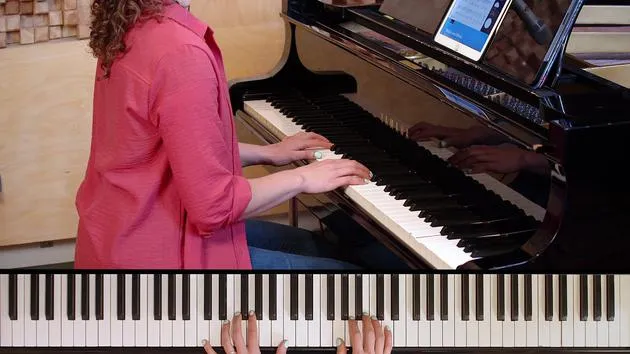
Talia GirtonTalia Girton breaks down the performance piece 'Jumping Around', working through its syncopation and tricky hand-position changes a chunk at a time.

What's in the course
23 lessons (0h 33m) · 1 free
01. What Are Tied Notes
Free lesson1:03
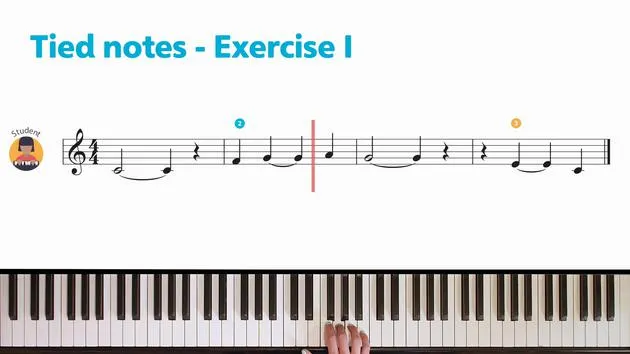
02. Tied Notes Exercise 1
1:00
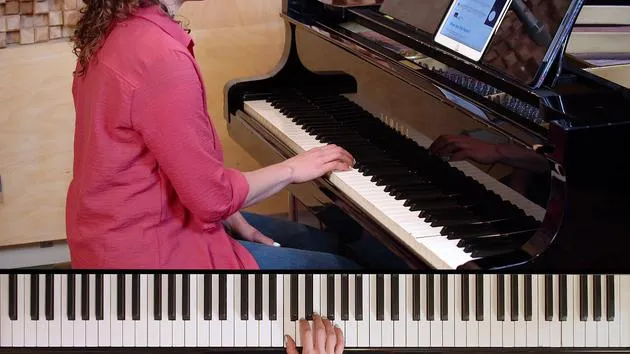
03. Tied Notes Exercise 1 (Performance)
1:23
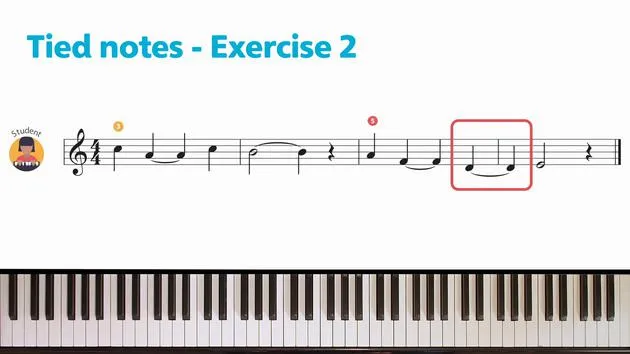
04. Tied Notes Exercise 2
1:09
05. Tied Notes Exercise 2 (Performance)
1:03
06. What Are Eighth Notes
1:25

07. Eighth Note Rhythm Game
1:48
08. Eighth Note Exercise 1
1:56
09. Eighth Note Exercise 1 (Performance)
1:21

10. Eighth Note Exercise 2
1:31
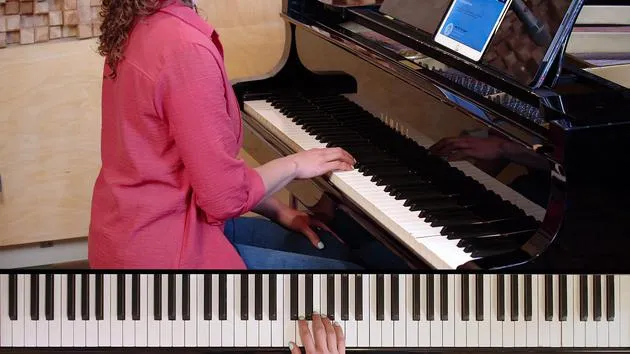
11. Eighth Note Exercise 2 (Performance)
1:05
Lesson transcript
Performance Piece: Jumping Around
Let's have a look at the next performance piece, Jumping Around.
This is a massive step up from what we've done so far, so make sure that you really take your time. It might take you a bit longer to learn this one.
Understanding the Piece
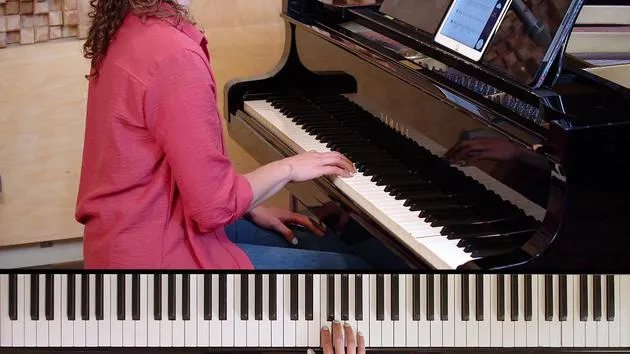
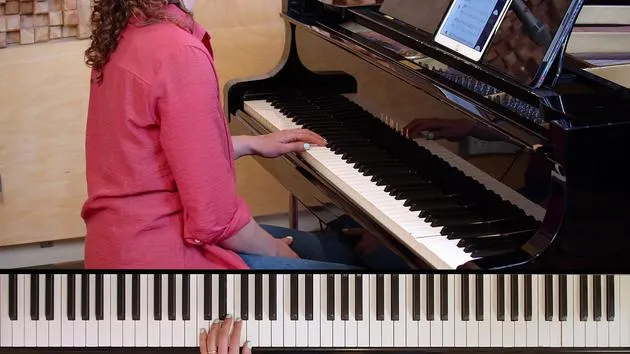
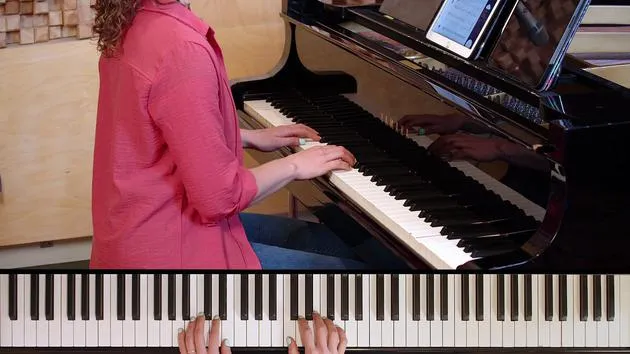
- The first thing to notice is that the left hand is playing the same melody that we were just practicing in the right hand exercise, so you might recognize that part.
- I would break this down into very small chunks and start with the most tricky bits first.
Syncopation and Rhythmic Differences
If we look at the music, there's a lot of syncopation happening in the second line, and there's quite a different rhythm occurring between the right hand and the left hand.
-
The left hand repeats:
1 and 2 and 3 and 4 and -
The right hand repeats this in the rhythm bit:
1 and 2 and 3 and 4 and
1 and 2 and 3 and 4.
Make sure to pay close attention to the finger numbers so that you can help yourself get to those places that are a bit farther away on the keyboard.
Practice Tips
Let's have a look at what this would sound like after four:
One and two and three and four.
And one and two and three and four.
And one and two and three and four.
And one and two and three and four.
And one and two and three and four.
And one and two and three and four.
And one and two and three and four.
And one and two and three and four.
And one and two and three and four.
Be sure not to start that first line too quickly, because when you get to the second line, those eighth notes will really sneak up on you and feel quite fast.
Visual Cues
Another tip is to look at where the notes stack on top of each other. Remember that when two notes stack in the treble and bass clef, they're played at the same time.
You can use these kinds of visual cues to show you where the notes play together and where they're played separately.
Happy practicing!
23 lessons
0h 33m of structured video lessons
Advanced video features
Slow down, loop a passage, follow along
Mobile, tablet & desktop
Practise wherever you are
100% satisfaction guarantee
30-day money-back guarantee
Meet your guru
Meet your guru
Talia Girton is a musician and HCPC-registered music therapist, and the founder of The Cycling Music Teachers. Her work brings together music therapy, counselling and education, and she tutors internationally on the music therapy training course at UDELAS in Panama as well as contributing to professional development with the European Piano Teachers Association (EPTA). On MusicGurus she teaches the Piano Method and Piano Foundations courses, guiding complete beginners from first steps through rhythm, both hands, theory and performance.







