



Le rôle du trombone, l'articulation et les styles de musique agressifs
Lesson time: (6min 35sec)
Course preview
This lesson is part of the course Musicalité et improvisation en brass band avec Youngblood
Watch a preview of the full course below.
Lesson transcript:
Trombone Articulation and the Youngblood Brass Band
Introduction
Hi there! This is Matt and Joe from the Youngblood Brass Band. Today, we're going to discuss the role of the trombone in our band and focus on articulation, especially in more aggressive styles of music.
The Trombone's Role in Music
-
Aggressive vs. Non-aggressive Sound
In many styles of music, particularly big band and classical settings, the trombone is often not seen as an aggressive instrument. As Joe pointed out:"You usually have to apologize for the volume of the trombone."
-
Youngblood's Style
In the Youngblood style, which is a spin-off of the New Orleans style, the approach is quite the opposite. Our music is:- Parade music
- Street music
- Focused on filling up space aggressively
Some genres, like salsa music and Cuban timba, treat the trombone with more aggression and articulation, while in big band jazz, it often remains subdued.
Articulation Misconceptions
We want to clear up some misconceptions about articulation, especially in our popular song, "Brooklyn."
Part 1: The Rhythm
- The rhythm we focus on is:
"Bad up but up ba ba da ba da."
Many bands misunderstand this and play it as a swung rhythm:
"Bad up but up ba ba da ba ba da da ba da."
However, as Nat, our sousaphone player, taught us, it's about:
- Microdynamics
- Aggressive trombone playing that doesn't always mean high volume.
Quiet Intensity
In fact, the second time we play this part, it's quite quiet while maintaining full aggression. We can describe this as:
"Quiet intensity."
Call and Response Section
Next, we move into the call and response section of "Brooklyn." Here, it's crucial to perform with an attitude:
- This is my call; their response.
I often notice trombone players trying to "sneak into" their parts, but that's not the approach. It's about:
- Inflection
- Selling your attitude
We transition from a background part with quiet intensity to the soloist section.
Approaches to Call and Response
There are two main approaches:
-
Matt's Call:
When I do the call, I have a lot of liberty. As you heard, I vary my articulations and sometimes even the notes. -
Congregation Response:
The rest of the band usually sticks to the main script, occasionally adding a twist or poking through. For example:"Ba da ba da ba da ba de ba da ba ba ba ba ba da ba da ba."
In some traditional New Orleans tunes, the band mimics the caller's exact phrases, but in this tune, we often stick to the script while allowing for inflection.
Conclusion
It's not just about volume. With five of us in the frontline, intensity is key. We incorporate:
- Little rips
- Stings
- Slide actions
- Glissandos
- Mini dynamics
This makes our play not just loud but full of character and energy!
About the instructor
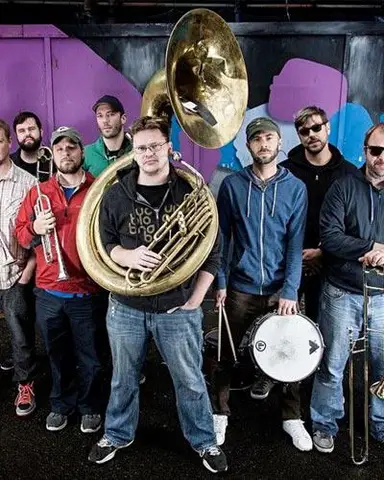
Youngblood Brass Band fusionne les cuivres sans concession de La Nouvelle-Orléans avec l'énergie et le lyrisme du hip-hop. Issu de Madison, Brooklyn, Minneapolis et Chicago, ce groupe de dix musiciens tourne dans le monde entier depuis 2000 et a collaboré avec des artistes tels que Questlove et Talib Kweli. Il est tout aussi à l'aise à mener une fanfare sur ses propres compositions qu'à faire la tête d'affiche d'un festival de punk. Sur MusicGurus, ils décomposent leur son mêlant La Nouvelle-Orléans et hip-hop : comment ils composent et arrangent pour les cuivres, le vocabulaire rythmique et harmonique qui relie le tout, et comment jouer une ligne de cuivre au sein d'une section soudée, y compris les parties complètes de leur morceau 'Brooklyn'. read more