



Glisser des accords de 9e à la 6e dans ton blues

Avec
Ron SayerRon Sayer montre comment glisser entre les accords de sixte et de neuvième pour ajouter de l'harmonie à tes solos et à ton accompagnement blues.
Le contenu du cours
12 leçons (1h 27min) · 2 gratuites
01. Jam de bienvenue au cours
Leçon gratuite2:21
02. Utiliser les arpèges dans ton blues
Leçon gratuite8:23
03. Gammes ton/demi-ton dans ton blues
8:49
04. Arpèges de septième diminuée dans ton blues
10:14
05. Plus d'arpèges de septième diminuée
10:32
06. Glisser des accords de 9e à la 6e dans ton blues
Tu es ici8:16
07. Quartal Harmony Blues Scale
4:46
08. Gamme de blues avec accords de neuvième
3:24
09. Accords de septième mineure et quartaux dans ton blues
4:36
10. Les arpèges de septième majeure dans ton blues mineur
12:48
11. Gammes altérées dans ton blues mineur
9:56
12. LEÇON BONUS : Santana - Black Magic Woman
3:16
Transcription de la leçon
Lesson on Sliding Sixth to Ninth Chords
Okay, the next lesson is a bit of a break from the weirdness of diminished sevenths, half tone whole tones, and minor seven flat five arpeggios. So, let's have a little light relief by looking at some sliding sixth to ninth chords that you can use over blues.
Chord Usage
What I like to do with these particular chords is throw them into solos, so you've got some more harmony going on in certain things. Obviously, they can also be used for accompanying as well, making sure that your accompaniment is a little bit more interesting than just straight block chords.
First Position Sixth to Ninth Chords in A
To start off with in A, we're going to look at first position sixth to ninth chords, which we call implied chords. This means that there aren't every note from the ninth or sixth chord, just some of them.
The Chord Shape
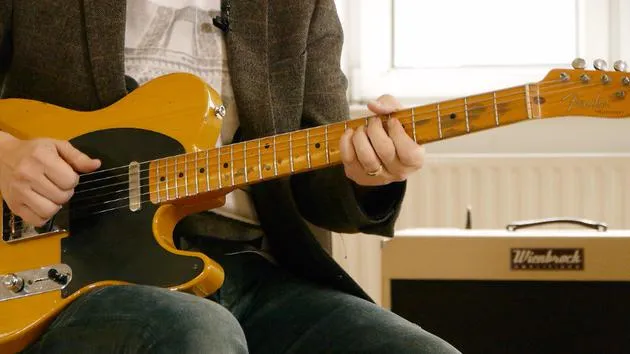
- In A:
- We'll be focusing on these three notes:
- D string: 5th fret
- G string: 4th fret
- B string: 5th fret
- We'll be focusing on these three notes:
This forms a ninth chord. If we play it with the A, you can hear that sound. When you slide it up, it's a commonly used technique, very, very Stevie Ray Vaughan inspired!
Sliding Technique
To do this:
- Slide that ninth chord up two frets, and it becomes a sixth chord, which you can use over the other chords as well.
For example:
- When you get to D up here, play the 9th chord at the 10th fret.
- Slide it up to the 12th fret for the sixth chord.
- Then, back down, and back to A.
- When you reach E, repeat the process:
- 12th fret to 14th fret
- Back down to the 10th (D)
- Finally back down to the 5th fret (A)
- And up to D, then back down to A, and up to E.
Alternative Positions
You can also play these chords in a different area of the fretboard. Instead of the 5th on the D, G, and B strings, you can create that chord higher up at the 12th fret by playing the G, B, and E.
- Slide from 12th fret to 14th fret to get the sixth chord:
So now we have:
- From A, we change to D by moving from the 5th fret up to the 7th, returning back to A at the 12th fret.
Ending Movements
Then go to the E, which is on the 7th fret, laying your fingers across the D, G, B, and E strings.
- Slide from the 7th to the 9th, back to the D, and then back up to the 12th again to finish off.
Bringing It All Together
I'll just go through that so you can hear how the whole thing sounds with the chords on the G, B, and E.
And of course, with those, you can mix and match positions. To save yourself moving around too much:
- When you switch to the D, you can use 5th position while still moving up to the E, B, and G strings.
Let's see how that sounds while throwing it into some soloing over some backing.
Let's Play!
So, let's set up a 12 bar and give it a try.
1, 2, 3, death.
12 leçons
1h 27m de leçons vidéo structurées
Fonctions vidéo avancées
Ralentissez, bouclez un passage, suivez la partition
Mobile, tablette et ordinateur
Pratiquez où vous voulez
Satisfaction garantie à 100 %
Garantie remboursement 30 jours
Rencontrez votre guru
Rencontrez votre guru
Ron Sayer est un guitariste de guitaristes du circuit blues britannique et un mentor pour des musiciens comme Oli Brown et Sol Philcox. Il a été nommé quatre fois aux British Blues Awards - pour l'album 'Better Side', le single 'Don't Make Me Stay' et sa coécriture sur 'Here I Am' d'Oli Brown - et a remporté le prix du guitariste de l'année. Dans ses cours, il décompose le phrasé, la sonorité et le feeling qui se cachent derrière le jeu solo de blues électrique.







