



Quartal Harmony Blues Scale

Lesson time: (4min 46sec)
Ron Sayer montre comment empiler des quartes pour former des accords quartaux et obtenir une sonorité aux accents fusion à glisser dans un slow blues ou un groove funk.
Course preview
This lesson is part of the course Sortir des sentiers battus 2 : et hop, tu t'envoles !
Watch a preview of the full course below.
Lesson transcript:
Understanding Chordal Harmony
Okay, we're going to look at something called chordal harmony. This posh name essentially refers to a chord that's created by stacking lots of fourths in a row. So, fourth, fourth, fourth, fourth creates our chordal harmony chord.
Why Use Chordal Harmony?
I really like this idea. It's nice to throw in to something like a slow blues or something funky, just to give things a bit of a fusion-esque sound. It's quite reminiscent of Robin Ford's style.
However, it was a guitarist named Greg Cork who actually showed me this nice little lick, so thanks Greg for that!
The Chord Structure
Finding the Chord
We're going to start with the following notes:
- F#
- B
- E
- A
This forms our chord, using A as the root note.
Concentration on Root Notes
What you need to concentrate on is that these notes move from the root note, allowing you to monitor where you're at.
- D ? 4th fret
- G ? 4th fret
- B ? 5th fret
- A ? 5th fret
This forms a nice chord, but take that top note, A. That's the note you need to keep an eye on.
Blending with the Blues Scale
Now, what you're going to do is play a pentatonic scale or a blues scale on your E string. It's up to you. I'm going to play a blues scale because I think it sounds much nicer.
Incorporating the Chord
You're going to include all the other parts of that chord while you play it. So, you're going to play your blues scale and then combine it with the chord:
- Play up to the top of the blues scale.
- Use the chord alongside it.
Once more, here's our pentatonic scale up the E string, combined with our chordal harmony style chord, played over the blues scale.
Extending the Scale
Obviously, you can carry on if you can reach. That's as far as I'm going to go, but you can also go back down.
Practical Application
So, the entire blues scale is using that chord over it. Now, I'm going to give you an example of the sort of things you can do.
What you're trying to achieve is to play over a blues scale while incorporating an entire chord.
Let's Play
I'm going to get the guys to play me a vamp, and I'll show you what we can do over it.
A 1, 2, 3, 4.
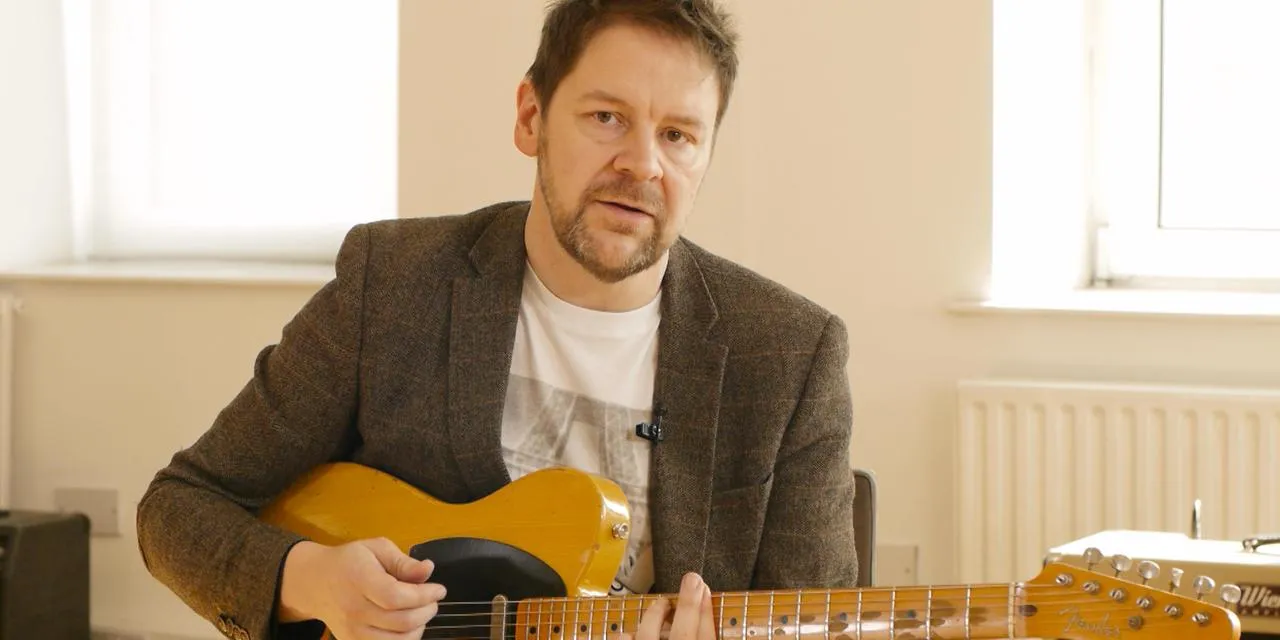
About the instructor
Ron Sayer est un guitariste de guitaristes du circuit blues britannique et un mentor pour des musiciens comme Oli Brown et Sol Philcox. Il a été nommé quatre fois aux British Blues Awards - pour l'album 'Better Side', le single 'Don't Make Me Stay' et sa coécriture sur 'Here I Am' d'Oli Brown - et a remporté le prix du guitariste de l'année. Dans ses cours, il décompose le phrasé, la sonorité et le feeling qui se cachent derrière le jeu solo de blues électrique. read more