



Utiliser les arpèges dans ton blues

Avec
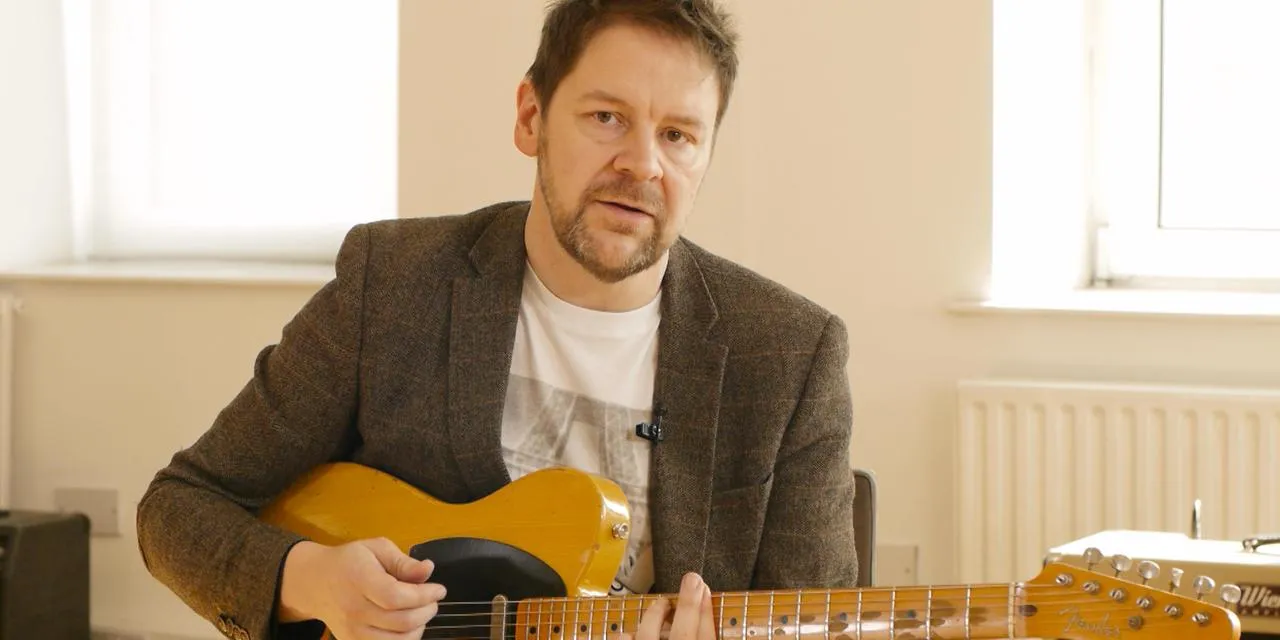
Ron SayerRon Sayer montre comment utiliser des arpèges minor 7 flat 5 sur un 12-bar blues, en déplaçant la même position sur les accords de A, D et E.
Le contenu du cours
12 leçons (1h 27min) · 2 gratuites
01. Jam de bienvenue au cours
Leçon gratuite2:21
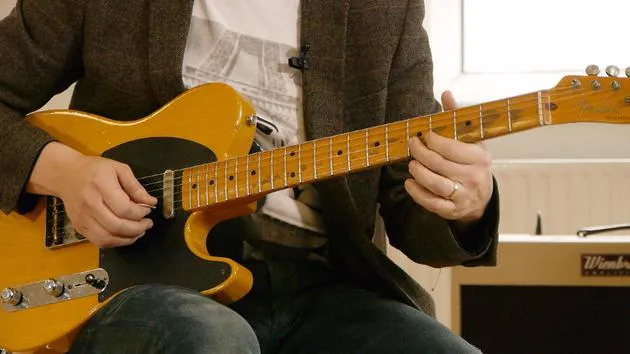
02. Utiliser les arpèges dans ton blues
Tu es ici8:23
03. Gammes ton/demi-ton dans ton blues
8:49
04. Arpèges de septième diminuée dans ton blues
10:14
05. Plus d'arpèges de septième diminuée
10:32
06. Glisser des accords de 9e à la 6e dans ton blues
8:16

07. Quartal Harmony Blues Scale
4:46
08. Gamme de blues avec accords de neuvième
3:24
09. Accords de septième mineure et quartaux dans ton blues
4:36
10. Les arpèges de septième majeure dans ton blues mineur
12:48
11. Gammes altérées dans ton blues mineur
9:56
12. LEÇON BONUS : Santana - Black Magic Woman
3:16
Transcription de la leçon
Using Minor 7 Flat 5 Arpeggios in a 12 Bar Structure
Okay, we're going to start by looking at how to use a certain arpeggio over our 12 bar. We'll focus on the minor 7 flat 5 arpeggio over the third note in the key of A major.
The Arpeggio
- Starting Note: C sharp
- Fret Positions:
- 4th fret A
- 7th fret A
- 5th fret D
- 4th fret G
- 6th fret G
- 5th fret B
- 3rd fret E
- 7th fret E
Let me play that for you again...
Incorporating the Arpeggio
Now, I'm going to show you how you can use that arpeggio over the 12 bar.
- Vamping: You can throw that arpeggio into a vamp.
- Changing Chords: You can also change it over the other chords in the scale.
- For D: Use the same arpeggio starting on F sharp.
- For E: Use the same arpeggio, but this time start on G sharp.
So basically, you've got three arpeggios you can use over the various chords in the 12 bar:
- From C sharp over A
- From F sharp over D
- From G sharp over E
Here's a quick demo of how to change that over a 12 bar...
1, 2, 3, 4.
Example Licks
Next up, I'm going to show you a couple of example licks that you can use over the 12 bar using that arpeggio.
First Lick
Here it goes...
- Starting in the A key.
- Practice changing it to different keys:
- A for the whole time.
- Move to D when it changes, starting from the 9th fret.
- Move back down to A.
- Then to E, back to D, and then back to A once more.
Let's try that with some music, shall we?
1, 2, 3, 4...
Second Lick
Here's another for you to try out:
- This lick moves the arpeggio up slightly.
- It's a bit of a cheat: Not using the whole of the arpeggio.
- We go chromatically down from the 7th to the 6th to the 5th.
And again, you'll do that over the other chords in the 12 bar:
- When you get to D: Change to the D arpeggio.
- Back down to A.
- Then to E.
- Finally back down to A.
We'll do that over some music so you can hear how it fits in around the 12 bar.
1, 2, 3, 4...
Conclusion
So, there are a couple of licks you can experiment with.
The best thing you can do is to experiment by using the arpeggio, trying not to make it sound like you're just playing an arpeggio, but incorporating it into your playing.
Go away and have a go at that!
12 leçons
1h 27m de leçons vidéo structurées
Fonctions vidéo avancées
Ralentissez, bouclez un passage, suivez la partition
Mobile, tablette et ordinateur
Pratiquez où vous voulez
Satisfaction garantie à 100 %
Garantie remboursement 30 jours
Rencontrez votre guru
Rencontrez votre guru
Ron Sayer est un guitariste de guitaristes du circuit blues britannique et un mentor pour des musiciens comme Oli Brown et Sol Philcox. Il a été nommé quatre fois aux British Blues Awards - pour l'album 'Better Side', le single 'Don't Make Me Stay' et sa coécriture sur 'Here I Am' d'Oli Brown - et a remporté le prix du guitariste de l'année. Dans ses cours, il décompose le phrasé, la sonorité et le feeling qui se cachent derrière le jeu solo de blues électrique.







