



Full House (Décryptage)

Avec
Talia GirtonTalia Girton décrypte le morceau d'interprétation 'Full House' en fa majeur, en démêlant les triolets et les notes liées sur une pulsation régulière de noires à la main gauche.

Le contenu du cours
21 leçons (0h 42min) · 1 gratuites




Transcription de la leçon
Next Performance Piece Overview
Let's look at the next performance piece. Full house.
Key Points to Focus On
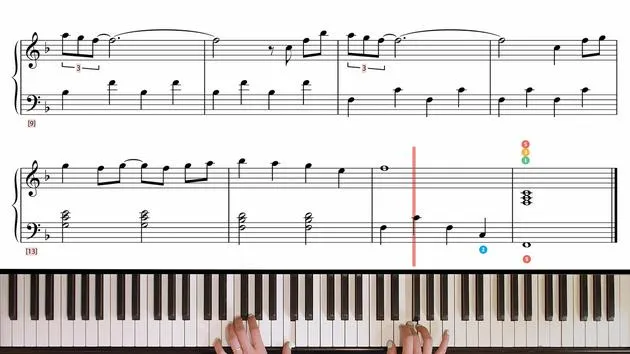
- The first line is nice and easy.
- Most of your attention will need to focus on lines two and three.
- In lines two and three, think about the left hand quarter notes as your steady beat, like that metronome we were practicing with earlier. They will play 1, 2, 3, 4 throughout.
Important Elements to Remember
-
Triplets:
- Watch out for where the triplets come in. This will happen in:
- Bars 9
- Bar 11
- Watch out for where the triplets come in. This will happen in:
-
Dynamic Marks:
- Remember:
- Piano - means soft
- Forte - means loud
- Remember:
-
Tied Notes:
- Pay attention to the tied notes and hold those notes over instead of playing them again.
Rhythm Patterns
There's a rhythm pattern that repeats twice in the piece. It consists of:
- Three eighth notes followed by a triplet pattern.
This occurs in:
- Bar 8 to Bar 9
- Bar 9 to Bar 10
It will sound like this:
"1 and 2 and 3 and 4 and 1 and A."
That note is then tied and held. It happens again in the next bar:
"1 and 2 and 3 and 4 and 1 and A."
Trickiest Rhythm Part
- Watch out for those bits because that's the trickiest rhythm part of this piece.
Block Chords
You'll also notice that there are block chords throughout:
- Bass Clef:
- This occurs in the first line and again in the last line.
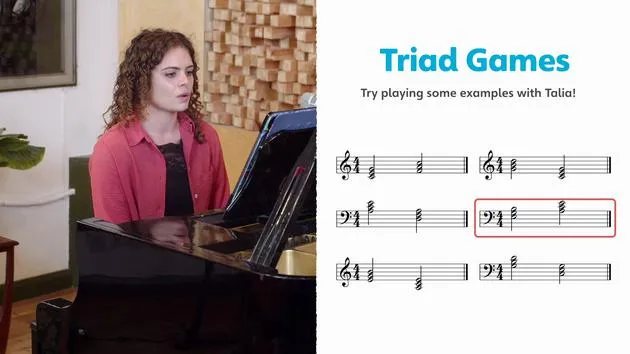
You might want to practice these triads to get them under your fingers.
- Try practicing them alone, then add them back with the treble clef notes.
Key Signature
Another thing to watch out for in this piece is that it's in the key of F major.
- Each time there's a B, play it as a B flat instead.
Practice Instructions
Let's give it a go. Start after a count of four:
"1 and 2 and 3 and 4 and 1 and 2 and 3 and 4 and 1 and 2 and 3 and 4 and 1 and 2 and 3 and 4 and 1 and 2 and 3 and 4 and 1 and 2 and 3 and 4 and 1 and 2 and 3 and 4 and 1 and 2 and 3 and 4 and 1 and 2 and 3 and 4."
Isolate Triplet Sections
- Be sure to isolate the places where you have the triplets as that's the new tricky rhythm.
- Remember, you can go into the interactive sheet music and loop that part to practice it repeatedly.
You can also slow it down and speed it up.
Let's Play
Let's see what this sounds like with the backing track.
21 leçons
0h 42m de leçons vidéo structurées
Fonctions vidéo avancées
Ralentissez, bouclez un passage, suivez la partition
Mobile, tablette et ordinateur
Pratiquez où vous voulez
Satisfaction garantie à 100 %
Garantie remboursement 30 jours
Rencontrez votre guru
Rencontrez votre guru
Talia Girton est musicienne et musicothérapeute agréée par le HCPC, et fondatrice de The Cycling Music Teachers. Son travail réunit la musicothérapie, l'accompagnement et l'éducation, et elle enseigne à l'international dans le cadre de la formation en musicothérapie de l'UDELAS au Panama, tout en contribuant au développement professionnel avec l'European Piano Teachers Association (EPTA). Sur MusicGurus, elle enseigne les cours Piano Method et Piano Foundations, guidant les débutants complets depuis les premiers pas à travers le rythme, les deux mains, la théorie et l'interprétation.







