



Nouvelle gamme : do majeur
Avec
Talia Girton
Le contenu du cours
21 leçons (0h 42min) · 1 gratuites
Transcription de la leçon
Introduction to Diatonic Scales
Previously, we learned about pentatonic scales. Now we're going to try some diatonic scales.
Difference Between Scales
- Pentatonic scales have five notes.
- Diatonic scales have seven notes.
C Major Scale
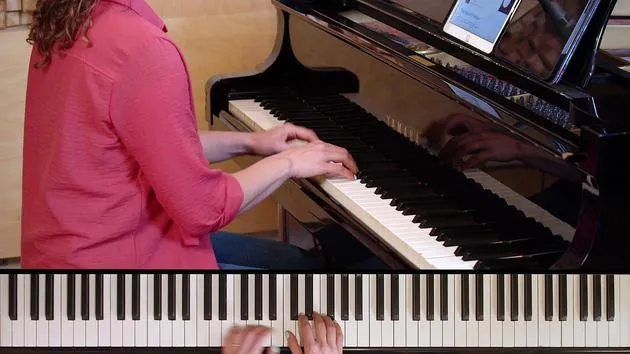
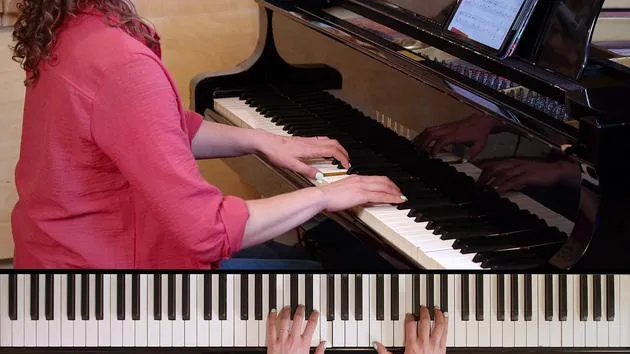
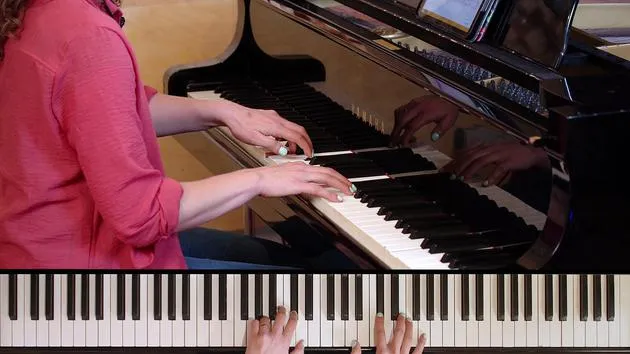
The first scale that we'll look at is the C major scale. I'll show you really slowly, and then I'll explain what I'm doing with my fingers.
Right Hand
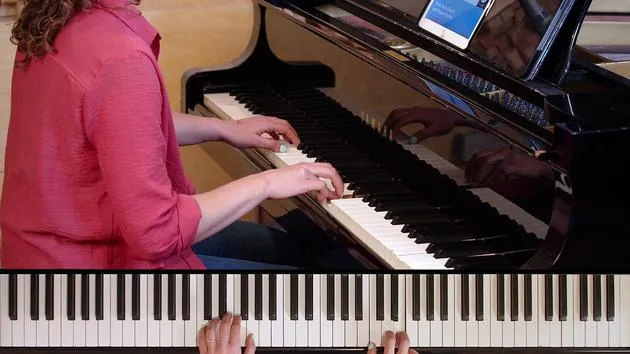
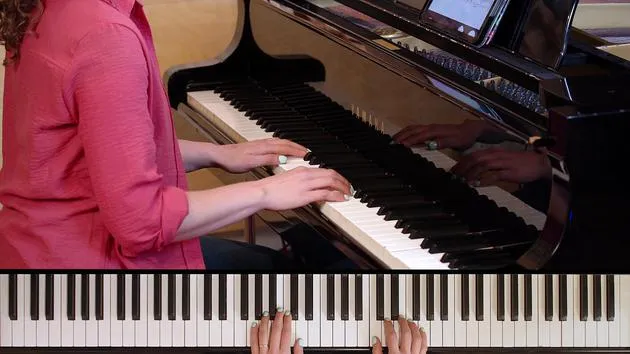
The right hand of the C major scale looks like this:
- Start with your one finger on middle C.
- We want it to sound really smooth and even, as if you've got eight fingers to make your way up the octave and back down.
Sequence:
- C, D, E.
- Thumb goes to F.
- Two goes to G.
- A, B, C.
Descending:
- Straight back down: B, A, G, F.
- 3 goes to E.
- 2 goes to D.
- Ending on C.
Let me show you that one more time.
Left Hand
The left hand of the C major scale uses the fingers in the opposite direction.
- First, we use all five fingers going up, and then on the way down, we switch.
- After the three finger, it looks like this.
Sequence:
- C, D, E, F, G.
- 3 goes to A.
- 2 goes to B.
- Ending on C.
Descending:
- Straight back down: B, A.
- Thumb goes to G.
- 2 goes to F.
- E, D.
- Ending on C.
Practicing Hands Separately
You'll probably need to practice both hands separately for several weeks until you're ready to try hands together.
Hands Together
It gets a bit tricky at this point because the fingers are switching at different moments of the scale.
It looks like this:
- Break it down slowly with both hands:
- C, D, E
- Right thumb to F.
- G, left 3 to A, B, C.
- B, A, left thumb to G.
- F, right 3 to E, D, C.
Final Tips
As always, make sure to go very slowly and take it at your own pace.
21 leçons
0h 42m de leçons vidéo structurées
Fonctions vidéo avancées
Ralentissez, bouclez un passage, suivez la partition
Mobile, tablette et ordinateur
Pratiquez où vous voulez
Satisfaction garantie à 100 %
Garantie remboursement 30 jours
Rencontrez votre guru
Rencontrez votre guru
Talia Girton est musicienne et musicothérapeute agréée par le HCPC, et fondatrice de The Cycling Music Teachers. Son travail réunit la musicothérapie, l'accompagnement et l'éducation, et elle enseigne à l'international dans le cadre de la formation en musicothérapie de l'UDELAS au Panama, tout en contribuant au développement professionnel avec l'European Piano Teachers Association (EPTA). Sur MusicGurus, elle enseigne les cours Piano Method et Piano Foundations, guidant les débutants complets depuis les premiers pas à travers le rythme, les deux mains, la théorie et l'interprétation.







