



La main gauche de la section 'A'

Avec
Tom SealsTom Seals construit la partie de main gauche pour la section A, transformant une position de G6 en une walking bass qui grimpe jusqu'à l'accord de D.

Le contenu du cours
23 leçons (1h 39min) · 1 gratuites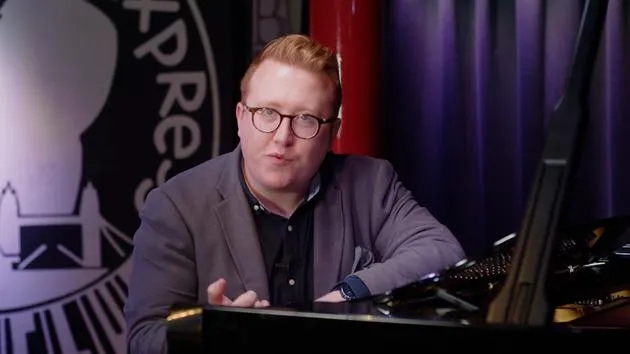
01. Introduction à Jumpin' At The Woodside
1:19
02. La mélodie de la main droite de la section 'A'
Leçon gratuite1:19
03. La main gauche de la section 'A'
Tu es ici8:09
04. Travaille la section 'A' avec Tom
3:31
05. La section « B » à la main droite
6:48
06. La section 'B' de Jumpin' At The Woodside à la main gauche
1:23

07. Travaille la section 'B' avec Tom !
3:17
08. Travaille Jumpin' At The Woodside avec Tom
4:16
09. Comping de la main droite
6:17

10. Idées d'ornementation
7:05
11. Interprétation de Jumpin' At The Woodside
2:08
01. La mélodie de la main droite de la section 'A'
5:13
02. La main gauche de la section 'A'
5:31
03. Ajouter les 'horn lines'
9:22

04. La section 'B' à la main droite
4:56
05. La section 'B' à la main gauche
9:17

06. Travaille Don't Get Around Much Anymore avec Tom
6:18
07. Conseils pour l'improvisation
1:38
08. Idées de solo
5:47

09. Don’t Get Around Much Anymore : interprétation
3:11



Transcription de la leçon
Left Hand Walking Bass Pattern
Okay, so the right hand is done. As simple as that. Now let's look at the left hand.
First Four Bars
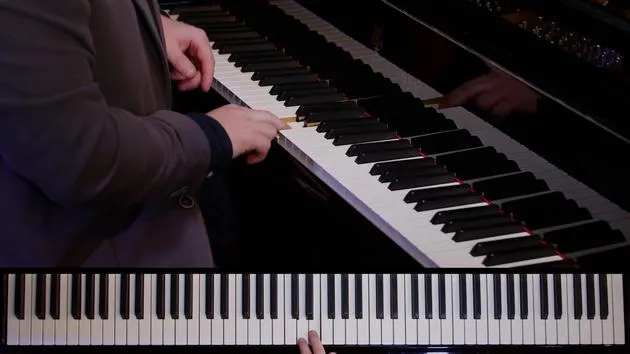
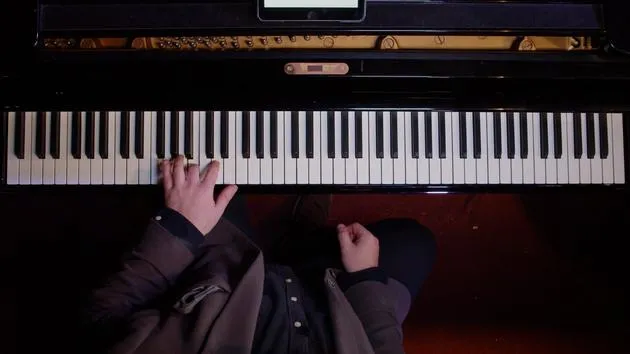
For the first 1, 2, 3, 4 bars, it's just a G.
Starting setup:
- Little finger on the G
- Third finger, middle finger on the B
- Second finger on the D
- Thumb on the E
Together, we have G, B, D, and E, which forms a G6 chord. While we won't play it as a chord, these notes create the chord:
Notes breakdown:
- G
- E
- D
- E
This arpeggiated pattern leads us into a walking bass.
Chord Progression
We will start with the first chord being G, played four times:
- G (4x)
- A minor 7 chord
Instead of playing the chord this time, we will walk up to the D chord, as shown on the chart.
Walking up:
- A
- B
- C
- C sharp
- D
So, altogether, that makes:
Notes Sequence:
- Four bars of G
- A, B, C sharp, D
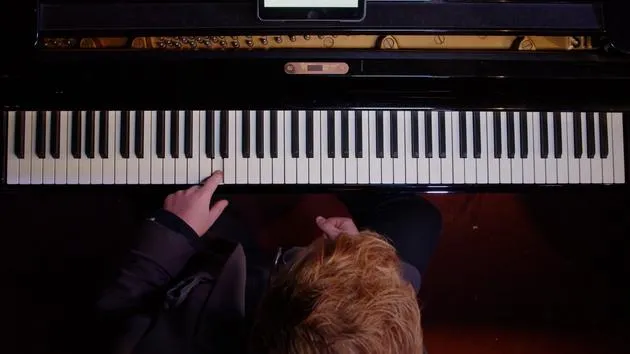
Finger Placement:
- Third finger on the A
- Second finger on the B
- Thumb on the C
- Second finger moving to C sharp
- Thumb lands back on D
So we pivot on the thumb, and then this finger exercise will help in moving down the piano.
Transition to D
We will go back to D after reaching G:
- Start at D
- Move thumb to G
Progression note movement:
- Thumb (D)
- Third finger (E)
- F
- F sharp
- G
Notes sequence (slowly):
- A
- B
- C sharp
- D
- E
- F sharp
- G
Now, let's speed this up:
Speed sequence:
From A to D, down to G.
Moving Forward
From the top:
- Four bars of G
- To A minor (up to the D)
- Down to G
This takes us to bars 1, 2, 3, 4, 5, and we start bar seven.
Last Two Bars of the First Section
The last two bars go like this:
- G
- E minor
- A minor
- D
1-6-2-5 Progression
This chord progression is known as 1-6-2-5, and while it sounds complicated, it's simply a counting exercise.
- G is the 1 (root note).
- Count 1-6: E (6 becomes E minor 7).
- 2: A (A minor).
- 5: D.
Hence, the progression:
- 1 = G
- 6 = E
- 2 = A
- 5 = D
Practice Sequence:
Sequence:
- G, E, A, D
- G, E, A, down to D
- G, E, A, D
Now, let's add passing notes in between.
Passing Notes:
- From G to E, add F sharp.
- From A, we could use G sharp down to D.
Revised Sequence:
- G, F sharp, E, A flat (or G sharp) down to E flat to D.
In simple form:
- G, E, A, D
- And again G, E, A, D.
With passing notes:
- G, F sharp, E, A flat, A, E flat, D.
Putting It All Together
This may seem complicated, but it flows smoothly once we integrate the right hand.
Loop Example:
- G, F sharp, E, A flat, A, E flat, D, back to G.
Finger Placement for the Left Hand of the Entire A Section:
- Thumb, second finger, third finger, second finger, thumb, third finger, fourth finger, second finger, thumb.
I will now play it all the way through, showcasing both versions: one with the simplified 1-6-2-5 progression and one with the additional passing notes.
First Version:
- Four bars of G, A minor to D, down to G.
Now with Passing Notes:
- Start with 4 bars of G.
23 leçons
1h 39m de leçons vidéo structurées
Fonctions vidéo avancées
Ralentissez, bouclez un passage, suivez la partition
Mobile, tablette et ordinateur
Pratiquez où vous voulez
Satisfaction garantie à 100 %
Garantie remboursement 30 jours
Rencontrez votre guru
Rencontrez votre guru
Le titre de Piano Man du Royaume-Uni a longtemps été détenu par Elton John, Jools Holland et Jamie Cullum. Au cours des cinq dernières décennies, personne d'autre ne s'en est même approché... jusqu'à aujourd'hui !
Tout juste sorti de sa tournée à guichets fermés "Let The Good Times Roll", Tom Seals - "tout simplement peut-être l'avenir du jazz et du blues" - tient le monde au bout des doigts. Son jeu de soliste virtuose, son excellent sens de l'improvisation et sa voix singulière ont conduit de grandes figures de l'industrie à le saluer comme le meilleur pianiste et chanteur de boogie woogie et de blues du Royaume-Uni.
À peine âgé de vingt-cinq ans, Seals a déjà donné des concerts à guichets fermés aux quatre coins du globe, dont le légendaire Ronnie Scott's de Londres, une performance éblouissante au Birdland Jazz Club de Broadway à New York, et des collaborations avec Jools Holland.
Apparitions notables :
- 'Gregory Porter & Friends' du Cheltenham Jazz Festival
- 'Boogie Woogie & Blues Spectacular' de Jools Holland
- Birdland Jazz Club, New York
- British Summer Time - Hyde Park
- Ronnie Scott's Jazz Club
- Gisburne Park Pop-Up
- Montreux Jazz Festival
- Cropredy Festival
- The Steinway Two Pianos Festival
- Glastonbury
- Newark Showground "Drive-In"
- Blenheim Palace
Dans son cours, Tom dévoile les secrets de son jeu - en vous montrant comment faire swinguer les standards au piano, construire d'authentiques lignes de boogie woogie et de blues, et trouver la liberté d'improviser - pour que vous deveniez à votre tour l'ultime Piano Man.
Vous pouvez lire la biographie complète de Tom sur www.tomseals.co.uk.







