Étendre le registre
Lesson time: (5min 42sec)
Course preview
This lesson is part of the course Apprends et prends plaisir au piano : une méthode fast track pour débutants et pianistes qui reprennent
Watch a preview of the full course below.
Lesson transcript:
Setting Sail: Exploring Colors and Timbres
In this section, we're setting sail. This is the really exciting part where we get to explore:
- A whole range of colors
- Different timbres
- Unique textures
There are so many possibilities at the piano that this incredible instrument can give us. This is a crucial part of our journey. Whether you're a beginner, returning to the piano, or looking to progress your skills, improvisation can unlock so many possibilities and allow us to have fun at the piano.
Transitioning from Concepts to Creativity
As we progress steadily through our piano lessons, we can perform in ways that might not be possible with the repertoire we learn each week. We're going to take the concepts from the first section, hand position, note pattern, and pulse, and see how we can extend those to create something that resembles a real piece of music.
Debussy, the pivotal writer of piano music, famously described the piano as "a wooden box of hammers and strings." He characterized it in a rather sterile way, yet through his writing, he showed us the infinite colors and possibilities this instrument can produce.
So now, back to creative work, maybe using Debussy as an inspiration. Let us think about how we can truly expand these ideas.
Developing Note Patterns
First, we'll take the note pattern itself. In the first section, we focused on our hand position, using the D above middle C. For any beginners, do use that note card to find these notes. I must stress, though, that the hand can go absolutely anywhere.
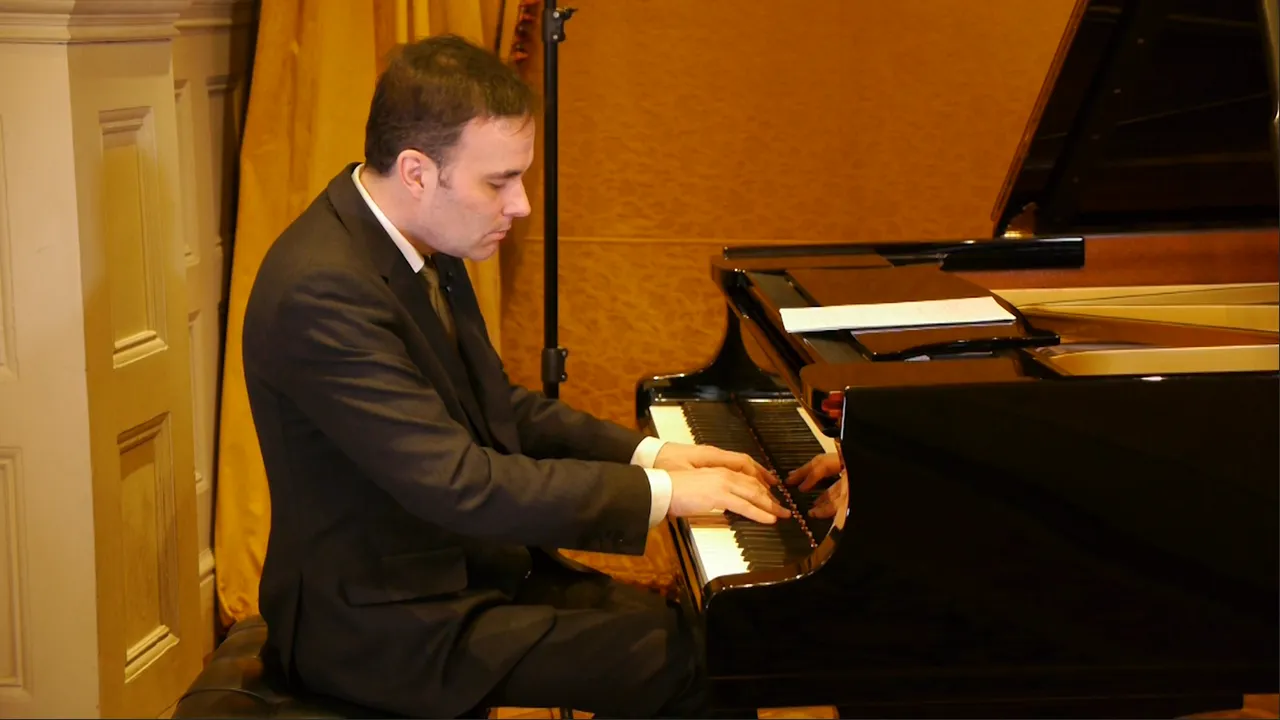
To demonstrate this, I'll shut my eyes and put my right hand on random white keys.
Now, let's think about developing note patterns based on where my hand has landed. Here are our first pattern notes, keeping the hand in the same place, with a finger above each key.
Of course, I could set that up with a pulse, just like we were doing in the first section. Always come back to that, especially if you're trying this for the first time.
Expanding the Patterns
Now, that was fine, but I want it to be more interesting. I want there to be:
- More colors
- Different sounds
- A more engaging melody
To achieve this, we can start to extend the pattern of notes. We will also develop important technique, as piano playing requires our hands to stretch, with fingers going over the thumb, and all kinds of movements.
What I'm going to do is get that note pattern going again but start expanding the range. My thumb will come a little lower, my fifth finger a bit higher. As a result, my other fingers might move closer to finger five or back to finger one, creating a wider pattern of notes.
It goes without saying that this could also be done with the left hand pulse. Of course, you can swap the hands, so the right hand gives the pulse while the left hand plays the melody, again expanding the range of that melody.
Embracing Adventure in Music
There I was, taking an adventure further. The principle remained the same: keeping the hand in one place and then expanding. Once the thumb (in the case of the left hand) came up a bit higher, I could create little patterns of notes to go with that higher position, and then take it even higher.
You can get little sequences within your pattern, for example, just by taking my thumb that little bit higher. Crucially, especially if you're someone starting as a beginner or near beginner, always return to hand position and work at a pulse and speed that is comfortable for you.
A New Approach to Learning
The great thing about this approach is that it emphasizes the physicality of playing. We learn from the physical touch rather than being confined by a page of music with complicated instructions. This method reverses traditional learning, providing a far more exciting experience as a result.
So remember, expanding hand positions for both hands is a fantastic way to gain variety and create a vast range of interest in your music!