



When You Wish Upon A Star - Apprentissage
Lesson time: (5min 23sec)
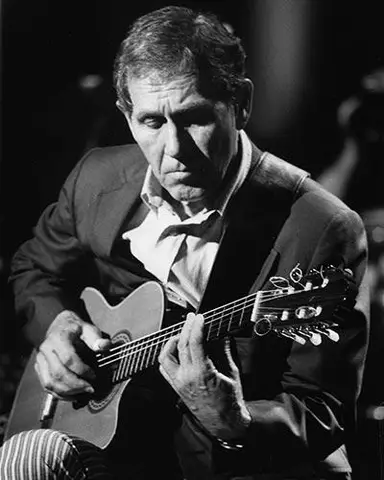
Chet Atkins enseigne son arrangement fingerstyle de When You Wish Upon A Star, y compris les harmoniques et pull-offs qui lui donnent son son scintillant.
Course preview
This lesson is part of the course La guitare de Chet Atkins
Watch a preview of the full course below.
Lesson transcript:
Music Lesson: Harmonics and Arrangements
Of course, that was When You Wish Upon a Star from the movie Snow White, I believe, about 1938.
Exploring Harmonics
I play it with harmonics and pure tones. I used to work with steel players who would play things like:
- They play a harmonic
- While they're doing it, they hit a pure tone.
So I got to fooling around with that years ago. You can play a pure tone and harmonic to get some nice effects.
Recording History
About 1960, I did this on a record. Then I went into White Christmas. Lenny Breau heard it, and he took harmonics and did just wonderful things with me. He came up with the pull-offs, which I used in this arrangement.
Recording Timeline
- I think I recorded this probably in '62 or '63; I don't know which album.
- Doesn't matter; they're not available now anyway, except at garage sales.
- I'm big at garage sales!
Playing Techniques
You play the same thing here, of course, as you do up here.
- Go on to harmony there.
- Have to get that kind of A chord to get that arpeggio.
- Then this B flat to an A diminished.
This can be played many ways. We'll see.
Moving Bass Line
This is very useful in the next part. I use a moving bass line:
- C major seventh
- C sharp diminished
This is an important chord too, as I mentioned earlier:
- E flat diminished
- C with an E in the bass
- A minor
You can do that in many light ways, like:
- Useful.
- Then the moving basses.
It's hard for me to play things slow. Let me try it again.
Arpeggio Techniques
Now, use some arpeggios here. Again, it's harmonics up and down.
- When you play them down, you start with a harmonic.
- If you play them up, you start with a pure tone.
See? And we add that, whatever it is there, 6th. See how we do that?
- Hammer on.
About the instructor
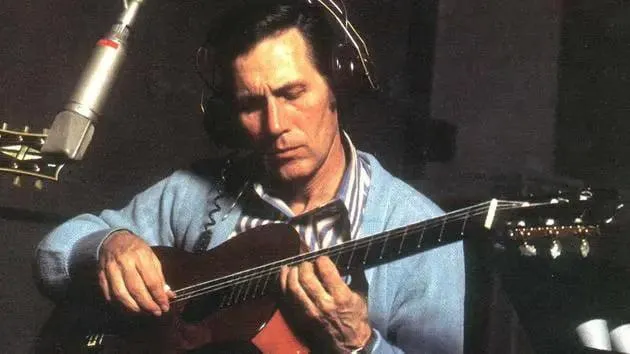
Surnommé « Mr. Guitar », Chet Atkins est l'instrumentiste soliste le plus enregistré de l'histoire de la musique. Son jeu de picking caractéristique s'inspire de Merle Travis, avec pour autres influences majeures Django Reinhardt, George Barnes, Les Paul et, plus tard, Jerry Reed. Ce jeu de picking et cette musicalité si reconnaissables lui ont valu des admirateurs au sein de la scène country et bien au-delà, aux États-Unis comme à l'international. Comme musicien de studio, son jeu a enrichi les disques d'Elvis Presley, Kitty Wells, The Everly Brothers, Hank Williams et des dizaines d'autres légendes de Nashville. Son style a fini par influencer de grands noms de la pop tels que Mark Knopfler, Duane Eddy, George Harrison, The Ventures, George Benson et Eddie Cochran, ainsi que des milliers de guitaristes country. Il a remporté neuf CMA Awards de Musician of the Year, quatre distinctions au sondage jazz de Playboy et treize Grammys. Avec plus de 35 millions d'exemplaires vendus de ses plus de 75 albums originaux, Atkins a également reçu le Grammy Lifetime Achievement Award. Il a contribué à créer le Nashville sound, un style de musique country qui devait presque autant à la pop qu'aux honky tonks — et sans lui, la country n'aurait peut-être jamais fait son entrée dans les charts pop dans les années 50 et 60. Apprends du maître : il te suffit de cliquer sur l'un des cours de cette page ! read more