



Chet se confie
Lesson time: (10min 26sec)
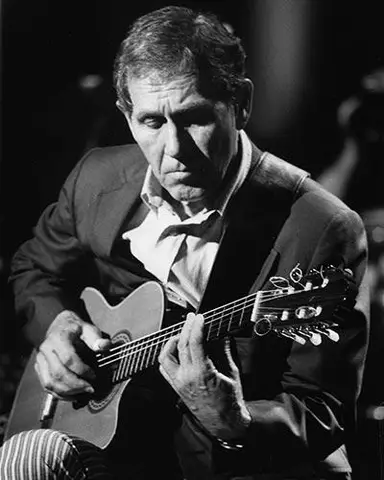
Dans cette vidéo, Chet revient sur sa carrière, le succès et ce qu'il faut pour réussir en tant que musicien. Un échange intime avec Chet, où il parle avec cœur aux guitaristes en herbe.
Course preview
This lesson is part of the course La guitare de Chet Atkins
Watch a preview of the full course below.
Lesson transcript:
Musical Journey and Influences
Well, we had a lot of stressful fun doing those sides for you. And I thought I'd tell you a little bit about how I got started.
Early Beginnings
I came from a musical family, and I played ukulele at first, my first memories of playing ukulele. When a string broke, I'd just rip a wire off the screen door and put it on the ukulele and keep going.
Then I played guitar. People ask me how long I've played, and I really can't remember. But I've played ever since I can remember.
- At first, I used a kitchen knife. They call it slide now. I'd tune it up in a major key and play with a kitchen knife.
- I always played with my fingers and a thumb pick. I don't know why; that's just the way we did it up there in the mountains.
We'd take a toothbrush made of celluloid, file it down thin, put it in hot water, and bend it around the thumb to make thumb picks. Because there was no money around in those days, you know?
Headphones and Sound
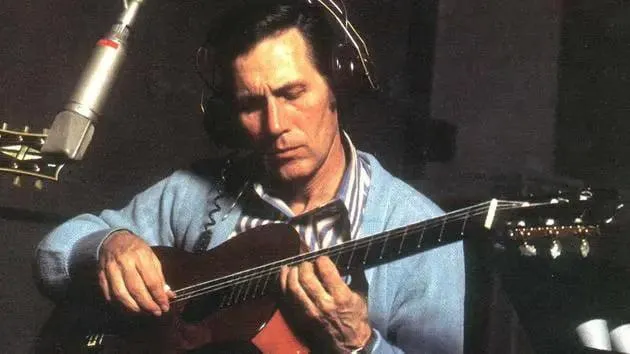
I want to mention that I wore headphones during the making of those sides. The reason I did that was:
- We ran the sound of my guitar through the mixing board with some nice echoes.
- It made it sound good to me, which helped me play better.
I hope that doesn't bother you.
Giving Credit
I think in this life, we need to give credit to people that have helped us along. And God knows there have been so many.
I don't know where I would be without the help of two particular people, executives that helped me along, signed me to a recording contract, and gave me a job with a radio station. But we all need that.
Key Qualities for Success
You get these opportunities by:
- Being a nice guy
- Showing diligence
- Having a desire to play well and make something of yourself
I certainly had those qualities, that's about all I had. But I want to recognize the ones before me.
Influences in My Music
The style that I play, as far as I know, started with:
- Kennedy Jones: A fellow up in Kentucky who made up "Cannonball Rag" and influenced Murl.
- Ike Everly and Mose Rager: They followed Kennedy around and learned to play from him.
- Merle Travis: He followed suit and further developed the style.
When I was 15, I heard Murl on the radio, and then he went into the Marines. I never heard him again, and thank God for that. I suppose I would have wound up as a direct copy if I'd heard him every day on the radio, I admired him so much.
Blind Blake and Django Reinhardt
There was another great fingerstyle player I didn't know about until recently, Pat Donahue, who sent me records of Blind Blake, a phenomenal finger picker from recordings between 1926 and 1932.
Also, a great influence on me was Django Reinhardt. He was the first guy who could burn it up playing single-string guitar with a straight pick. He was a wonderful, uneducated gypsy who played with all that gypsy fire, teaching the world how to play in the 30s and 40s.
Then, of course, Les Paul came along and imitated Django. My older brother, who had a trio with him, would send me air checks of Les, and I'd copy his courses.
Inspirations from Other Musicians
Another fellow on the radio at that time that inspired me was George Barnes. I never tried to play like him much because he had such a different style.
I also want to mention Johnny Smith, a great musician who plays so tastefully. I hope a little of that has rubbed off on me.
Then came Jerry Reed, who played like me for a while, before branching off into his own thing. Lenny Burrow copied my records and knew every note I ever played. There are also people like John Knowles, a great teacher here in town.
Though they took the style in different directions, it became intimidating when I was around Lenny and Jerry. I thought, "Why am I still playing? These guys are so far ahead of me." However, I learned some of their stuff, which helped a lot. If it weren't for Lenny, Jerry, and some of those guys, I wouldn't have many licks to play when I improvise.
Lessons on Success
I want to tell you that making it in business varies for everyone. It was difficult for me, as I got fired from most every job I had because I was shy. I didn't know anything about human relations, about getting acquainted with the executives of a radio station and becoming friends to get hired.
I was trying to play a little too slick, maybe, attempting jazz and pop tunes. I wasn't a great mail drawer, and in those days, your worth was determined by the mail you drew.
But I could knock out the musicians because I was different in those days. Getting a job didn't last long, as I sounded like two bad guitar players, I guess.
Key Takeaways
There are some basic things I can tell you:
-
Educate Yourself: This is essential, not just in music. Read newspapers, explore different genres, classical, jazz, gospel, rhythm and blues, everything. You can learn from those areas, and that's helped me tremendously.
-
Work Within Your Limitations: If you realize you can't make it professionally, perhaps do it for fun.
Select something you like, and play guitar on the side. Even if you feel you don't have the talent to compete with great players, remember:
"I may be one of the most famous around, but I'm sure not the greatest."
There are many great finger pickers everywhere who impress me every time I hear them.
Final Thoughts
Looking back, I remember when I was a kid, me and Merle were the only ones playing fingerstyle. It turns out that the style I play is kind of a pseudo-classic style. That's alright; it's how a guitar is supposed to be played.
The thumb pick, for instance, isn't a classical way of playing, it has its disadvantages but also a lot of advantages. I make sure I have one in my left pocket at all times, and I'll carry one with me to my grave.
It's been a great life. I've played all over the world, with just about every pops orchestra in the United States, and on all major TV shows. I often tell my band, "Well, we fooled them again," as it's such a temporary experience.
There are many talented musicians out there who will surpass me and everyone currently around.
I want to thank you for all your support. I hope this tape helps you along the way, and I wish you great luck and success in your life.
Thank you.
You rolling? I wish I was in the land of cotton.
Let's try it again.
I can't play, too many cameras.
Just... I'm all tuckered out after that.
About the instructor
Surnommé « Mr. Guitar », Chet Atkins est l'instrumentiste soliste le plus enregistré de l'histoire de la musique. Son jeu de picking caractéristique s'inspire de Merle Travis, avec pour autres influences majeures Django Reinhardt, George Barnes, Les Paul et, plus tard, Jerry Reed. Ce jeu de picking et cette musicalité si reconnaissables lui ont valu des admirateurs au sein de la scène country et bien au-delà, aux États-Unis comme à l'international. Comme musicien de studio, son jeu a enrichi les disques d'Elvis Presley, Kitty Wells, The Everly Brothers, Hank Williams et des dizaines d'autres légendes de Nashville. Son style a fini par influencer de grands noms de la pop tels que Mark Knopfler, Duane Eddy, George Harrison, The Ventures, George Benson et Eddie Cochran, ainsi que des milliers de guitaristes country. Il a remporté neuf CMA Awards de Musician of the Year, quatre distinctions au sondage jazz de Playboy et treize Grammys. Avec plus de 35 millions d'exemplaires vendus de ses plus de 75 albums originaux, Atkins a également reçu le Grammy Lifetime Achievement Award. Il a contribué à créer le Nashville sound, un style de musique country qui devait presque autant à la pop qu'aux honky tonks — et sans lui, la country n'aurait peut-être jamais fait son entrée dans les charts pop dans les années 50 et 60. Apprends du maître : il te suffit de cliquer sur l'un des cours de cette page ! read more