



Analyse de la page 1

Lesson time: (4min 18sec)
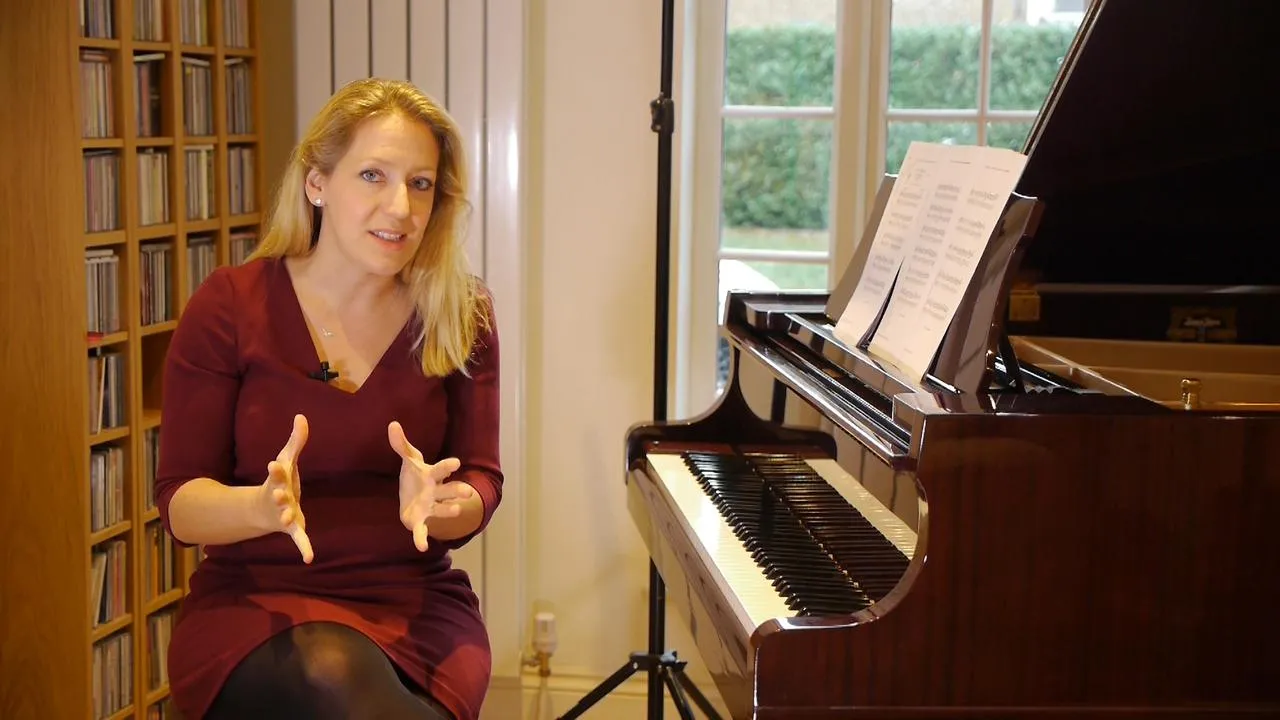
Annabel Thwaite travaille la première page de Für Elise de Beethoven, en commençant par son célèbre et envoûtant motif de demi-ton.
Course preview
This lesson is part of the course Apprends les classiques favoris au piano
Watch a preview of the full course below.
Lesson transcript:
Music Lesson: Exploring Tempo and Melodic Structure
Now we've looked at the tempo and negotiated what is a good speed.
Page-by-Page Breakdown
We're going to look at the piece page by page.
Page One: The Haunting Melody
- The first page has this wonderful beginning of semitones.
- It's a really famous haunting melody that'll be with you. You'll hear it everywhere.
- This E flat, or as it's written here as D sharp, is apparently the same note as written in German, Es.
- So, E flat = Es.
- Some people believe that this little melody, this motif, this little snippet, is actually representative of the word Elise.
Hands in Harmony
- Look at the left hand and the right hand:
- They are both in arpeggiated forms.
- Arpeggiated meaning the chords of A minor and E major.
Practice Recommendations
I would recommend practicing:
- Staccato and legato for your arpeggios:
- Maybe A minor legato or even staccato.
- Staccato and also an E.
This way, you have an idea of how the hands relate to each other, especially the thumbs.
- Remember that the thumb is a very strong finger. Well, it's a thumb.
- You want more emphasis on the little finger of the left hand because you don't want to hear thumping like that.
- You want to hear more of the downbeat.
And of course, this is all within pianissimo.
Differentiating the Melody
Let's also look at how the melody can be differentiated because it appears several times on:
- Page one
- Page two
- Finally on page three.
It's a rondo, a recurring theme, so look at how intricate it actually is.
- It begins with A minor, then E major, and there's a melody that goes up and then finishes there.
You might be able to bring out the octave intervallic tension as opposed to the semitone.
Transition to Major Key
Later on, when you get to the major key at bars 10 and 11 (C major):
- You have this wonderful seventh, and another one, and another one; also, there's this descending seventh idea.
- All of that is in the space of three lines of music.
Creating Musical Vocabulary
You can always create a musical vocabulary:
- Bring a little bit more out,
- Bring a little bit less,
- Or bring it back in a bit more.
Focus on Bar 14
Let's take a brief moment to have a look at Bar 14.
- We have these octaves, and sometimes we don't want that third E to pop out in the left hand.
- To address this, you could take it over with the right hand or simply be very careful:
- Place more emphasis on your little finger of the left hand on the first beat so that it doesn't clash in the middle of the bar.
Understanding Diminuendo and Ritenuto
Lastly, let's have a look at the dim avrit.
- That means diminuendo and rittenuto, getting softer and slowing down.
- I would take these very gently, with a pinch of salt, because:
- You don't want to slow down too much; they're probably editorial.
- Just have the idea of relaxing a bit, not slowing down in a romantic fashion, because that's 19th-century music and we're in the 18th century.
About the instructor
Reconnue comme l'une des pianistes les plus polyvalentes et charismatiques de Grande-Bretagne, Annabel Thwaite mène une carrière variée de soliste, de chambriste, d'artiste de studio, de pédagogue et d'examinatrice, et a remporté tous les grands prix d'accompagnement, dont les prestigieux Kathleen Ferrier, Gold Medal et Richard Tauber Piano Prizes. Elle a collaboré avec des artistes de renom tels que Roberto Alagna, Bryn Terfel, David Kempster et "Only Men Aloud!" Annabel a enregistré pour Universal records avec le "Scottish Tenor", dont l'album a été nommé aux Classical Brit Award et passe régulièrement sur Classic FM. Deux fois accompagnatrice du Festival of Welsh Male choirs, ses concerts au Royal Albert Hall ont été enregistrés par Sain et diffusés sur S4C. Elle est aussi pianiste de séance pour le cinéma, ayant enregistré à Abbey Road la musique du film "Awake", de la série de la BBC sur Jane Austen "Emma", de "The Secret Diaries of Miss Anne Lister" et, plus récemment, elle est apparue à la fois dans Blue Peter et dans "The Rob Brydon Show". "...aidée sans doute par les accompagnements de piano manifestement brillants d'Annabel Thwaite... un vrai plaisir." Dans ses cours MusicGurus — Learn Christmas Classics on Piano, Learn Classical Favourites on Piano et Growing Chamber Groups and Small Ensembles — Annabel partage la musicalité qui sous-tend cette carrière polyvalente. Tu apprendras à faire vivre au piano des pièces de Noël et classiques bien-aimées, à développer ton toucher et ton phrasé et, forte de son expérience primée d'accompagnatrice, à découvrir comment écouter, mener et jouer ensemble en faisant de la musique avec d'autres musiciens au sein de groupes de chambre et de petits ensembles. read more