



Doigté

Lesson time: (4min 29sec)
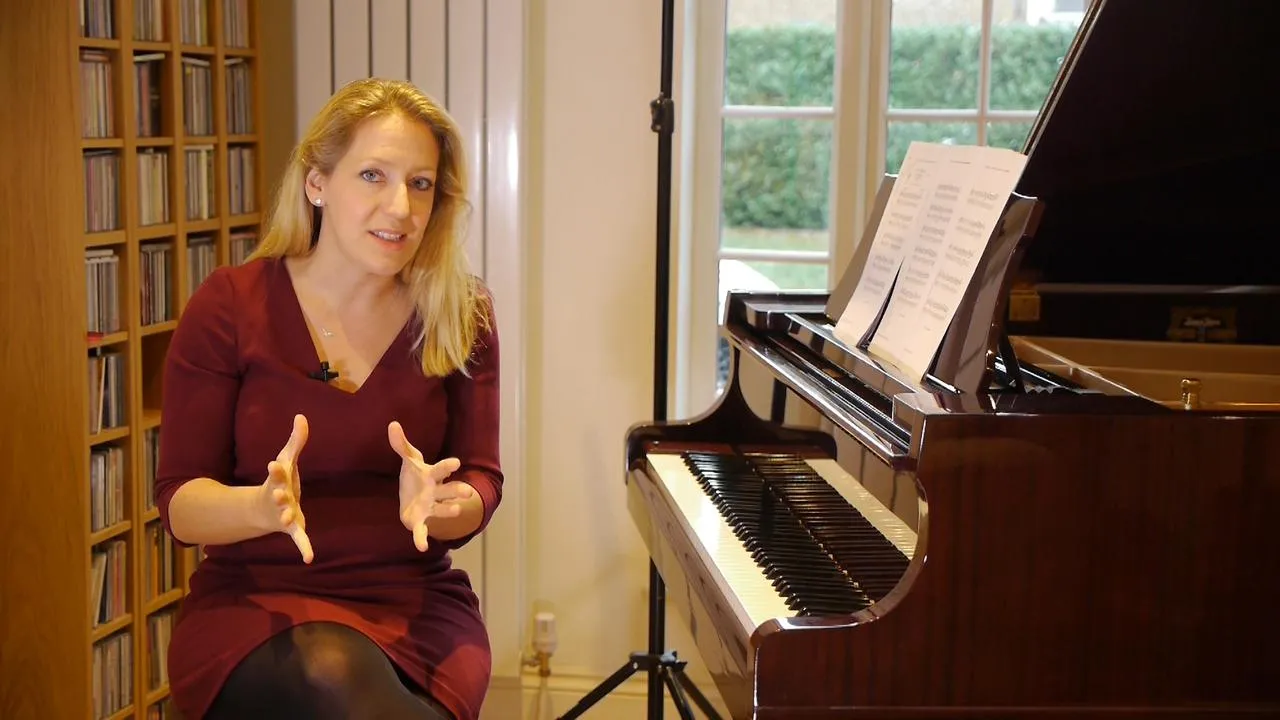
Annabel Thwaite explique comment elle choisit ses doigtés, en visant la position de main la plus naturelle et des groupes réguliers, comme trois, puis quatre, puis cinq sur une gamme de Sol majeur.
Course preview
This lesson is part of the course Apprends les classiques favoris au piano
Watch a preview of the full course below.
Lesson transcript:
Understanding Fingering for Pianists
Let's talk briefly about fingering. As a pianist, I love to write on my score, and I often use fingering as a signpost of when my brain needs to sort of engage more about this turn or that turn. Thus, I use it with phrasing.
Purpose of Fingering
The reason we use fingering is to achieve the maximum effect with minimal effort. We are very lucky as pianists because we're quite symmetrical:
- Two thumbs
- Second finger
- Third finger
- Fourth finger
- Fifth finger
Natural Hand Position
We should be very free. There's a variety of schools of playing, but the most notable one emphasizes achieving the most natural hand position.
Example: C Major Chord
For example, a C major chord allows the fingers to fall naturally, and the hand rests comfortably on the chord.
Frederic Chopin's Favorite
Frederic Chopin's favorite scale was actually B major in the right hand. Look at the natural kind of hand placement:
- You have this bridge
- A relaxed elbow
- Fingers falling naturally over the sharps
Fingering Passages
When fingering a passage, try to find the most natural way for the hand to move.
Example: G Major Scale
Let's take a G major scale. We want to transition from this position to another as evenly as possible.
- We could group four and three, but that would be odd since we'd end on a four, which is quite a weak finger at the top of the scale.
- The most natural approach is to do a group of three, then a group of four, and end with a five.
If working with another octave, note that the thumb has the flexibility to go underneath and move easily without creating any bumps.
Patterns for Scalier Passages
If you have a big scalic passage, aim for a simple pattern. For instance:
- Group of five
- Group of three
- Group of four
Avoid complicated sequences like 2, 2, 3, 4, 1, 3, 2. The fingering should be something your brain can easily grasp.
Fingering Arpeggios
For arpeggios, my hand loves the pattern 1, 2, 3, 5. I have quite small hands, so I avoid stretching too much between the fourth and fifth fingers, as it wouldn't be comfortable.
Comfort Check
When fingering, consider:
- How does it look?
- Does it feel comfortable?
The Cheater's Guide to Fingering
We all have our nemesis in fingering. For example, I tend to avoid using 5 and 4 or sometimes even 4 and 3 to utilize my stronger fingers.
- If you were trilling on 3 and 4, it might be easier for you to trill on 2 and 3, or even 1 and 3.
- Use your strengths to your advantage.
Committing to Your Fingering
Finally, once you've settled on fingering, stick to it, really stick to it.
- Practice and practice it.
- If it's still not working after about two weeks or after the 20th time, revisit it.
- However, avoid constantly changing between fingerings.
Stick with one, see if it works, practice it, solidify it, and then move on.
Comparison to Dance Routine
It's like learning a dance routine. You must learn the moves before you embark on improvisation.
About the instructor
Reconnue comme l'une des pianistes les plus polyvalentes et charismatiques de Grande-Bretagne, Annabel Thwaite mène une carrière variée de soliste, de chambriste, d'artiste de studio, de pédagogue et d'examinatrice, et a remporté tous les grands prix d'accompagnement, dont les prestigieux Kathleen Ferrier, Gold Medal et Richard Tauber Piano Prizes. Elle a collaboré avec des artistes de renom tels que Roberto Alagna, Bryn Terfel, David Kempster et "Only Men Aloud!" Annabel a enregistré pour Universal records avec le "Scottish Tenor", dont l'album a été nommé aux Classical Brit Award et passe régulièrement sur Classic FM. Deux fois accompagnatrice du Festival of Welsh Male choirs, ses concerts au Royal Albert Hall ont été enregistrés par Sain et diffusés sur S4C. Elle est aussi pianiste de séance pour le cinéma, ayant enregistré à Abbey Road la musique du film "Awake", de la série de la BBC sur Jane Austen "Emma", de "The Secret Diaries of Miss Anne Lister" et, plus récemment, elle est apparue à la fois dans Blue Peter et dans "The Rob Brydon Show". "...aidée sans doute par les accompagnements de piano manifestement brillants d'Annabel Thwaite... un vrai plaisir." Dans ses cours MusicGurus — Learn Christmas Classics on Piano, Learn Classical Favourites on Piano et Growing Chamber Groups and Small Ensembles — Annabel partage la musicalité qui sous-tend cette carrière polyvalente. Tu apprendras à faire vivre au piano des pièces de Noël et classiques bien-aimées, à développer ton toucher et ton phrasé et, forte de son expérience primée d'accompagnatrice, à découvrir comment écouter, mener et jouer ensemble en faisant de la musique avec d'autres musiciens au sein de groupes de chambre et de petits ensembles. read more