



Histoire et contexte

Lesson time: (1min 48sec)
Le contexte de l'Air on a G String de Bach : un arrangement de sa Suite pour orchestre en ré majeur, avec la basse continue confiée à la main gauche.
Course preview
This lesson is part of the course Apprends les classiques favoris au piano
Watch a preview of the full course below.
Lesson transcript:
Music Lesson: Understanding "Air on a G String"
This piece, Air on a G String, is much more complex than you may think at first approach.
Background
It is an arrangement of Bach's original Orchestral Suite in D Major, which was orchestrated for:
- Three trumpets
- Timpani
- Strings
- Basso continuo
Basso Continuo
The basso continuo is particularly important to mention because it's a continuous bass line, often played by:
- A continuous early cello
- In this piece, it is represented with the left hand
This bass line is crucial as it:
- Keeps the harmony
- Maintains the movement in the piece
Structure of the Piece
The piece is an air, the second movement of Bach's orchestral suite. The term air means an "aria," which is derived from Italian and translates to a "song-like" composition.
- We always want to maintain the purity of a song, a melody.
- It's important to think about breath support so we don't run out of breath.
- The piece has a total of 19 bars and is played very slowly.
Continuous Support
We want to achieve continuous support, much like the breath support of a singer, in the bass line, while highlighting a beautiful, refined soprano quality in the right hand.
Historical Context
The piece was transcribed by the 19th-century violinist August Wilhelm. His transcription was for violin and harmonium (an organ or a piano) with an idea focused on:
- More romanticism
- A romantic sound
Interpretation
His transcription is characterized by depth of sound, not necessarily driven by rhythmic freedom (rubato), but rather by a rich, full tone.
In future lessons, we'll delve deeper into how to create a really refined tone in performance.
About the instructor
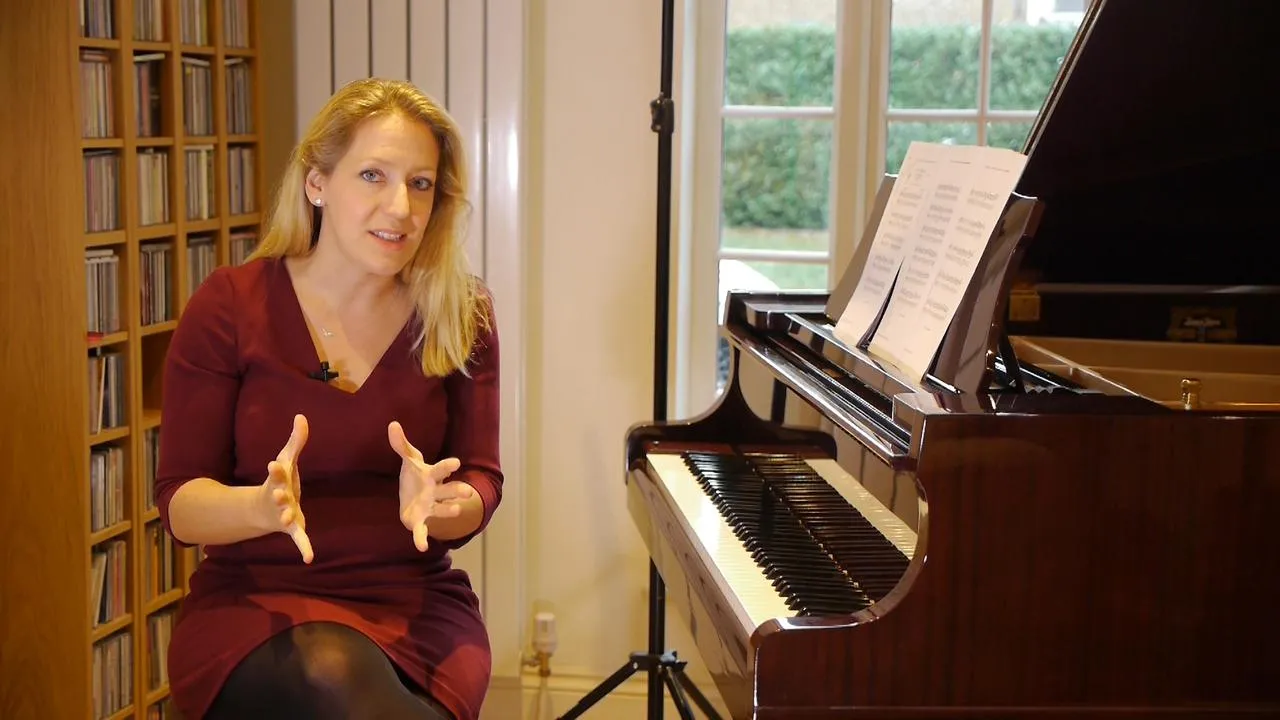
Reconnue comme l'une des pianistes les plus polyvalentes et charismatiques de Grande-Bretagne, Annabel Thwaite mène une carrière variée de soliste, de chambriste, d'artiste de studio, de pédagogue et d'examinatrice, et a remporté tous les grands prix d'accompagnement, dont les prestigieux Kathleen Ferrier, Gold Medal et Richard Tauber Piano Prizes. Elle a collaboré avec des artistes de renom tels que Roberto Alagna, Bryn Terfel, David Kempster et "Only Men Aloud!" Annabel a enregistré pour Universal records avec le "Scottish Tenor", dont l'album a été nommé aux Classical Brit Award et passe régulièrement sur Classic FM. Deux fois accompagnatrice du Festival of Welsh Male choirs, ses concerts au Royal Albert Hall ont été enregistrés par Sain et diffusés sur S4C. Elle est aussi pianiste de séance pour le cinéma, ayant enregistré à Abbey Road la musique du film "Awake", de la série de la BBC sur Jane Austen "Emma", de "The Secret Diaries of Miss Anne Lister" et, plus récemment, elle est apparue à la fois dans Blue Peter et dans "The Rob Brydon Show". "...aidée sans doute par les accompagnements de piano manifestement brillants d'Annabel Thwaite... un vrai plaisir." Dans ses cours MusicGurus — Learn Christmas Classics on Piano, Learn Classical Favourites on Piano et Growing Chamber Groups and Small Ensembles — Annabel partage la musicalité qui sous-tend cette carrière polyvalente. Tu apprendras à faire vivre au piano des pièces de Noël et classiques bien-aimées, à développer ton toucher et ton phrasé et, forte de son expérience primée d'accompagnatrice, à découvrir comment écouter, mener et jouer ensemble en faisant de la musique avec d'autres musiciens au sein de groupes de chambre et de petits ensembles. read more