



The 5.55 (leçon)
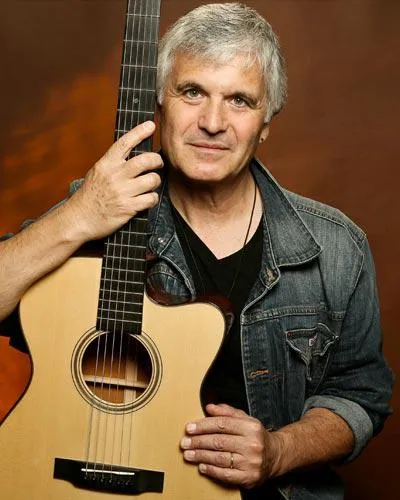
Avec
Laurence JuberDans cette leçon, Laurence Juber t'apprend à jouer son morceau "The 555" à la guitare acoustique.
Le contenu du cours
12 leçons (1h 22min) · 1 gratuites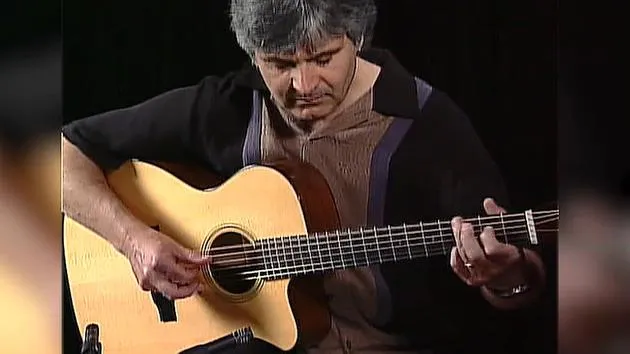
01. Cobalt Blue (interprétation)
3:20
02. Cobalt Blue (leçon)
Leçon gratuite10:18
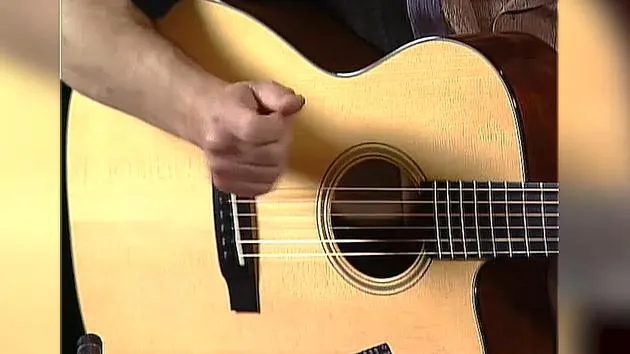
03. The White Pass Trail (interprétation)
4:58
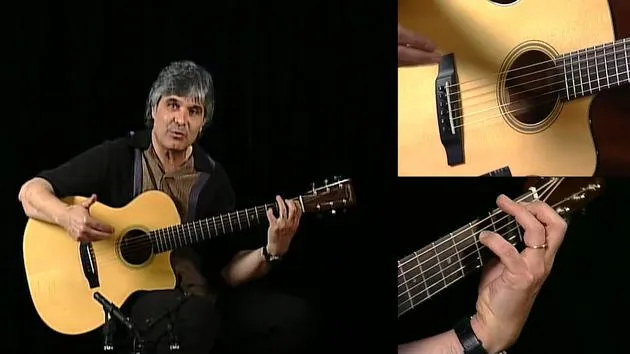
04. The White Pass Trail (leçon)
10:17
05. Breaking Point (performance)
3:28
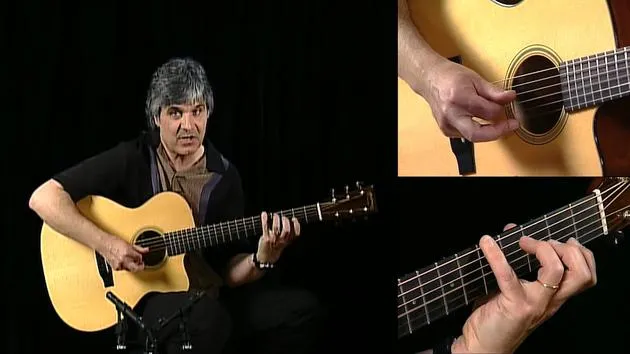
06. Breaking Point (leçon)
8:35
07. Buffalo Nickel (interprétation)
3:41
08. Buffalo Nickel (cours)
10:29
09. Catch (interprétation)
3:31
10. Catch (leçon)
10:38
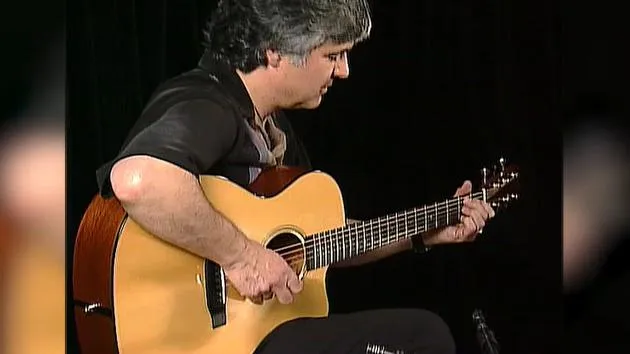
11. The 555 (interprétation)
2:49
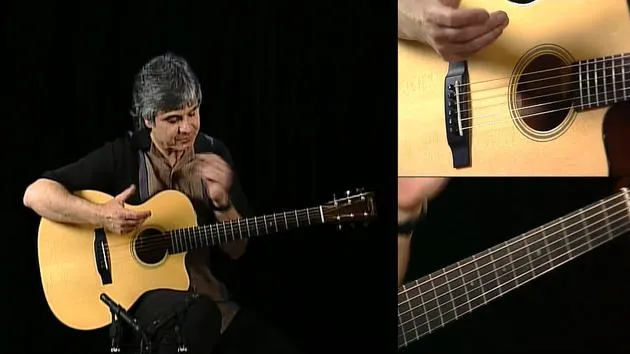
12. The 5.55 (leçon)
Tu es ici10:44
Transcription de la leçon
Music Lesson: The 555 in E Minor
So, working on the 555, we're in standard tuning and it's in the key of E minor.
Introduction to Chords
We're starting off with:
- E minor chord
- Alternating with C7 chord
- Then moving to a cowboy B7 shape
There's a little bit of a lick in between. I do this two different ways:
- Coming off the C7 chord
- Repeating in the second verse
Right Hand Technique
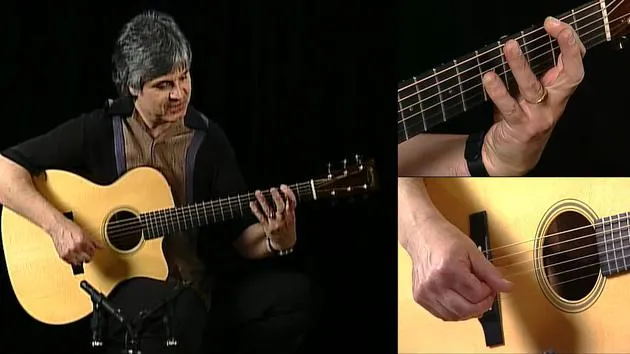
You might just want to look at the right hand here:
- I'm just rolling through the chord like that: B7.
Now, walking up to a G chord (although actually, there's no B in there), transitioning to a:
- G5 to D
- A minor
- E minor
Complex Chords
It gets a little interesting here:
- I've got an A minor A7 chord, but I'm also throwing in the D melody note.
Melody Structure
The melody goes:
- C, D, E, and then moving to a B minor 7 (although that really is actually A; it's more like a G over B).
Next, we have:
- C# minor 7 flat 5.
Voicing Technique
The cool thing about that chord is that you can actually voice it with just one fretted note:
- C# here
- G (the flat 5)
- B (the minor 7)
- E (the minor 3rd)
Because those strings are open, my melody goes: G, F#, E. Everything keeps ringing.
Cascading Patterns
These cascading patterns aren't exclusive to DADGAD tuning at all. You can do this kind of thing in standard tuning as well.
For example:
- There's a little cascade there (kind of a faux cascade) trying to make it smooth.
- Coming down on that B note and then sliding backwards to G major.
Chord Progressions
Then moving on to:
- C major 7.
It's kind of tricky because there's no third in that chord until I articulate it as a melody note.
- B7#9 to flat 9 to B natural.
So there's my melody:
- Now transitioning to E minor to A7.
Melody Integration
In contrast to the section where I'm playing basic cowboy shapes, I incorporate melody notes into a more complex texture:
- Walking up from A minor to D and then to B7 (just a B over D#).
Advanced Chords
Now to a G chord without mentioning any copyright control tunes, but the ones that move around in tenths:
- E flat 9 to D9 to G.
There's also an F#.
Alternative Voicings
Here, C# minor 7 flat 5 can be a straightforward one-note chord. But if I raise the melody notes an octave, I get this voicing:
- F# minor 7 flat 5 to B.
I'm playing around with G major and E minor harmonically.
Returning to E Minor
You might think I'm going to E minor from the B chord, but I actually go to G and then a different voicing of C# minor 7 flat 5, which contains:
- C#
- G
- E
- G on top.
Licks and Solos
I have this little lick that goes in there and then back to the head.
The second turn ends with a little extension. It's actually a C7 chord, voiced a bit differently:
- Normally you'd play it like this.
- Here I'm using a couple of open strings and then a B7 throwing in an open E melody note and transitioning to B flat 7.
Bass Lick and Improvisation
After that:
- Moving down to AB7, then back up again to B and then a bass lick.
Now, I've got an improvised solo where I'm kind of playing off this bass line and some licks in E and E minor.
Favorite Licks
That's one of my favorite swing licks in E minor because it's a cascade:
- E, F#, G, B, D#, E.
So everything kind of rings, alternating between an E minor chord and a C7 chord.
Solo Section
The solo section might go something like this:
- Notice I'm muting using the palm of my hand to mute with the right hand to give that kind of upright bass feel.
It's a bit challenging to mute and keep the melody going simultaneously, but once I get the melody worked in, I kind of come off of that.
Returning to the B Section
Now I'm going to go back to the B section with the simple cowboy chords and the cascades, then back to the top.
After playing the verse through a couple of times, it will return to this pattern:
- Using the pickless pick technique with a little strum here.
Final Chord Progression
It's a little tricky here:
- A7, but with a little F# note thrown in, creating another cascade.
- Then transitioning to a jazzy seventh chord progression up to the top.
Finally, I'll play that last lick for you:
- Also a cascade, ending with a harmonic and a little virtual whammy bar.
So, there's the 555!
12 leçons
1h 22m de leçons vidéo structurées
Fonctions vidéo avancées
Ralentissez, bouclez un passage, suivez la partition
Mobile, tablette et ordinateur
Pratiquez où vous voulez
Satisfaction garantie à 100 %
Garantie remboursement 30 jours
Rencontrez votre guru
Rencontrez votre guru
Laurence Juber s'est d'abord fait connaître comme guitariste principal des Wings, le groupe de Paul McCartney. Depuis, il a bâti une carrière de guitariste fingerstyle, compositeur et arrangeur, travaillant essentiellement en accordage DADGAD, ce qui lui a valu le surnom de 'the Duke of DADGAD'.
Élu Guitariste de l'année par les lecteurs de Fingerstyle Guitar Magazine et cité parmi les meilleurs guitaristes par le magazine Acoustic Guitar, il affiche aussi une longue liste d'albums solo et de tournées à travers le monde.
Dans ses cours, il enseigne sa technique fingerstyle et l'accordage DADGAD qui l'a rendu célèbre, comment agencer mélodie, harmonie et basse pour la guitare solo, et les morceaux - comme sa pièce phare 'Wooden Horses' - qui réunissent le tout.







