



Catch (leçon)
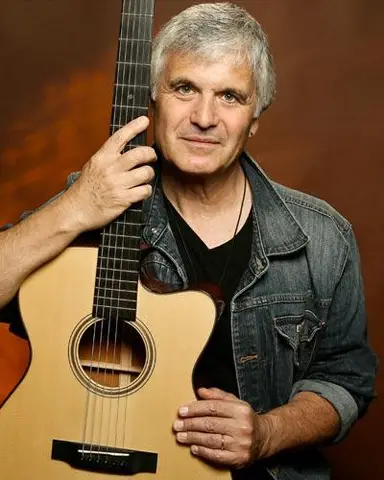
Lesson time: (10min 38sec)
Dans cette leçon, Laurence Juber t'apprend à jouer son morceau "Catch" à la guitare acoustique.
Course preview
This lesson is part of the course The Guitarist : Six morceaux originaux en DADGAD et accordage standard
Watch a preview of the full course below.
Lesson transcript:
Music Lesson: "Catch"
Introduction to Techniques
Let's take a look at Catch. This one opens with a little bit of the old two-hand slap and tickle.
Hammer-On and Pull-Off
- I'm doing the hammer with my INM fingers of the right hand.
- Follow this with a pull-off and then a hammer-on with fingers two and three of the left hand.
- After this, another pull-off and then a hammer again on the seventh fret.
The whole pattern goes like this:
- I hit the back chord using the back of my index fingernail.
- Alternating between the two, you'll notice I slide in twice.
Pickless Pick Technique
This kind of technique is what I think of as the pickless pick. Imagine you're holding a pick, but there is no pick. Instead:
- The back of the first fingernail serves for the downstrokes.
- The back of the thumb serves for the upstrokes.
You'll get a little bit of the flesh involved on the back of the thumb, but you kind of get used to it after a while.
Chord Explanation
Looking at this chord for a second:
- A bass note
- C sharp
- F (augmented fifth)
- G (seventh)
- C (sharp nine)
Essentially, it is an A7 sharp nine augmented, which is a very cool kind of jazzy chord and not a particularly complicated fingering. It's the same chord, same basic shape we use here.
Verse Techniques
So, moving on into the verse, I have a very staccato approach:
- I'm hitting the bass note, then using my third finger to make a staccato melody note.
- There's a slide picking out the melody followed by another slide.
I'm also incorporating the percussive effect, pretty much like a snare drum would do:
- That's a nice chord. I'll keep that same shape, F13.
Harmonic Characteristics
This seems to be characteristic of my harmonic style. I often use thickened lines to articulate a melody without a conventional series of harmonies. Instead, I maintain a consistent fourth, fifth, octave pattern.
The whole thing repeats, including a little lick in the middle, using octaves, a straightforward jazz lick.
Transitioning Sections
Now into the next section, I slide up:
- I think this is cool in DADGAD; if you play this shape, you've got a G7.
- The open G string paired with the same note on the fifth string creates a nice slight dissonance as you slide in.
Exploring Chords
- Bass line: a little walk-up.
- Here's an E7 chord, with a tenth between the bass note and the melody.
Here's the tenth and another lick:
- A slide, a slide, and then back to the head. Try and add a little vibrato there.
Continuity and Improvisation
Repeat. I think the trick with this stuff is to take all these individual moves and create continuity with the groove:
- Each one is articulated a little differently.
- There's a mix of slides, hammers, and pulls, but the overall groove maintains a swing feel.
After that, it goes back to the intro figure. Now, we walk up to that same basic chord: the seven sharp nine.
Beginning the Solo
I've walked it up to an F sharp, starting the solo in a cycle of fifths pattern:
- B7 to E7 (actually an E9).
- Here's an A and now to a D.
I never play exactly the same way twice. I look at this as a bit of an improvised solo.
Chord Shapes
- Here's your basic B7 in DADGAD.
- Here's your E9.
The second time it occurs:
- I hit the A over an A pedal.
- A flat, A, B flat, B, C, going up to the D.
B Section and Call and Response
Going around that whole sequence again, we return to the B section, which has a call-and-response feel.
Observe this:
- The F sharp and the C create a tritone, leading to the D7.
This will go around again and then comes back into the melody. The last time changes a bit, featuring a coda that I love.
Conclusion
In the final iteration, there's a B bass note and the open strings on top:
- Another walk-up then vamps with little licks over it.
- The last time serves as my signal that it's going to end.
I keep walking up the fingerboard and hit the following chord, but wait, I hit this chord, which resembles an augmented 11th. It's a D, F sharp, C, E, and G sharp.
So, we get a nice kind of jazzy ending.
Virtual whammy bar, and that's Catch!
About the instructor
Laurence Juber s'est d'abord fait connaître comme guitariste principal des Wings, le groupe de Paul McCartney. Depuis, il a bâti une carrière de guitariste fingerstyle, compositeur et arrangeur, travaillant essentiellement en accordage DADGAD, ce qui lui a valu le surnom de 'the Duke of DADGAD'.Élu Guitariste de l'année par les lecteurs de Fingerstyle Guitar Magazine et cité parmi les meilleurs guitaristes par le magazine Acoustic Guitar, il affiche aussi une longue liste d'albums solo et de tournées à travers le monde.Dans ses cours, il enseigne sa technique fingerstyle et l'accordage DADGAD qui l'a rendu célèbre, comment agencer mélodie, harmonie et basse pour la guitare solo, et les morceaux - comme sa pièce phare 'Wooden Horses' - qui réunissent le tout. read more