



Buffalo Nickel (cours)
Lesson time: (10min 29sec)
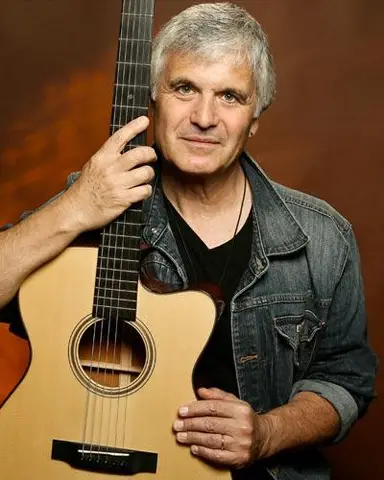
Dans cette leçon, Laurence Juber t'apprend à jouer son morceau "Buffalo Nickel" à la guitare acoustique.
Course preview
This lesson is part of the course The Guitarist : Six morceaux originaux en DADGAD et accordage standard
Watch a preview of the full course below.
Lesson transcript:
Buffalo Nickel Lesson
So let's get started with Buffalo Nickel.
What I'm going to do on my recording of this is:
- I actually use a capo at the second fret.
- For the purposes of teaching the lesson, I'm going to play it to you without the capo.
- This approach allows us to think a little more logically about what's going on harmonically and fingering-wise.
Key Details
- We are in DADGAD and the key of F, which is the relative major of D minor. This is a kind of root key for DADGAD.
- I'm starting off immediately with a little bit of a chromatic turn.
Even though I'm in F, my second note is a B natural:
- C
- B natural
- C with an F.
By itself, it sounds a little dissonant, but in context:
- Go to A G minor.
- Now here's a C chord, it's actually a C9, C13, really.
- Here's an F chord and there's a D chord.
I've got the melody ringing out on top, so I've got:
- F sharp, G, and A.
Back to the G minor with a B flat sounding against the A natural.
And there's another D chord.
Chord Progressions
See all these different fingerings, different inversions, and voicings of these chords:
- A D chord
- D7 chord
- D9 because there's an E natural.
Then, it's:
- D flat to C.
So it's really a chromatic move down from:
- D to D flat to C, and then the whole thing repeats.
At the end, see, now this:
If you look at this progression:
- D flat 9 to C9.
The shape is our familiar cowboy C shape:
- But in DADGAD, that's a B flat and that's a D.
It gives you a stacked ninth chord:
- Root
- Third
- Fifth
- Flat seven
- Nine
This voicing is not really very available in standard tuning; it's almost like a piano-like voicing.
Then, we end up on:
- An F chord to an E, A minor.
Now that's a D7 flat nine to a G minor.
- E
- A minor
- D7
- G7.
Whoops. Hang on.
Unfamiliar Shapes
There we go to C7 augmented.
See? Unfamiliar shapes. You might really want to pay a little attention to what the left hand is doing separately on this. Also, refer to the music. Because these are very cool chords, but they're not necessarily intuitive.
The basis of what we used to from standard tuning voices, and then the pattern repeats again.
Now we end up on the F, and we're going to move up:
- Now we're moving up to an A minor.
Transitioning Keys
So now we're in the key of A minor.
- Here's an E, but it's a little tricky because it's A.
- It's actually got a G sharp on top and a G natural underneath it.
So when you do it up to tempo, it makes sense.
And again.
So we've got these sixths moving upwards and now to a D.
Now we're in the key of G.
But again, there's this constant thing that happens where there are these minor seconds going on between the major third and the minor third.
I got these octaves.
Now, that's kind of a cool one.
Now we got tenths on a C with the open strings ringing.
There's a diminished shape.
In fact, the second time this happens, I actually walk up through all the diminished chords.
Diminished Chord Explanation
Remember, a diminished chord is stacked minor thirds.
So if you transpose it up a minor third or three frets, you get the same chord but in a higher voicing, a higher inversion.
And then to the A minor, G, E.
Okay, now I'm back in G.
But now I'm going to modulate to D minor, E minor 7 flat 5, to A7, flat 9.
Nice little cascade there.
And now we go:
- D minor, E, C minor to G.
Putting It All Together
So the chords.
So I'm going to play that all the way through that section:
- E flat major 7 to a B flat, to an A and then to a D.
Let me do that again.
- Oh, that's what I do.
That's right to the E minor 7, like with the E minor 7 flat 5, like we do in the intro.
And again, C minor.
Now this gets a little tricky.
- Let me do that again.
- Do a little walking bass.
And now I'm hitting a D7 chord and I'm back to the G section.
That will repeat and then eventually you'll end up on the G.
Then moving down from the G to a G flat, back to F to the original melody.
Coda and Closing
There's a little coda at the end:
- F, D, F.
And then there's a different voicing there of:
- A D7, B9, D flat in this voicing to that G13 chord.
Then I got an octave G, C here.
- And then I follow that with an octave D there to the F with a little sliding part at the end.
Now the two:
The I and M of the right hand playing up the scale there.
Then I pull off and then I hit here, this chord, which is an F7, which is an F9, F13.
In fact, you can give it a little bit of the virtual whammy bar at the end.
Let me just explain the virtual whammy bar, as I call it.
Virtual Whammy Bar Explanation
What happens here is because the top of the guitar is very flexible, and a lot of the sound is coming from here.
What I'll do is use my forearm to very gently change the harmonic structure of the chord so that it gives it a little bit of a chorusing kind of vibrato.
So just throw a little bit of that in at the end.
So there you have Buffalo Nickel.
About the instructor
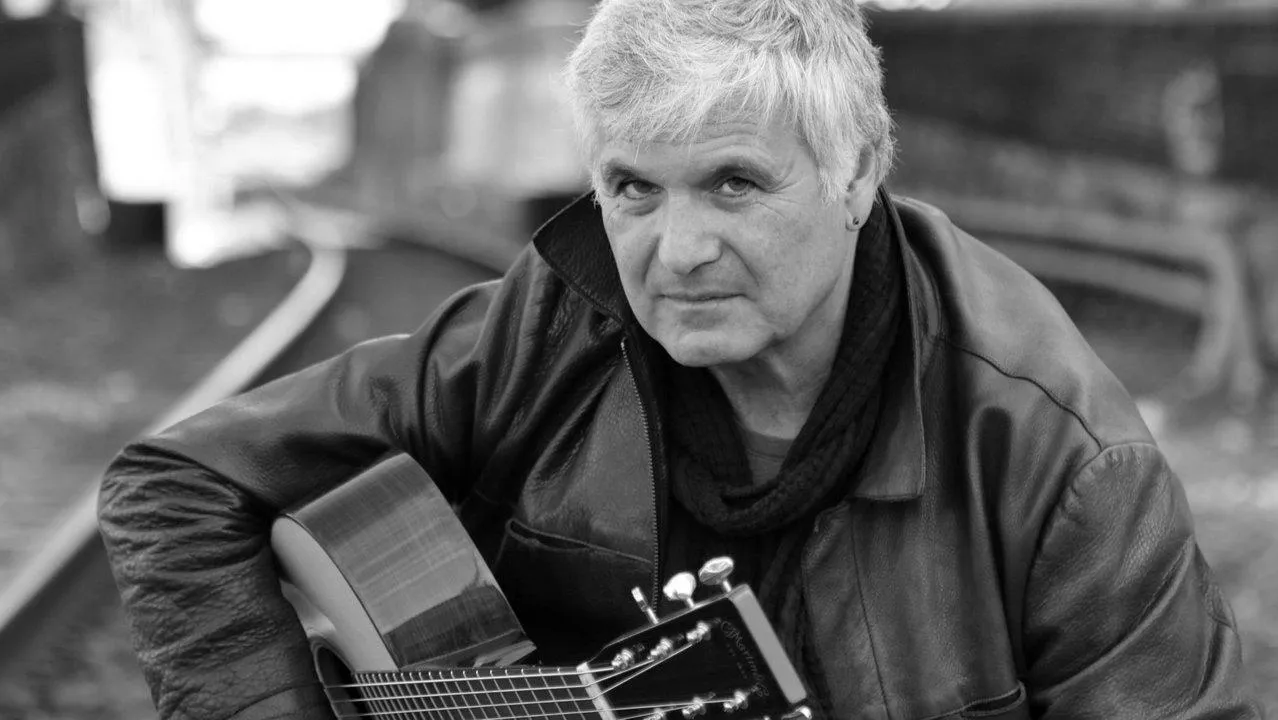
Laurence Juber s'est d'abord fait connaître comme guitariste principal des Wings, le groupe de Paul McCartney. Depuis, il a bâti une carrière de guitariste fingerstyle, compositeur et arrangeur, travaillant essentiellement en accordage DADGAD, ce qui lui a valu le surnom de 'the Duke of DADGAD'.Élu Guitariste de l'année par les lecteurs de Fingerstyle Guitar Magazine et cité parmi les meilleurs guitaristes par le magazine Acoustic Guitar, il affiche aussi une longue liste d'albums solo et de tournées à travers le monde.Dans ses cours, il enseigne sa technique fingerstyle et l'accordage DADGAD qui l'a rendu célèbre, comment agencer mélodie, harmonie et basse pour la guitare solo, et les morceaux - comme sa pièce phare 'Wooden Horses' - qui réunissent le tout. read more