



Enough Is Never Enough
Avec
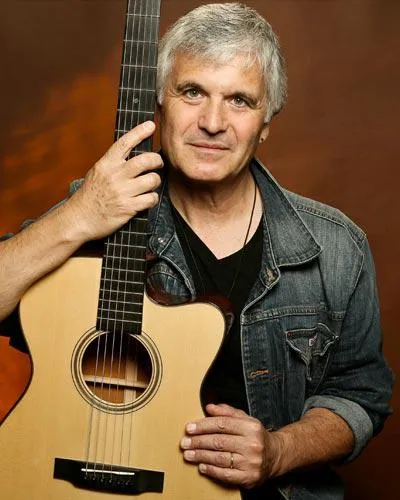
Laurence JuberDans cette leçon, Laurence Juber t'apprend à jouer son morceau Enough Is Never Enough à la guitare acoustique.
Le contenu du cours
14 leçons (1h 33min) · 1 gratuites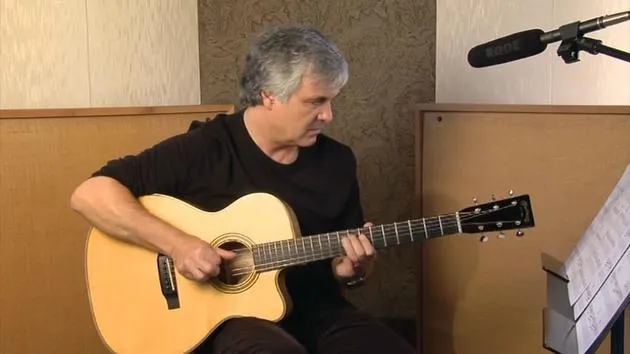
01. Enough Is Never Enough
Tu es ici8:12
02. Guitar Noir
5:34
03. The Crow's Nest
Leçon gratuite5:15
04. Maple Avenue Strut
9:05
05. The Ornament Waltz
10:38
06. Rufus
7:19
07. Highway 17
8:38
08. Being Here With You
4:51
09. Wooden Horses
7:42
10. Double Agent
7:01
11. Shebeg & Shemore
4:44
12. Around The Block
6:39
13. Portobello Road
6:28
14. Dernières réflexions
1:03
Transcription de la leçon
Music Lesson: "Enough is Never Enough"
Introduction
Let's get started with the first tune: "Enough is Never Enough." It's in DADGAD tuning and the key of A. There's a lot of useful pentatonic information to explore here.
Opening Remarks
In the opening section, I'm playing around with an A7 and a D7. You'll notice with my right hand I can be doing some rhythmic stuff that isn't necessarily fully notated, or fully articulated. There's a kind of underlying groove going on, and I'm catching some rhythmic moments in between the actual picked notes.
Pentatonic Licks
- Example of a pentatonic lick: (play lick)
- Another pentatonic lick: (play lick)
I tend to discourage people from thinking in terms of boxes when fingerings are involved, but it's quite useful to recognize that in DADGAD, some of your bluesy pentatonic shapes exist in an area that is really just two frets higher than in standard tuning on the top two strings.
Chord Progressions
Now, moving into Bar 9, I'm shifting up to a C chord. It's a C7 with an added 13, with no nines. Notice there's an open A string involved on the second string.
Transitioning to B7
- The B7 chord also incorporates the open A string for the seventh.
Licks and Chords
The lick that follows is not slurred; I'm picking every note. Then again, on a D7 with the A string open, followed by a C#7, which is augmented.
In measure 12, I'm barring the whole thing with a pentatonic bluesy lick, transitioning into an F# minor.
Chord Configurations
- I'm moving from a D to a Badd2 over D#, which is one of my favorite DADGAD chord configurations, landing on an E Sus. The sus is simply one finger across the whole guitar since DADGAD is basically a sus tuning.
Repetition and Extension
This phrase will repeat, with an extension the second time around. Notice what happens when I go to the G7 chord. Recognize this shape, which comes up frequently; it's the seventh and is the equivalent of doing this in standard tuning. I'm reaching back to get the E on the top string, then moving to an F#.
Doubling in Thirds
This time, I'm doubling that in thirds.
Continuing into Bar 23
Continuing into Bar 23, what's happening:
- Over an F zone, then a G, and then going up to the A.
- Notice the top strings are still open.
I'll play that bit again in Bars 25 and 26, then back to the F again.
Picking Notes
Each one of these notes is not slurred. I prefer the energy of picking each note. The pattern repeats, and between each F, G, and A, there are different licks that occur. Feel free to improvise; I play them differently each time, but they are integral to the music.
Coda Section
When we reach the coda, it picks up with a breakdown section:
- Just over an A, A/C#, and D.
- On top of that, I'm adding a pattern that repeats.
Stretch Caution
Be careful with that stretch; I'll play that one more time. Notice how it progresses and gets louder. The intensity should start at the beginning of that coda section and gradually build in volume.
Final Thoughts
Essentially, everything else is a repeat of what has come before.
B Section Reminder
In the B section starting at Bar 9, be careful when playing those with thumb downstrokes, especially with the bar that occurs there.
Conclusion
To recap:
- Be conscious in DADGAD of the fact that A is a very cool key to be in.
- Familiarize yourself with these chords: F, G, A, C, B, D, C#, and F# minor as you progress in DADGAD.
Thanks for paying attention!
14 leçons
1h 33m de leçons vidéo structurées
Fonctions vidéo avancées
Ralentissez, bouclez un passage, suivez la partition
Mobile, tablette et ordinateur
Pratiquez où vous voulez
Satisfaction garantie à 100 %
Garantie remboursement 30 jours
Rencontrez votre guru
Rencontrez votre guru
Laurence Juber s'est d'abord fait connaître comme guitariste principal des Wings, le groupe de Paul McCartney. Depuis, il a bâti une carrière de guitariste fingerstyle, compositeur et arrangeur, travaillant essentiellement en accordage DADGAD, ce qui lui a valu le surnom de 'the Duke of DADGAD'.
Élu Guitariste de l'année par les lecteurs de Fingerstyle Guitar Magazine et cité parmi les meilleurs guitaristes par le magazine Acoustic Guitar, il affiche aussi une longue liste d'albums solo et de tournées à travers le monde.
Dans ses cours, il enseigne sa technique fingerstyle et l'accordage DADGAD qui l'a rendu célèbre, comment agencer mélodie, harmonie et basse pour la guitare solo, et les morceaux - comme sa pièce phare 'Wooden Horses' - qui réunissent le tout.







