



The Tempest (leçon)

Lesson time: (10min 31sec)
Course preview
This lesson is part of the course Guitare instrumentale contemporaine
Watch a preview of the full course below.
Lesson transcript:
The Tempest Music Lesson
Introduction
This next tune is called The Tempest and so named probably because I feel like I'm in one when I'm playing it. There are lots of swirling notes that kind of remind me of a whirlwind.
- Tuning: Standard tuning
- Key: E minor
- Chords: A lot of standard chords in this one, which will help with the learning process.
Opening Riff
The opening riff of the tune basically is the melody in the left hand. However, I don't play it there; I wrote this to get a kind of harp-like effect. There are ways of playing scales that achieve this.
Technique:
- Start in the seventh position where my first finger is hammering on.
- Notes:
- E
- F sharp
- The next note is G, but I'm not playing it there.
- Instead, I'm playing the open third string, then going back to the F sharp, catching the A at the seventh fret of the fourth string.
The next note is B above the A, which I catch on the second string. To be honest, I kind of wrote this melody with that in mind, utilizing these open strings.
Finally, there's that last little riff. One thing I like to do is when I hammer that third finger down, I keep it down.
Picking Technique
In my right hand, as far as the picking goes, I'm using my thumb a lot.
- Notice: My thumb is up there on the fourth string. You may choose to play with your fingers instead.
- Although I don't usually do this, notice you're using I M, I M almost the entire time, which actually comes in handy because you have to play bass notes with that melody later on.
Chorus
After that, we move to the chorus, which pretty much uses standard chords:
- E minor
- D over F sharp
- G
- A9
- G over B
- C
- D
Picking Pattern:
- Thumb, thumb, index
- The melody starts off with the ring finger playing the melody, then the middle finger.
Rhythm:
- Below the thumb pattern:
- thumb, thumb, index
- thumb, thumb, index
It stops doing thumb, thumb, index when I stop saying it. The first half of the chorus has the quarter notes in the melody, and underneath is the triplet feel.
Then it switches halfway through; the melody notes take over the triplets.
Key Points:
- I will point out the switch.
- Switch back to the original pattern.
- Switch one more time.
You can hear the switch in there.
Returning to the Verse
Now, you go back to the verse, playing the same way, except you add bass notes.
- Technique: Same type of harp technique, alternating with chords.
- It's pretty straightforward.
A Minor Section
In the A minor section, this is just like the first chorus. It's all based on chords:
- A minor
- F6
- B minor 7
- E7
- A minor
- F6
- B minor
- A minor
- D7 over F sharp
- G
Picking: Pretty much the same idea, thumb, thumb, index, with the middle finger playing the melody.
Middle Section
In the middle section, I transpose to A minor and use this little shuffle:
- Shuffle Pattern:
- thumb, index
- repeated
Keep your fourth finger down. It really helps to keep your left hand down while maintaining the shuffle with the thumb and index finger of the right hand.
Final Section
If you recognize this part, I ripped off Tchaikovsky at that point. You may recognize it, but his lawyer can call my lawyer if that doesn't work out!
- Reference: From the Nutcracker, you might recognize that.
The only thing left is this little turnaround, and then get back to the A minor.
Conclusion
I hope you enjoy that, and good luck with it! Thanks a lot.
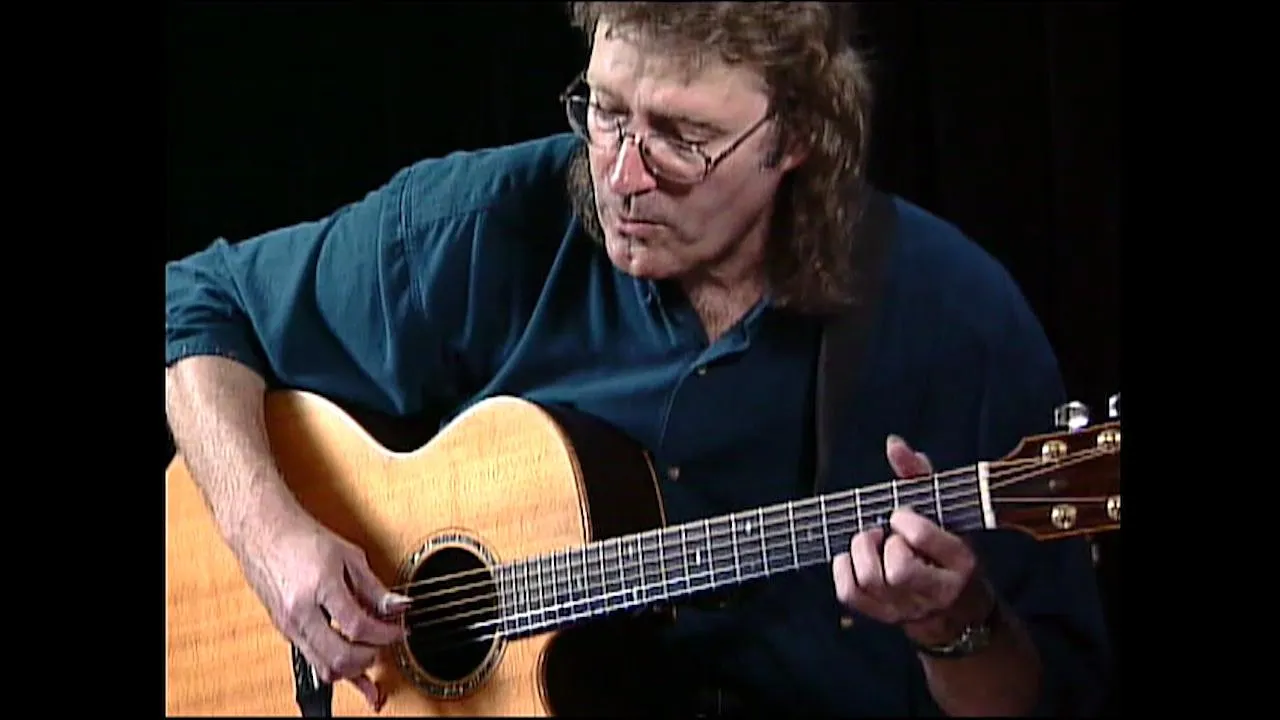
About the instructor
Doug Smith est un guitariste acoustique fingerstyle lauréat d'un Grammy et ancien vainqueur du Winfield International Fingerstyle Guitar Competition, dont le jeu a été mis en avant dans le film August Rush. Son style puise dans le folk, le classique et le jazz, et il a partagé la scène avec des instrumentistes tels que Tommy Emmanuel, Laurence Juber et Andy McKee. Dans son cours MusicGurus "Contemporary Instrumental Guitar", il décortique les techniques qui se cachent derrière ses arrangements en solo. read more