



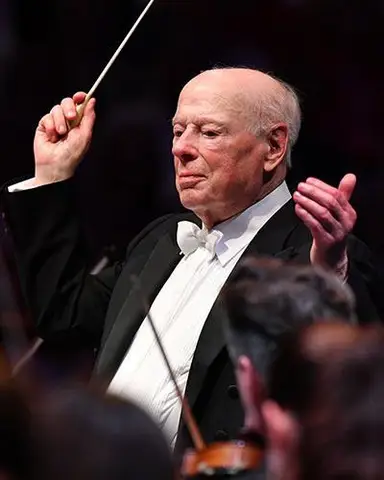
Poco Allegretto - Bernard Haitink donne son analyse et ses retours à Anne-Marie Granau
Lesson time: (21min 37sec)
Anne-Marie Granau dirige l'introspectif troisième mouvement de la Symphonie n° 3 de Brahms et reçoit des retours détaillés de Bernard Haitink.
Course preview
This lesson is part of the course Brahms - Symphonie n° 3
Watch a preview of the full course below.
Lesson transcript:
Music Lesson: Third Movement Insights
The third movement is extremely touching.
It features:
- Still more chamber music
- A smaller orchestra
- A wonderful tune for celli and violins
- Later on, the oboe takes over
What's interesting about this movement is that orchestras and musicians really want to immerse themselves in it. It is extremely espressivo. However, Brahms notated mezzavoce.
Introspection in Interpretation
So, it should be very introverted in a way, not so much introverted as inward-looking. It should not resemble a quasi Italian aria. No, it needs to be... I don't like the word humble, but in that direction.
Scoring Insights
The third movement has a compelling beginning with a wonderful tune, espressivo, but marked mezzavoce. This indicates a very subtle sound.
- There are little hairpins here for the violas.
- It is a very nostalgic piece, Brahms was a lonesome man, and sometimes, as you can hear from his music, he was rather nostalgic.
There exists a sort of longing for something, perhaps unknown. This balancing act between lyricism and longing must translate into sound, which is very difficult.
Performance Technique
But the playing should not sound like daily bread and butter. The celli must really find a way to express this espressivo but mezzovoce.
- Try to answer, Celia.
- "Yeah. I would not start the crescendo too soon."
Timing is crucial in this piece:
- Tip: Bow to the next bar after two beats.
- One, two. And now, no crescendo.
Yes, here lies the nostalgia. He has no espressivo. Yes, there is vibrato, but there is no crescendo there.
Rehearsal Notes
Let's try it once more:
- One, two, sample piano.
- Okay, I hope this aligns with your way of thinking too.
Another challenge for the conductor is to convey that mood with the limited options of two hands and maybe a face.
- May I try it once?
- "Sorry, I feel always a bit inhibited because one sings. Of course, it's an ego trip. Conducting is an ego trip. But in this case, I really mean it. I mean well."
Finding the Right Tempo
Of course, you don't have to adopt my slow tempo; take your own. But try to find the right mood.
- Important Note: In the score, you might notice a small form at the last letter "I".
- You are getting dangerously slow, and gaps are beginning to appear.
Keep the line moving a little bit more.
- Notice: If it feels a bit blocked.
Revisiting Letter I
Let's revisit letter I.
- "I'd like to do this one once more, please. Be careful in the last four bars."
- Retenuto is already composed by Brahms himself, don't add something extra to it.
At letter I, the gaps feel too big for my taste.
- Reminder: Keep it moving.
- Let's do it once more.
Conducting Challenges
It is essential for a conductor to maintain the right concentration and not get upset when things go wrong during performances. In such moments:
- You can't talk or criticize.
- Don't make bad faces; just go on and try to give them confidence.
This is very important. You have to convey to them that you are there not to criticize, but to give them confidence.
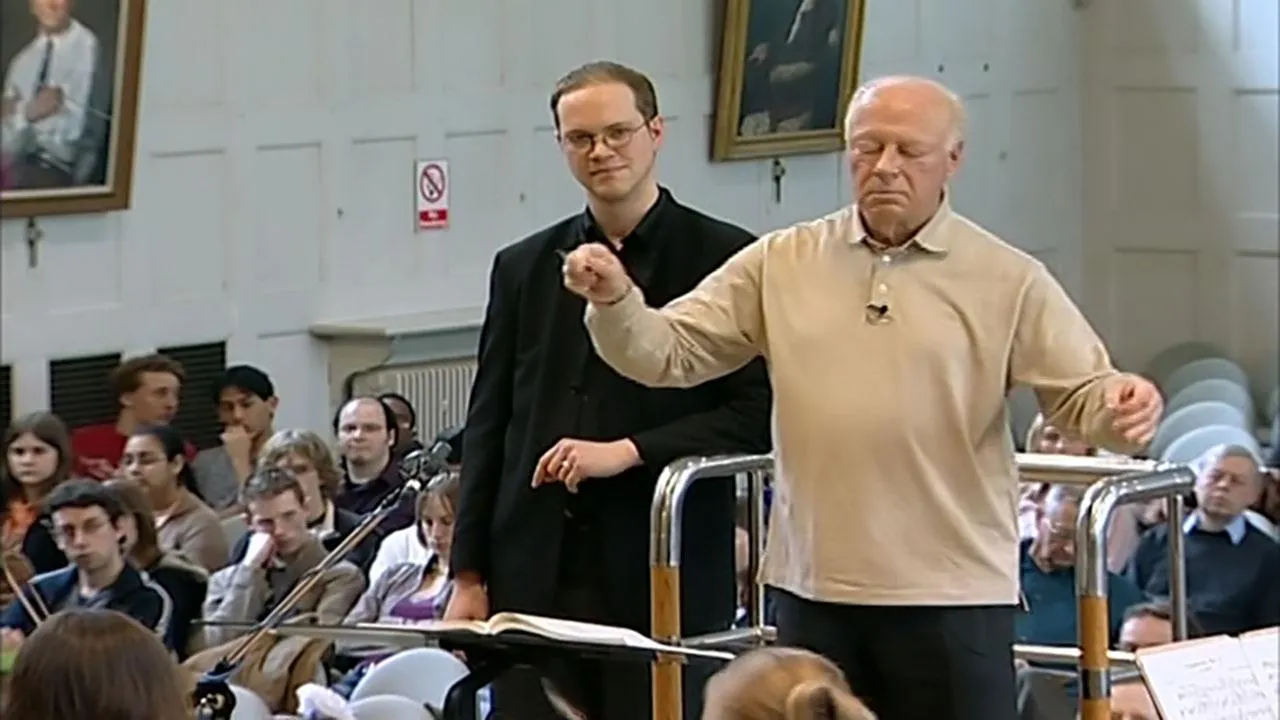
About the instructor
Avec une carrière internationale de chef d'orchestre qui s'étend sur plus de cinq décennies, Bernard Haitink, né à Amsterdam, est l'un des chefs les plus célébrés de notre époque. Nommé chef principal du Chicago Symphony Orchestra dès le début de la saison 2006-7, il a dirigé nombre des plus grands orchestres du monde, dont plus de 25 ans à la tête du Royal Concertgebouw en tant que directeur musical. En outre, M. Haitink a auparavant occupé les postes de directeur musical de la Staatskapelle de Dresde, du Royal Opera, Covent Garden, du Glyndebourne Festival Opera et du London Philharmonic. Il est chef lauréat du Royal Concertgebouw Orchestra, chef émérite du Boston Symphony Orchestra et membre honoraire de la Philharmonie de Berlin. Il s'est produit fréquemment comme chef invité avec la Philharmonie de Berlin, la Philharmonie de Vienne, la Radio bavaroise, le London Symphony et d'autres orchestres de premier plan. M. Haitink a beaucoup enregistré pour les labels Phillips, Decca et EMI, notamment des cycles complets des symphonies de Mahler, Bruckner et Schumann avec le Concertgebouw et un vaste répertoire avec les Philharmonies de Berlin et de Vienne et le Boston Symphony Orchestra. Ses enregistrements les plus récents sont les intégrales des symphonies de Brahms et de Beethoven avec le London Symphony Orchestra sur le label LSO Live. Sa discographie comprend également de nombreux enregistrements d'opéra avec le Royal Opera et Glyndebourne, ainsi qu'avec l'Orchestre de la Radio bavaroise et la Staatskapelle de Dresde. L'enregistrement par M. Haitink de Jenufa de Janáček, avec l'orchestre, les solistes et le chœur du Royal Opera House, Covent Garden, a reçu un Grammy Award du meilleur enregistrement d'opéra en 2004. M. Haitink a reçu de nombreuses distinctions internationales en reconnaissance de ses services rendus à la musique, dont un titre honorifique de chevalier et l'Ordre des Compagnons d'honneur au Royaume-Uni, ainsi que l'Ordre de la Maison d'Orange-Nassau aux Pays-Bas. Il a été nommé « Musicien de l'année » par Musical America en 2007. Dans son cours MusicGurus sur la Symphonie n° 3 de Brahms, Haitink puise dans toute une vie passée au pupitre pour t'emmener au cœur de la partition — comment il en façonne le phrasé, l'équilibre, le tempo et la structure — offrant un aperçu rare de la façon dont l'un des grands chefs lit une symphonie de Brahms et lui donne vie, que tu sois chef d'orchestre, musicien d'orchestre ou auditeur passionné. read more