



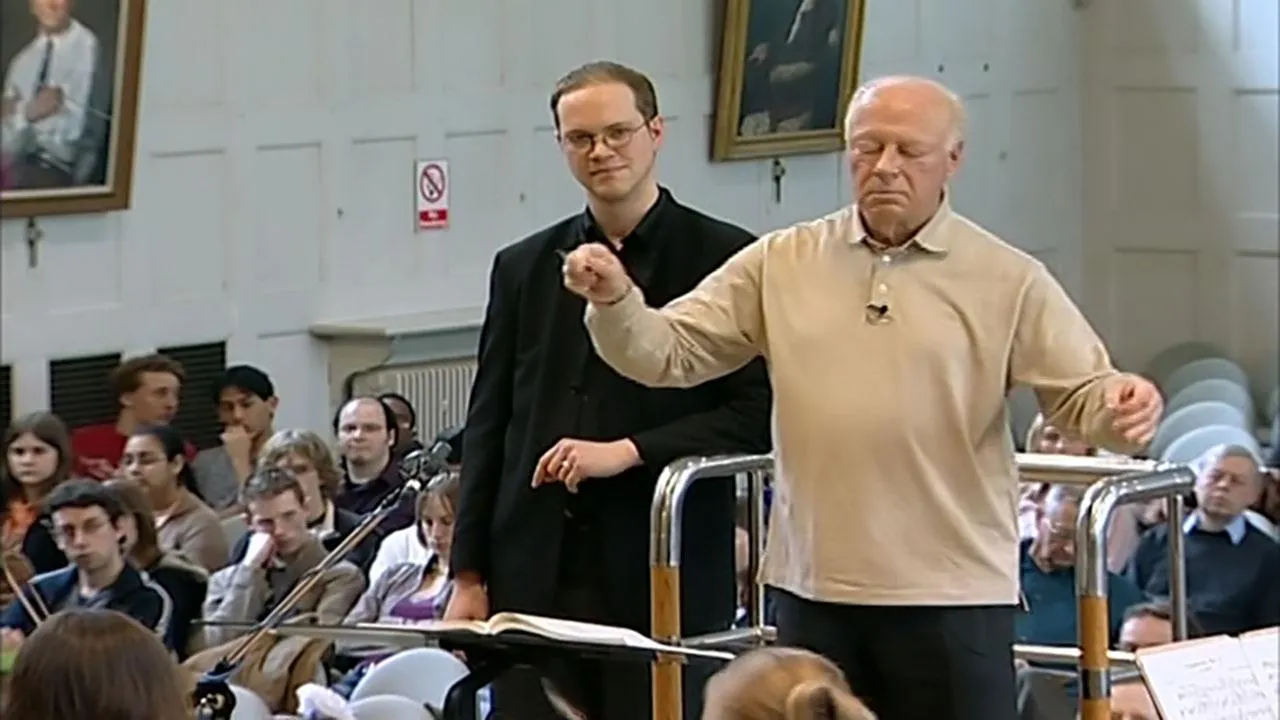
Allegro - Bernard Haitink donne son analyse et son retour à Karim Said
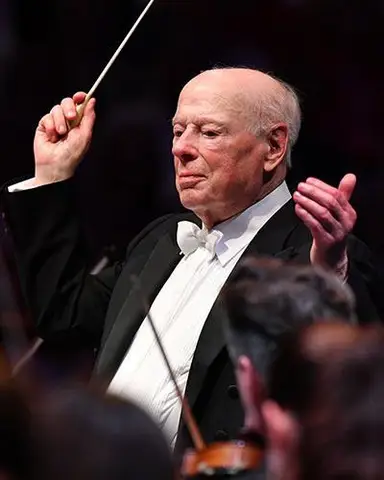
Lesson time: (7min 52sec)
Course preview
This lesson is part of the course Brahms - Symphonie n° 3
Watch a preview of the full course below.
Lesson transcript:
Music Lesson
Instructor:
My fault. Very sorry. No, it was not very good. My fault. I said very sorry.
No, no, no. This was not together at all.
Very funny.
Discussion of Dynamics:
-
In the beginning, you give that, but it's sort of...
And then:
Pom, pom, pom, pom, yum, pom, pom, pom.That was good.
But then it gets louder and louder there. They think, "Well, you're not looking at us well, we play out."
Keep a check on them. Yes.
The more you play, the more there's a danger the piano will not be there.
So, do it once more.
I also forgot trombone. Very sorry. He will not hold it against you. With a bit of luck, once more.
Encouragement:
Yeah, okay, Karim, I'm sure you can.
And you want to have more pianist, more soto voce.
Questioning Techniques:
Yes. So, how?
Get something out of your box of ideas.
Yeah, but the danger is when you want it more pianissimo, that it also becomes slower.
So that's always one of the eternal problems of the conductor.
How can I get really pianissimo, but in tempo?
Feedback on Tempo:
Okay, okay, Karim.
Okay, good, good.
But it's getting slower and slower.
Yeah, getting slower.
Yeah. And you don't want that, or do you want it a little bit?
I want a little bit of space before the.
And then you can pick up.
Yeah, okay. The ones were the beginning.
Final Thoughts:
Okay. And I will keep my mouth shut.
Yeah, no, no, no, no. I'll keep my mouth shut.
It's a bit too slow. I need to...
Well, yes, yes, yes.
So it's very good in many ways, but sometimes you do things that I think, "My goodness, how can they keep it together?"
Because you are so busy, and you want everything, and I know you have it here.
It comes through and it's very impressive.
Oh, yeah.
But maybe I'm your most critical admirer.
Yeah, you do very well.
But you have to discipline yourself, and I'm sure you will do, because you are clever enough.
Concluding Remarks:
So, end of the slow.
Furtw?ngler could do that at the end of his life.
But when you start as a young man already with that, how slow will you be at the end of your life?
I would keep it a bit more in a classic shape.
Movement Insights:
The whole movement is from here?
No, the poco sostenuto is becoming a molto sostenuto.
And I found the beginning dangerously slow too.
But okay, that's a Lego.
It's not a Lego comrio that I buy from you. I mean, if that's your...
If you're convinced about that.
But in the fortissimo, keep a little bit more energy for yourself because you are so.
You are attacking them, and there's a danger that you lose the rhythm.
Yeah.
Okay. Well done.
Thank you.
Thank you.
About the instructor
Avec une carrière internationale de chef d'orchestre qui s'étend sur plus de cinq décennies, Bernard Haitink, né à Amsterdam, est l'un des chefs les plus célébrés de notre époque. Nommé chef principal du Chicago Symphony Orchestra dès le début de la saison 2006-7, il a dirigé nombre des plus grands orchestres du monde, dont plus de 25 ans à la tête du Royal Concertgebouw en tant que directeur musical. En outre, M. Haitink a auparavant occupé les postes de directeur musical de la Staatskapelle de Dresde, du Royal Opera, Covent Garden, du Glyndebourne Festival Opera et du London Philharmonic. Il est chef lauréat du Royal Concertgebouw Orchestra, chef émérite du Boston Symphony Orchestra et membre honoraire de la Philharmonie de Berlin. Il s'est produit fréquemment comme chef invité avec la Philharmonie de Berlin, la Philharmonie de Vienne, la Radio bavaroise, le London Symphony et d'autres orchestres de premier plan. M. Haitink a beaucoup enregistré pour les labels Phillips, Decca et EMI, notamment des cycles complets des symphonies de Mahler, Bruckner et Schumann avec le Concertgebouw et un vaste répertoire avec les Philharmonies de Berlin et de Vienne et le Boston Symphony Orchestra. Ses enregistrements les plus récents sont les intégrales des symphonies de Brahms et de Beethoven avec le London Symphony Orchestra sur le label LSO Live. Sa discographie comprend également de nombreux enregistrements d'opéra avec le Royal Opera et Glyndebourne, ainsi qu'avec l'Orchestre de la Radio bavaroise et la Staatskapelle de Dresde. L'enregistrement par M. Haitink de Jenufa de Janáček, avec l'orchestre, les solistes et le chœur du Royal Opera House, Covent Garden, a reçu un Grammy Award du meilleur enregistrement d'opéra en 2004. M. Haitink a reçu de nombreuses distinctions internationales en reconnaissance de ses services rendus à la musique, dont un titre honorifique de chevalier et l'Ordre des Compagnons d'honneur au Royaume-Uni, ainsi que l'Ordre de la Maison d'Orange-Nassau aux Pays-Bas. Il a été nommé « Musicien de l'année » par Musical America en 2007. Dans son cours MusicGurus sur la Symphonie n° 3 de Brahms, Haitink puise dans toute une vie passée au pupitre pour t'emmener au cœur de la partition — comment il en façonne le phrasé, l'équilibre, le tempo et la structure — offrant un aperçu rare de la façon dont l'un des grands chefs lit une symphonie de Brahms et lui donne vie, que tu sois chef d'orchestre, musicien d'orchestre ou auditeur passionné. read more