



Carole King - You've Got A Friend
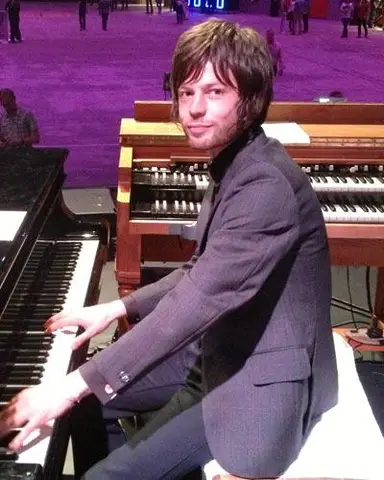
Lesson time: (8min 22sec)
Joe Glossop explore 'You've Got A Friend' de Carole King au Hammond, en jouant la mélodie d'une main avec un phrasé soul-jazz.
Course preview
This lesson is part of the course Le langage authentique du Hammond pour le soul et le jazz
Watch a preview of the full course below.
Lesson transcript:
Exploring "You've Got A Friend" by Carole King
So, following on from What's Going On, we're going to try the same sort of effects and employ some of the same techniques.
The Famous Melody
We're going to explore a very famous melody: "You've Got A Friend" by Carole King. I thought I'd choose this because, as keyboard players, it's quite likely you've heard this or maybe played it in some context. It's a very famous melody.
If we were to play this dead straight, just to demonstrate the melody, it would go something along those lines.
"That sounds cool. You can still have some really nice phrasing on that, Jack McDuff, Jimmy Smith type thing."
A New Approach: One Hand
This time, we're going to try it fully voiced with a different tone.
- Technique Shift: We're now going to try it with one hand playing the melody.
- On What's Going On, we tried a two-handed approach, similar to the Earl Van Dyke tune.
- Using one hand creates a different feeling.
- You are a bit more limited in terms of what you can do because you don't have the left hand pushing you along and helping to guide it.
So, let's have a go!
Sliding and Trilling Techniques
What we're going to do is more of that sliding, slipping, trilling stuff.
- We can get quite easily from A flat to B flat.
- But to get to C, we're going to have to slide up there.
"I'm just going to slightly give us a little bit less of that so you can hear that."
Here's a go through the main bulk of the melody.
Harmony and Rhythm
So how do we get the harmony to actually work?
- It's a bit less of an exact science compared to when we were doing What's Going On.
- This time, it's more about making things work with what you have available.
Playing Without Sustain
- On a piano, you have sustain; on an organ, you don't.
- You need to rely on techniques like slipping up.
I'm taking a big chunk each time with my thumb on the way down. It's quite nice to complement what's going on at the top with some melody down below.
- I came down there and put that Carole King classic line that she puts on the piano.
Going up slow:
- On the C leading up to the F, I've got 7, sharp 9, and then flat 9.
- Sharp 9, flat 9, fast Leslie again.
- I've got an 11 there in the left hand, so that's an E flat with the D flat major chord on top of it, and then just going to an E flat 7.
Breaking Free
That part of the melody is very free the way she sings it.
- So, I've broken away from the chordal structure, as you can't be that free with it.
I played quite a nice little gospel riff and then came back.
"You've Got A Friend" played very fully with one hand rather than the two-handed approach we used for What's Going On.
Conclusion: Evolving Familiar Melodies
It's really nice to pick an old melody that you're very familiar with and try to do something different with it.
- If you find a song that you've known since you were a kid, my example being You've Got A Friend,
- If you can find something similar on a record, then go for it!
Try and use one of those sounds rather than playing it straight. Evolve it into a different feel and sound, and you'll learn something about the instrument along the way.
About the instructor
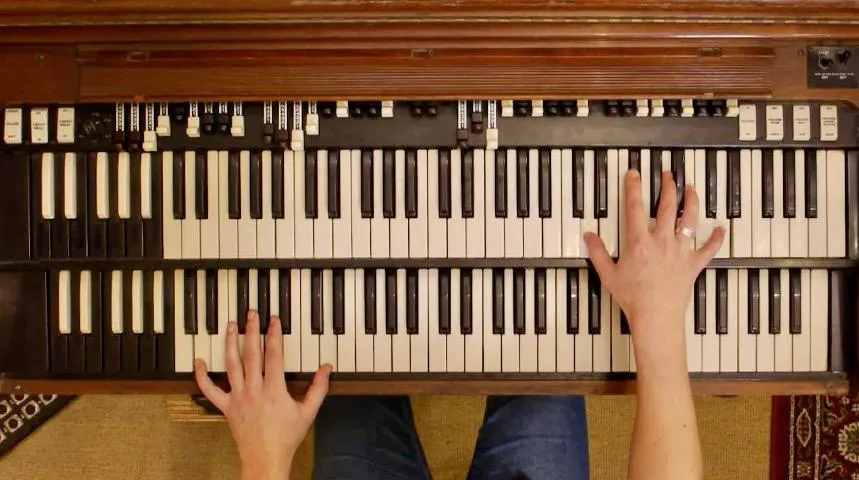
Joe Glossop est un claviériste de Sheffield qui s'est fait un nom à l'orgue Hammond. Il occupe actuellement le poste d'organiste dans le groupe de tournée de Tom Jones, et a joué avec Van Morrison et James Hunter, ainsi qu'au piano et au Rhodes. Ses cours permettent de tirer le véritable son Hammond de n'importe quel clavier : le réglage des drawbars, le Leslie, la basse walking à la main gauche, et le vocabulaire d'accompagnement et de solo des traditions de l'orgue soul-jazz, blues et rock, de Jimmy Smith à Booker T. read more