



Question et réponse (analyse)
Avec
Kay Charlton
Le contenu du cours
16 leçons (0h 51min) · 1 gratuites
01. Bienvenue dans Are You Ready
1:17
02. I Can Play In Three (interprétation)
1:36
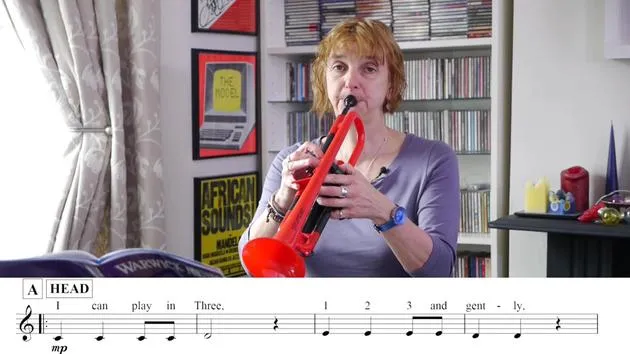
03. I Can Play In Three (analyse)
Leçon gratuite3:16
04. How Many Bars in a Blues (interprétation)
1:40
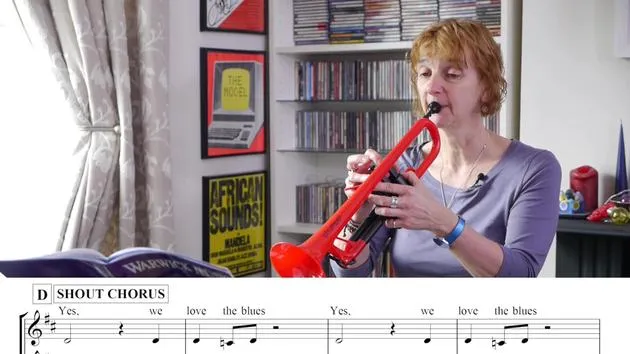
05. Combien de mesures dans un blues (analyse)
6:23
06. Lay Down The Bass (interprétation)
2:51
07. Lay Down The Bass (analyse)
5:01
08. Eastern Promise (interprétation)
2:23
09. Eastern Promise (analyse)
4:40
10. Are You Ready (interprétation)
2:32
11. Are You Ready (analyse)
5:49
12. Scale It (interprétation)
2:48
13. Scale It (analyse)
2:03
14. Question and Answer (interprétation)
2:52
15. Question et réponse (analyse)
Tu es ici6:05
16. Félicitations pour avoir terminé le cours !
0:40
Transcription de la leçon
Music Lesson: Asking Questions in Tune
This tune's all about asking questions and trying to get answers.
Introductory Notes
The long notes at the beginning can be thought of as the words:
- Why
- What
- Who
- Where
When you're playing these long notes, you can choose to play:
- A C
- An E
- A G
Whichever you're most comfortable with.
If you're playing in a class or with multiple people, you can share out the notes to create harmony. Remember, either C, E, or G works really well in the introduction section.
The Main Part of the Tune
When we reach the main part of the tune, known as the head, the first part is about asking a question.
-
Ask a Question
I'm going to ask a question... -
Give an Answer
...and then I'll provide an answer.
The pattern of C, E to G is a very well-known sequence called an arpeggio. Practice this pattern, as you might come across the word later on.
Question and Answer Dynamics
-
The question phrase goes up, creating an inquiry:
"What's happening?" -
The answer phrase comes down, resolving the inquiry.
Demonstration
Here's the question played slowly:
1, 2, 3.
Sounds unfinished, doesn't it? It needs something to follow.
Here's the answer:
Starting on that high note, G, where we just finished.
That sounds more finished, as we've landed on a low note.
- Use your tongue:
ta, ta, ta, ta, ta, ta, ta.
Follow the sound of the guitar at the beginning, it's quite heavy. Use lots of tongue to create a strong question and then ta, ta, ta, ta, ta, ta, ta.
Practice Long Notes
In this section, you can practice your long notes with backing tracks. There's a guide track with the trumpet, so feel free to play along with long notes, either C, E, or G, ta, ta. This will complement the question section.
Transition to the Second Part of the Tune
When you reach the second part of the tune, it changes slightly, and we go to an F.
New Questions
- What is the question?
I do not know.
What is the question?
No, I do not know.
Still don't know what the question is.
Slow Playthrough
Let's play that slowly, starting on an F.
- Lip's quite tight to start off.
- Take a good breath, supporting the note, and ensure you're standing up straight.
Here we go:
From F, 1, 2, 3.
Conclusion and Improvisation
This brings us back to the beginning. I'm going to ask a question, provide an answer, and then you have to say or shout, "What is the question? I don't know."
In the improvisation section for this tune, think about the dynamics between the question phrase and answer phrase.
Remember
This is the last tune in the course, so use all the notes we've learned:
- Low B
- C
- D
- E
- F
- G
- And if you can manage it, upper A as well.
Practice Session
I'll start off by giving you some questions, and you can provide the answers.
Remember:
- The question phrase will tend to go up.
- The answer phrase can come down and can also include elements from the question.
Here we go:
1, 2, 3, Your answer, 3, 4.
1, 2, 3, And my last question, 2, 3, 4.
Practice creating answers and questions. If you're doing this in class or with a friend, take turns making up the questions and answers.
Final Notes
Don't forget, C, E, and G work really well anywhere in this tune.
Now, I'm going to give you a few more questions, along with answers, to demonstrate the kind of improvisation you could do.
Here I go:
1, 2, 3, 4.
16 leçons
0h 51m de leçons vidéo structurées
Fonctions vidéo avancées
Ralentissez, bouclez un passage, suivez la partition
Mobile, tablette et ordinateur
Pratiquez où vous voulez
Satisfaction garantie à 100 %
Garantie remboursement 30 jours
Rencontrez votre guru
Rencontrez votre guru
Kay est trompettiste, compositrice et professeure de cuivres et de musique scolaire, spécialisée dans l'enseignement en classe au primaire - KS2, First Access/WCET (enseignement en ensemble pour toute la classe, où une classe entière apprend un instrument ensemble) et CPD des enseignants (développement professionnel continu). Elle a obtenu en 2018 un master en éducation musicale - 'Teaching Musician' au Trinity Laban Conservatoire.
Kay joue de la trompette au sein du Bollywood Brass Band, une formation de 9 musiciens de cuivres et de percussions dont le CD de 2017 Carnatic Connection a été nommé à un 'World Music Award' du magazine Songlines et a reçu une critique 5 étoiles dans le London Evening Standard. Kay compose et arrange pour le groupe et dirige son travail pédagogique, ayant fondé la Bollywood Brass Academy en 2017.
Kay a présenté ses recherches sur l'enseignement à toute la classe au Music Education Expo et au First Access Forum. Elle a conçu et animé des CPD pour LSO Discovery, Trinity College London, Music Education Solutions et le Bollywood Brass Band, et elle est consultante en éducation pour Warwick Music.
Le recueil de répertoire pour débutants de Kay, 'Are You Ready?', est publié par Warwick Music ; en 2017, Warwick Music et Music Education Solutions ont commandé à Kay des chansons pour un nouveau programme KS1 destiné au pBuzz, qui a été nommé 'Education Resource of 2018' par les 'Education Awards'.
Parmi ses autres publications figurent des pièces pour les programmes de piano Initial (2015/2018) et Grade 1 (2018) de Trinity, Bollywood Blast! (Spartan Press) - une série de méthodes pour cuivres et vents avec pistes d'accompagnement dans un style Bollywood - et Whole Class Bollywood Blast avec David Rose (Bedford Music Hub), destiné aux professeurs de cours instrumentaux en classe entière et incluant un programme Arts Award Discover.
Ses cours MusicGurus t'apportent directement cette expérience de la classe : de ta toute première leçon de trompette jusqu'à deux ensembles de morceaux pour débutants, Kay expose précisément quoi jouer et comment le jouer.







