



Combien de mesures dans un blues (analyse)
Avec
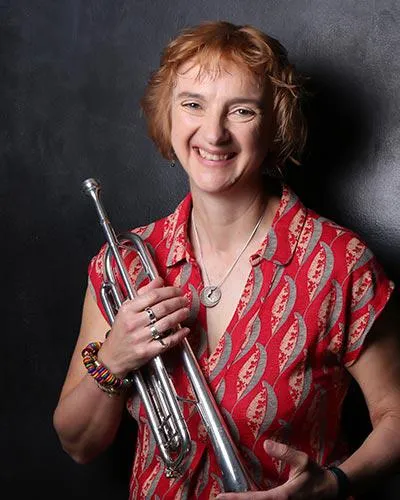
Kay CharltonUn blues de 12 mesures dans un style rock and roll et jazzy qui introduit la nouvelle note Fa, jouée avec le premier piston, comme quatrième note de la gamme.
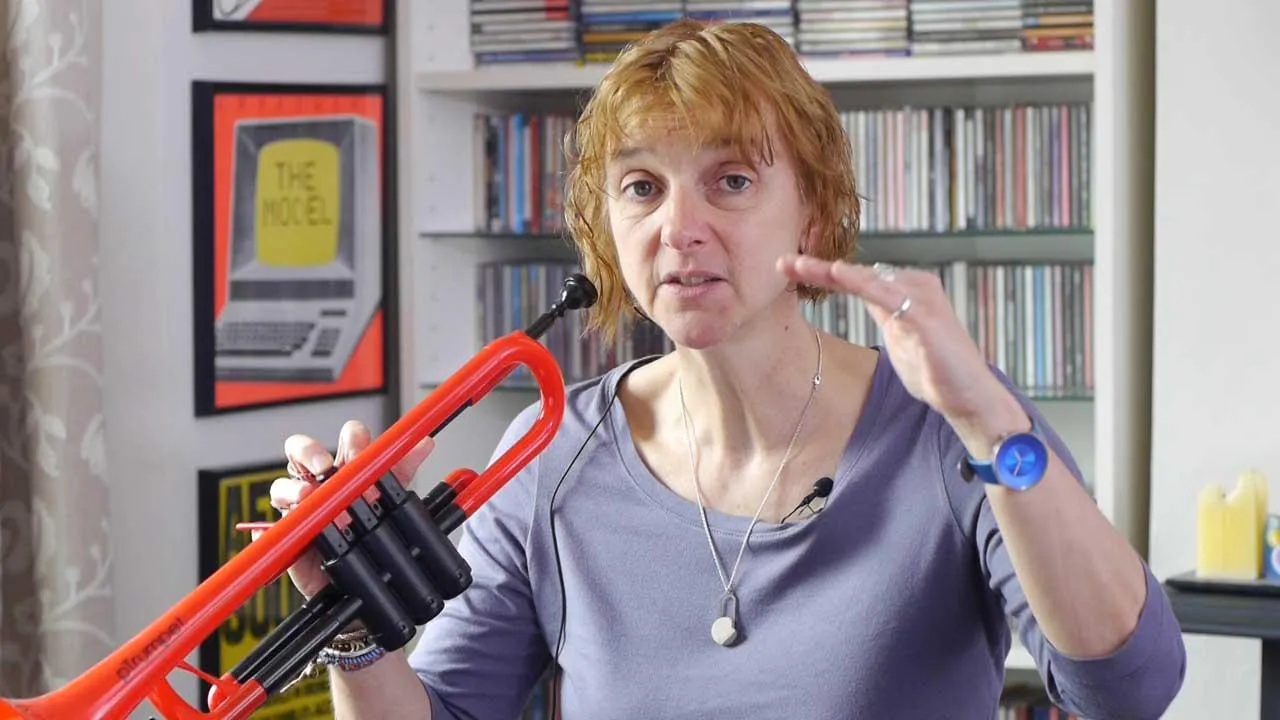
Le contenu du cours
16 leçons (0h 51min) · 1 gratuites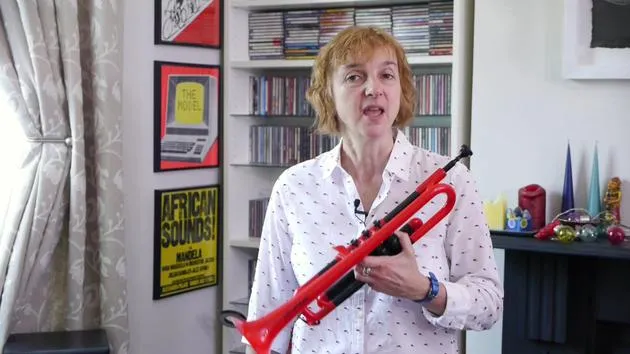
01. Bienvenue dans Are You Ready
1:17
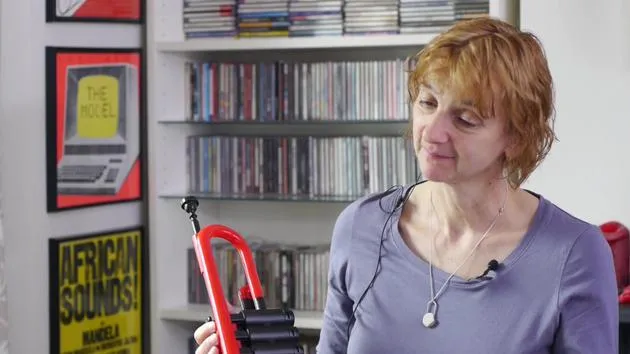
02. I Can Play In Three (interprétation)
1:36
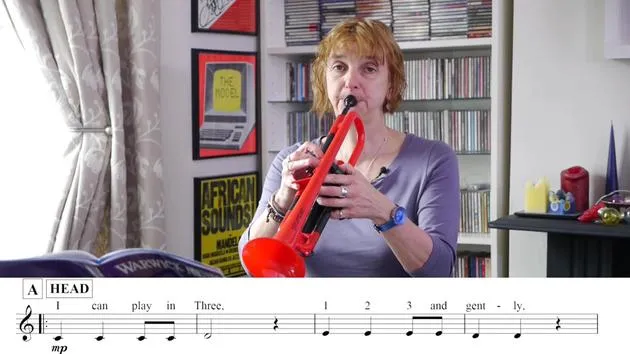
03. I Can Play In Three (analyse)
Leçon gratuite3:16
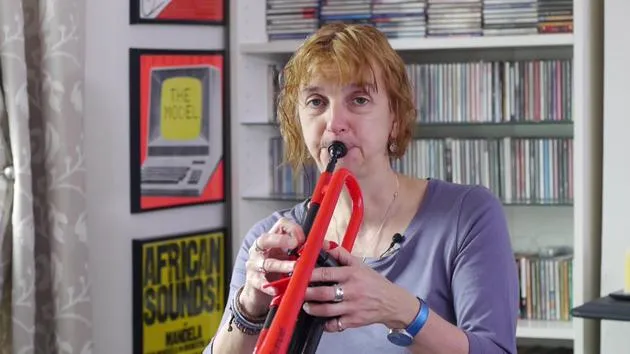
04. How Many Bars in a Blues (interprétation)
1:40
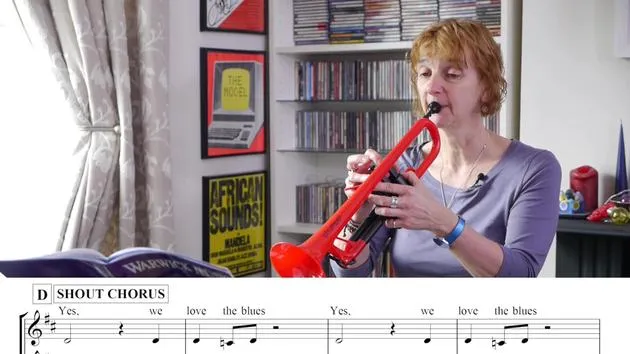
05. Combien de mesures dans un blues (analyse)
Tu es ici6:23
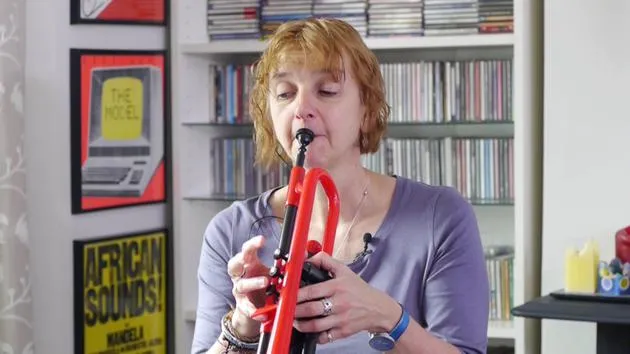
06. Lay Down The Bass (interprétation)
2:51
07. Lay Down The Bass (analyse)
5:01
08. Eastern Promise (interprétation)
2:23
09. Eastern Promise (analyse)
4:40
10. Are You Ready (interprétation)
2:32
11. Are You Ready (analyse)
5:49
12. Scale It (interprétation)
2:48
13. Scale It (analyse)
2:03
14. Question and Answer (interprétation)
2:52
15. Question et réponse (analyse)
6:05
16. Félicitations pour avoir terminé le cours !
0:40
Transcription de la leçon
Music Lesson: Introducing the Note F
Understanding the Scale
So we need to learn F.
- F is going to take us to the fourth note in our scale.
- I say the fourth note because we're counting C as our home note.
- We had B as well, but in this scale, in this piece, we use four notes: C, D, E, and F.
Playing Higher Notes
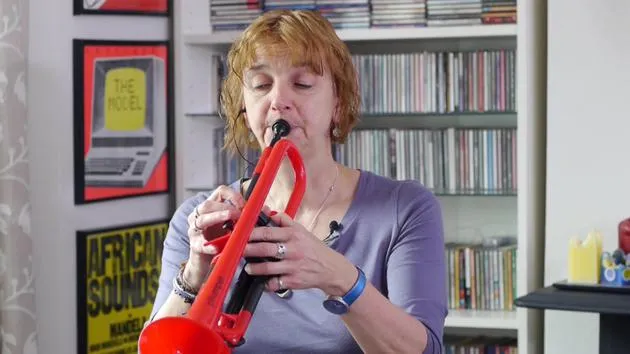
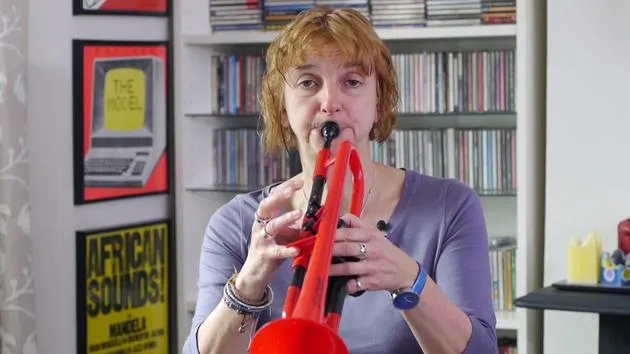
- As we're going higher in our scale or higher in pitch, you need to make your lips a bit tighter.
- Don't forget to always take a good breath before you play.
- If you breathe in really well, you can support the note by blowing out and pushing against your tummy muscles to make a really strong sound, especially on the higher notes as we go up.
Using F on the Instrument
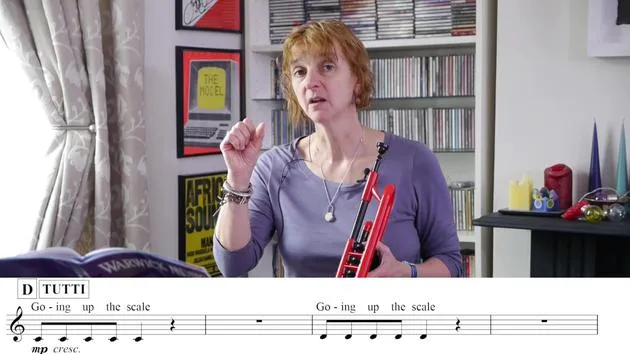
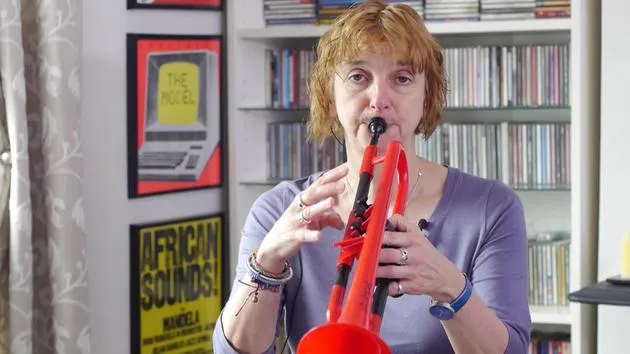
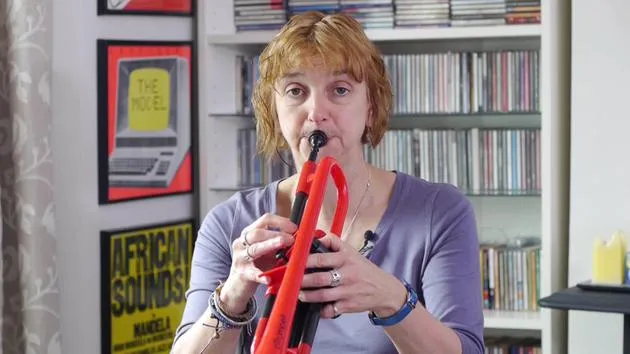
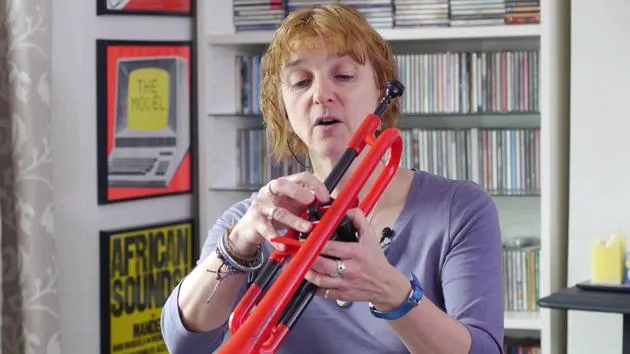
- Use your first valve only for F.
- As I said, lips quite tight.
Try Going Up the Scale
Let's try going up the scale starting from C. Here we go!
The Tune
For this tune, we use the home note of D.
- D is our sort of home base.
- The sound of the tune is based around D, which makes F into a quite a bluesy note, what we call a blues note.
- This is really great in the improvising section.
Notes for Improvisation
- In the improvisation, you can use all of our four notes: C, D, E, and F.
- Let's not use B for this one.
How Many Bars in a Blues?
The tune starts on D.
- How many bars in a blues?
- The answer is 12.
- Very important! There are 12 bars in a blues, or 12 bar blues, using only D and F on that first part of the tune.
Let's just try that together:
- So how many bars in a blues?
- Let's try that:
- 1, 2, 3. The answer is 12.
- Same note starting on D: The answer is 12.
Repeating the Bars
- Get your fingers back down, all the way down.
- Don't forget for the 12.
So how many bars in a blues? The answer is 12.
- That goes around twice.
Note E and Introducing F
Then we have these:
- How many?
- How many on E?
- And then your new note, F.
- The answer is just as before.
Timing and Waiting
Then we wait a bit.
- Don't forget to wait.
- The answer is 12, which is not where you might expect to put that number 12.
- So wait for that little gap.
I'm going to go from how many harmony, starting on E:
- 1, 2, 3, 4, wait.
Great! You put the 12 just in the right place.
Improvisation Section
Now, on the improvising for this, as I said, we're using four notes: C, D, E, and F.
- The C and F are the kind of bluesy notes.
- In this one, the improvisation is 12 bars long and it's really great to just listen to the backing track a few times.
Listening for Chord Changes
See if you can hear where the backing, the chords on the backing on the guitar, change.
Copy Backs
I'm going to do some copy backs for you. Now, of course, you can either use my copy backs for inspiration or you can just make up your own thing.
Now, you're getting quite good at improvising and making up your own tunes.
Example Copy Backs
So here's some copy backs based around the blues:
- One to me first.
- 1, 2, 3. Your turn.
- 1, 2, 3, 4.
- 1, 2, 3.
Structure of the Song
There are two more sections in this song:
- The Head: The bit that sticks in your head, the tune played around twice (How many bars in a blues?).
- The Improvisation Section: Which is 12 bars long and that goes around twice.
Backing Section
Then we have the backing section.
- If there's more than one of you, one of you could play the backings and one of you could do the improvising.
- If you're playing along with the track, you can either play the backings or you can keep on improvising because backings are what we put underneath an improvisation.
The Shout Chorus
You can carry on for a third time round of 12 bars.
Then we have what I call the shout chorus.
- That's the bit at the end.
- This goes around twice and it is: Yes, we love the blues.
Ending Riff
Now, that riff (that really short phrase), goes around:
- 1, 2, 3, 4 times.
Then we have a slightly different piece to end.
Final Playthrough
So I'm just going to play all the way around the last chorus.
- It starts on D with yes, we love the blues.
- And this is four times.
Here we go:
- 1, 2, 3.
So that riff goes around four times.
And then we have:
- Yes, yes, yes, we love the blues.
- And again: yes, yes, yes, we love the blues.
At the end, the guitar goes a bit mad and we call that a rock and roll ending.
So enjoy playing anything you like on the last note.
Final Phrase
I'll just play the last phrase, which is:
- Yes, yes, yes, we love the blues.
- Round twice and I'll show you a rock and roll ending.
Here we go:
- 2, 3, 4.
Enjoy the last note!
16 leçons
0h 51m de leçons vidéo structurées
Fonctions vidéo avancées
Ralentissez, bouclez un passage, suivez la partition
Mobile, tablette et ordinateur
Pratiquez où vous voulez
Satisfaction garantie à 100 %
Garantie remboursement 30 jours
Rencontrez votre guru
Rencontrez votre guru
Kay est trompettiste, compositrice et professeure de cuivres et de musique scolaire, spécialisée dans l'enseignement en classe au primaire - KS2, First Access/WCET (enseignement en ensemble pour toute la classe, où une classe entière apprend un instrument ensemble) et CPD des enseignants (développement professionnel continu). Elle a obtenu en 2018 un master en éducation musicale - 'Teaching Musician' au Trinity Laban Conservatoire.
Kay joue de la trompette au sein du Bollywood Brass Band, une formation de 9 musiciens de cuivres et de percussions dont le CD de 2017 Carnatic Connection a été nommé à un 'World Music Award' du magazine Songlines et a reçu une critique 5 étoiles dans le London Evening Standard. Kay compose et arrange pour le groupe et dirige son travail pédagogique, ayant fondé la Bollywood Brass Academy en 2017.
Kay a présenté ses recherches sur l'enseignement à toute la classe au Music Education Expo et au First Access Forum. Elle a conçu et animé des CPD pour LSO Discovery, Trinity College London, Music Education Solutions et le Bollywood Brass Band, et elle est consultante en éducation pour Warwick Music.
Le recueil de répertoire pour débutants de Kay, 'Are You Ready?', est publié par Warwick Music ; en 2017, Warwick Music et Music Education Solutions ont commandé à Kay des chansons pour un nouveau programme KS1 destiné au pBuzz, qui a été nommé 'Education Resource of 2018' par les 'Education Awards'.
Parmi ses autres publications figurent des pièces pour les programmes de piano Initial (2015/2018) et Grade 1 (2018) de Trinity, Bollywood Blast! (Spartan Press) - une série de méthodes pour cuivres et vents avec pistes d'accompagnement dans un style Bollywood - et Whole Class Bollywood Blast avec David Rose (Bedford Music Hub), destiné aux professeurs de cours instrumentaux en classe entière et incluant un programme Arts Award Discover.
Ses cours MusicGurus t'apportent directement cette expérience de la classe : de ta toute première leçon de trompette jusqu'à deux ensembles de morceaux pour débutants, Kay expose précisément quoi jouer et comment le jouer.







