



¿Qué es una idea?!
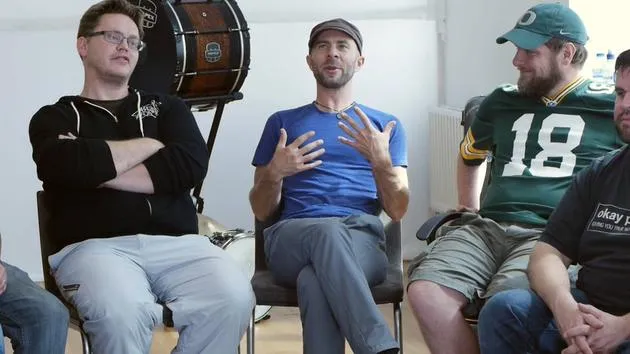
The Youngblood Brass Band desentraña de dónde viene realmente una idea musical, mostrando cómo un solo intervalo -un tritono- se convirtió en todo un tema.
Qué incluye el curso
8 lecciones (1h 4m) · 1 gratis
01. Componer y colaborar
11:54
02. Cómo se escribieron los temas más famosos de Youngblood
8:33
03. Elegir temas para álbumes o directos
6:18
04. Cómo abordar las versiones
8:12
05. Cómo reconocer una "buena idea"
Lección gratis4:44
06. La estructura y cómo convertir ideas en una pieza terminada
8:15
07. ¿Qué es una idea?!
Estás aquí4:17
08. Componer y arreglar para vientos
12:18
Transcripción de la lección
Music Lesson: The Creative Process
Not much. Sometimes, there's a song on the record called Whiskey Tango Foxtrot.
Starting with Space
I just wanted to start with a bass line and a beat that had a lot of space,
that used space a lot more than we had been using. So I wrote.
I started singing beats that I liked. And I think I just... I was just like, "That's what I liked."
That started the song tune I wrote for our Is That a Riot? album called Dead Man Stomping, which Dave ended up putting lyrics over that weren't part of the conversation when I was writing the tune.
I liked the interval of a tritone for some reason at that point.
And so there you go. That was my idea,
it's a song about a tritone.
Reflection on the Tritone
"That's what I started with. That was the idea."
How's it good?
"Sorry? How's it good? The song, the tritone part."
"Well, I can't remember how the bass line goes right now."
"You wrote it."
"He's moved on from tritone."
"But you loved it."
Influence on Writing
For anybody that's new to it, I think, in a way, it won't really be up to you. Whatever you're listening to at that time will bleed into your writing.
And whatever you record,
like, it'll bleed into your outlet.
I don't know. I listened to stuff I wrote maybe six years ago, and I was like, "Oh, yeah, I was listening to that guy a ton."
It's always sort of from your reference library.
I mean, I can out us a little bit. I know that when Is That a Riot? was being recorded, Dave spent the most time in the studio,
he was basically producing the records.
I know he was listening to Tied and Tickled Trio quite a bit at that time, and you can find the thumbprints all over that album.
There's some... You know, we were just loving that sound, and it kind of snuck into it.
Recent Influences
I'd say the latest album, PAX Volume I, Dave listened to a lot more electronic music, and I think that left its print on there.
For all of us, everything we wrote kind of has whatever we're currently into,
your brain's in that mode.
The Nature of Ideas
That's one thing that might be helpful to realize: how few actual unique ideas there are.
Most ideas come from something else that moved you in some way.
Then, you just try to think about what it is about that that moved you and how you can make it different enough that you don't get sued for writing it.
I like to think about, when I write something,
when I write some melody over the top of something,
and realize that the first four notes of it are also in this other song,
or the last four notes of it or something.
I actually love those moments because I feel like maybe that song is in your subconscious somewhere. And it's like you really liked that hook.
But the way you wanted to always hear it was the way you ended up writing this thing.
Originality and Honesty
You always loved the way this progression of notes worked, but you were never sold on the end of the phrase.
You just ended up writing a phrase where you're like, "I love the way this leads into it, but I always wanted to hear that."
And that's kind of like every idea,
there's nothing new.
The only thing that's interesting is the fact that, like, if you're making music that's really honest, it's only going to sound like you.
I guess the only possibly new thing is that everyone is a complete universe in and of themselves.
If you're making music that's honest,
or anything that's really honest,
it's only going to sound like you.
Conclusion: The Culture of Music
I'm so not worried about quoting things or stealing or whatever. It's like, yeah, we're also in a brass band, and that's the name of the game.
Did that sound hot? We should take that eight bars and turn it into this other thing. That's what brass bands do.
Oh yeah, that's part of the New Orleans culture. Everybody plays each other's stuff.
There are like seven different songs that all have the same part A,
that's just how it works together.
8 lecciones
1h 4m de lecciones en vídeo estructuradas
Funciones de vídeo avanzadas
Ralentiza, repite un pasaje, sigue la partitura
Móvil, tablet y ordenador
Practica donde quieras
Garantía de satisfacción 100%
30 días de garantía de devolución
Conoce a tu gurú
Conoce a tu gurú
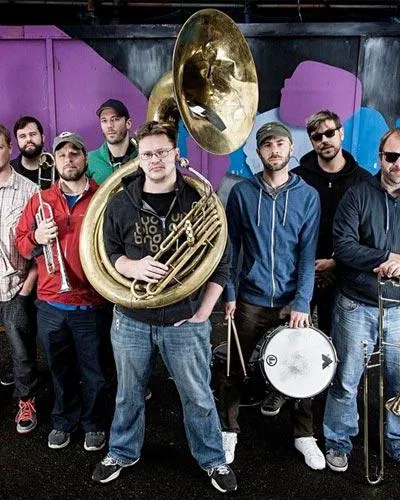
Youngblood Brass Band fusiona los metales sin concesiones de Nueva Orleans con la energía y el lirismo del hip-hop. Procedente de Madison, Brooklyn, Minneapolis y Chicago, este grupo de diez integrantes ha girado por todo el mundo desde 2000 y ha colaborado con figuras como Questlove y Talib Kweli. Se sienten igual de cómodos liderando una banda de marcha con sus propias composiciones que encabezando un festival de punk. En MusicGurus desglosan su sonido que mezcla Nueva Orleans y hip-hop: cómo componen y arreglan para los metales, el vocabulario rítmico y armónico que lo mantiene todo unido, y cómo tocar una línea de viento como parte de una sección compacta, incluidas las partes completas de su tema 'Brooklyn'.







