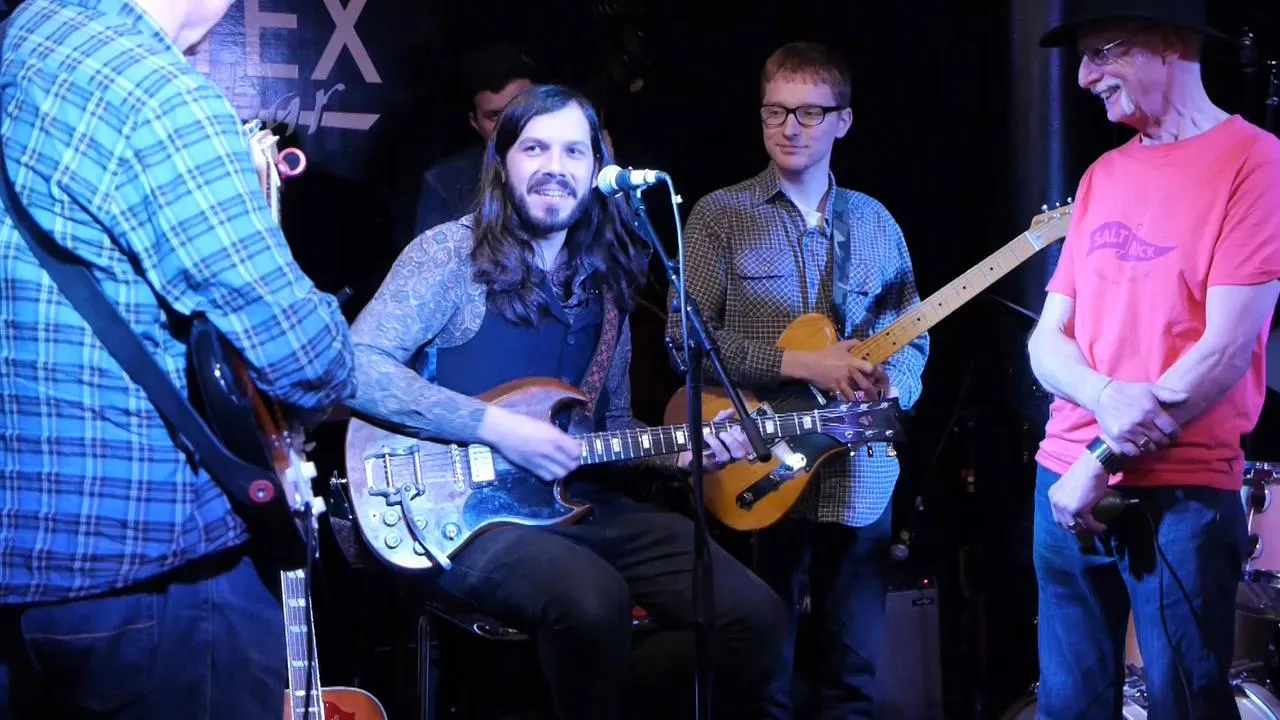
Tercera banda - interpretación
Lesson time: (7min 28sec)
Course preview
This lesson is part of the course Taller de blues en el Vortex de Londres
Watch a preview of the full course below.
Lesson transcript:
Music Lesson
Introduction
No, no, no. I was just saying, like. Yeah, yeah, yeah. That's all part of it.
Establishing the Changes
So, quick change. I'll tell you, it's much better to establish something before playing the song than wait till you're in the middle of it. If there's something important about chord structure or anything.
- Important Note: Never be afraid to say something before it ends, for sure.
Kicking Off the Lesson
All right, so who's gonna kick this off? Which one of you instrumentalists is gonna take off the top?
- Piano Player: What's your name, man?
- Response: Steve.
- Question: Steve, do you want to count it off, or do you want to be like...?
Chord Structure Importance
That's a very important point there. Like, you're saying:
- Is there a quick change to the C in the 12-bar?
- Some blues go to the C after the first bar; some don't.
I know, like, people have been playing blues for a long time. It's a bit of a sticking point like that. If you decide on one thing, that's what it should be for the rest of the tune.
- You don't play it going to the C on 1 and 2, then play without going to the C the next 12.
- It's sort of... yeah, it's just one of those things you don't do.
If you don't establish it, what happens in the first round is that half the band thinks, "Oh God, I'm wrong." And then the other half does the same thing.
It happens again and again, and then it's like you said: it gets there eventually, but you want to get there from the start.
Establishing the Form
So, should we just all in on the form?
- First of all, I think, because "Storming Monday" does have...
- Are we going to do those extra changes, the G to the A minor?
What we have with you is good to establish that everyone knows the sort, first of all. So is it?
- Response: Yeah, exactly.
If you don't... no harm in sitting the first chorus out and getting the form.
- It's got a few little substitutions, a little climb up, and a diminish.
- But like I said, if you don't know the sequence, maybe the good idea is just to sit the first chorus out, have a little listen, and go, "I gotcha."
Then you're in. Do you know what I mean? Because then you get to enjoy it a bit more because you know what you're dealing with in a situation like this.
- If I was in this right now, I would say to you, why don't you take it around once, and then we'll come in.
That is a way that everyone can get the chord sequence.
Taking Turns
So the piano player is going to take a 12-bar round on his own, and we're all going to have a little listen. Then we're going to have that chord sequence for us all to come in.
And that's how I would sort of approach this.
Take It Away, Steve!
I said, "So long, darling, I shot him."
Here to see you go all the ways I could have loved you.
- Well, honey, honey, I guess you never know there's that kind of...
For the vocals when he's singing, you could keep it down when you sing.
- Open up right now.
If I didn't quite get the ending of the solo, I'd probably just introduce him to make it allow he didn't mess up:
- Steve on the piano: I said, "You once loved me, and now it seems to have changed your mind."
I'm gonna cue the ending.
- "Boy, I want you to reconsider, my darling. Just give yourself a little more..."
Well played, boys!