



The 5.55 (lección)
En esta lección, Laurence Juber te enseña a tocar su tema "The 555" en la guitarra acústica.
Qué incluye el curso
12 lecciones (1h 22m) · 1 gratis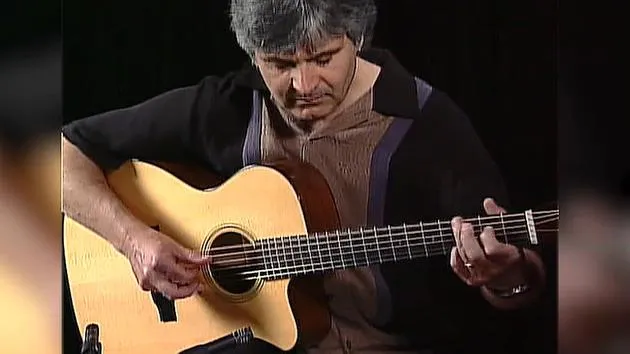
01. Cobalt Blue (interpretación)
3:20
02. Cobalt Blue (lección)
Lección gratis10:18
03. The White Pass Trail (interpretación)
4:58
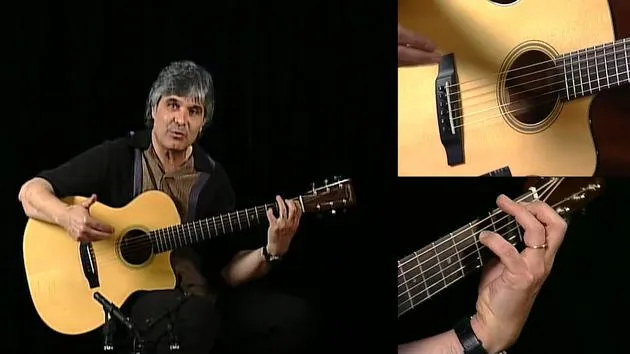
04. The White Pass Trail (lección)
10:17
05. Breaking Point (interpretación)
3:28
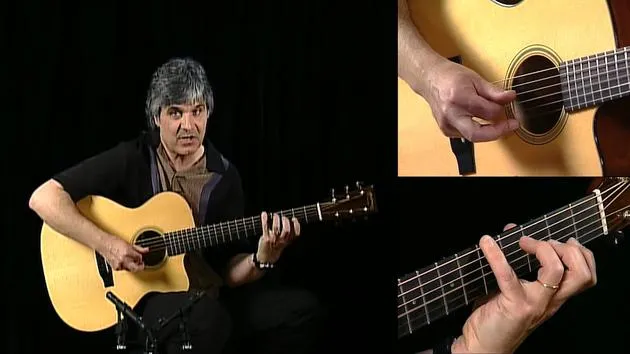
06. Breaking Point (lección)
8:35
07. Buffalo Nickel (interpretación)
3:41
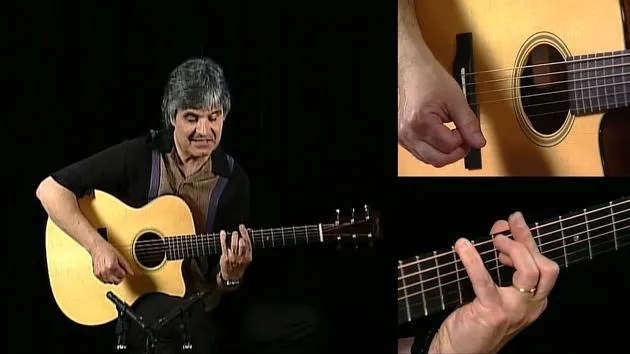
08. Buffalo Nickel (clase)
10:29
09. Catch (interpretación)
3:31
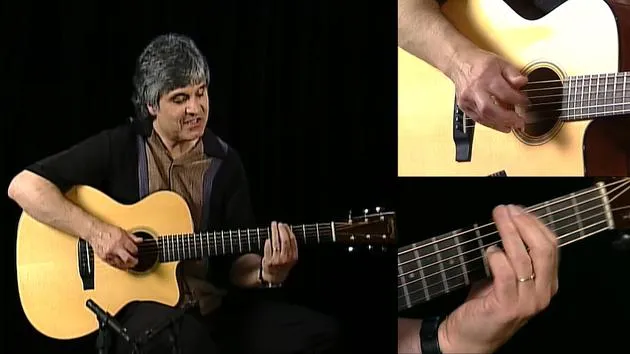
10. Catch (lección)
10:38
11. The 555 (interpretación)
2:49
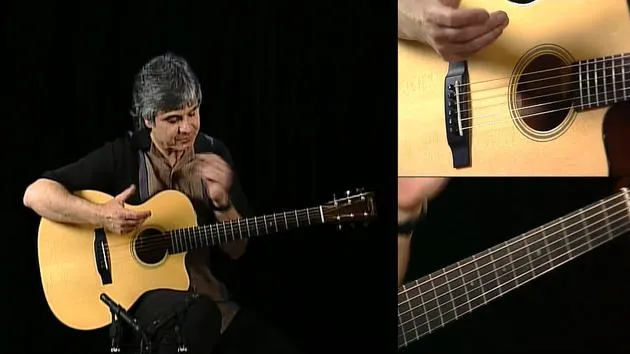
12. The 5.55 (lección)
Estás aquí10:44
Transcripción de la lección
Music Lesson: The 555 in E Minor
So, working on the 555, we're in standard tuning and it's in the key of E minor.
Introduction to Chords
We're starting off with:
- E minor chord
- Alternating with C7 chord
- Then moving to a cowboy B7 shape
There's a little bit of a lick in between. I do this two different ways:
- Coming off the C7 chord
- Repeating in the second verse
Right Hand Technique
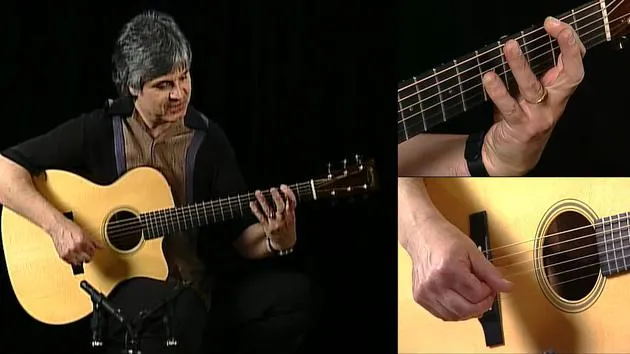
You might just want to look at the right hand here:
- I'm just rolling through the chord like that: B7.
Now, walking up to a G chord (although actually, there's no B in there), transitioning to a:
- G5 to D
- A minor
- E minor
Complex Chords
It gets a little interesting here:
- I've got an A minor A7 chord, but I'm also throwing in the D melody note.
Melody Structure
The melody goes:
- C, D, E, and then moving to a B minor 7 (although that really is actually A; it's more like a G over B).
Next, we have:
- C# minor 7 flat 5.
Voicing Technique
The cool thing about that chord is that you can actually voice it with just one fretted note:
- C# here
- G (the flat 5)
- B (the minor 7)
- E (the minor 3rd)
Because those strings are open, my melody goes: G, F#, E. Everything keeps ringing.
Cascading Patterns
These cascading patterns aren't exclusive to DADGAD tuning at all. You can do this kind of thing in standard tuning as well.
For example:
- There's a little cascade there (kind of a faux cascade) trying to make it smooth.
- Coming down on that B note and then sliding backwards to G major.
Chord Progressions
Then moving on to:
- C major 7.
It's kind of tricky because there's no third in that chord until I articulate it as a melody note.
- B7#9 to flat 9 to B natural.
So there's my melody:
- Now transitioning to E minor to A7.
Melody Integration
In contrast to the section where I'm playing basic cowboy shapes, I incorporate melody notes into a more complex texture:
- Walking up from A minor to D and then to B7 (just a B over D#).
Advanced Chords
Now to a G chord without mentioning any copyright control tunes, but the ones that move around in tenths:
- E flat 9 to D9 to G.
There's also an F#.
Alternative Voicings
Here, C# minor 7 flat 5 can be a straightforward one-note chord. But if I raise the melody notes an octave, I get this voicing:
- F# minor 7 flat 5 to B.
I'm playing around with G major and E minor harmonically.
Returning to E Minor
You might think I'm going to E minor from the B chord, but I actually go to G and then a different voicing of C# minor 7 flat 5, which contains:
- C#
- G
- E
- G on top.
Licks and Solos
I have this little lick that goes in there and then back to the head.
The second turn ends with a little extension. It's actually a C7 chord, voiced a bit differently:
- Normally you'd play it like this.
- Here I'm using a couple of open strings and then a B7 throwing in an open E melody note and transitioning to B flat 7.
Bass Lick and Improvisation
After that:
- Moving down to AB7, then back up again to B and then a bass lick.
Now, I've got an improvised solo where I'm kind of playing off this bass line and some licks in E and E minor.
Favorite Licks
That's one of my favorite swing licks in E minor because it's a cascade:
- E, F#, G, B, D#, E.
So everything kind of rings, alternating between an E minor chord and a C7 chord.
Solo Section
The solo section might go something like this:
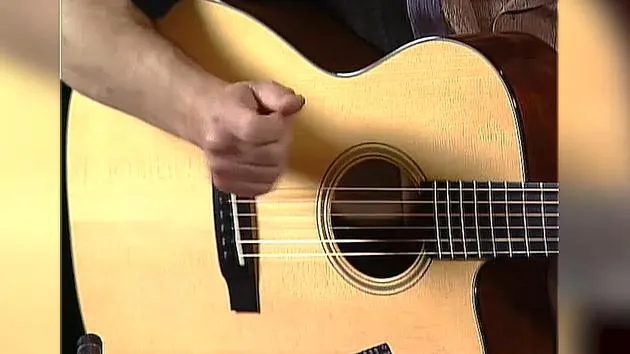
- Notice I'm muting using the palm of my hand to mute with the right hand to give that kind of upright bass feel.
It's a bit challenging to mute and keep the melody going simultaneously, but once I get the melody worked in, I kind of come off of that.
Returning to the B Section
Now I'm going to go back to the B section with the simple cowboy chords and the cascades, then back to the top.
After playing the verse through a couple of times, it will return to this pattern:
- Using the pickless pick technique with a little strum here.
Final Chord Progression
It's a little tricky here:
- A7, but with a little F# note thrown in, creating another cascade.
- Then transitioning to a jazzy seventh chord progression up to the top.
Finally, I'll play that last lick for you:
- Also a cascade, ending with a harmonic and a little virtual whammy bar.
So, there's the 555!
12 lecciones
1h 22m de lecciones en vídeo estructuradas
Funciones de vídeo avanzadas
Ralentiza, repite un pasaje, sigue la partitura
Móvil, tablet y ordenador
Practica donde quieras
Garantía de satisfacción 100%
30 días de garantía de devolución
Conoce a tu gurú
Conoce a tu gurú
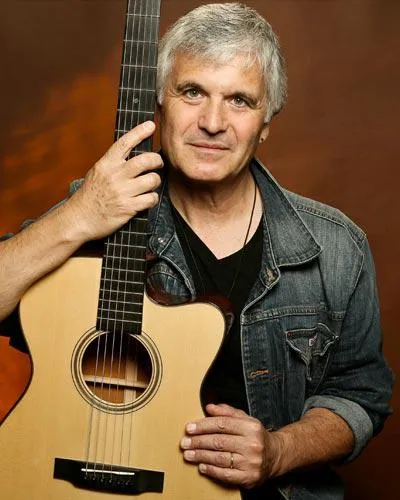
Laurence Juber se dio a conocer primero como guitarrista principal de Wings, la banda de Paul McCartney. Desde entonces ha construido una carrera como guitarrista fingerstyle, compositor y arreglista, trabajando en gran medida con la afinación DADGAD, que le valió el apodo de 'the Duke of DADGAD'.
Los lectores de Fingerstyle Guitar Magazine lo han votado Guitarrista del año, y la revista Acoustic Guitar lo ha incluido entre los mejores guitarristas, junto a una larga lista de álbumes en solitario y giras por todo el mundo.
En sus cursos enseña su técnica fingerstyle y la afinación DADGAD por la que es conocido, cómo combinar melodía, armonía y bajo en un arreglo para guitarra sola, y las piezas -como su emblemática 'Wooden Horses'- que lo reúnen todo.







