



Cobalt Blue (lección)
En esta lección, Laurence Juber te enseña a tocar su tema "Cobalt Blue" en la guitarra acústica.

Qué incluye el curso
12 lecciones (1h 22m) · 1 gratis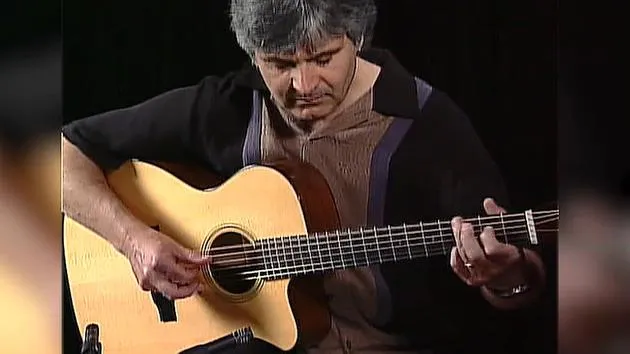
01. Cobalt Blue (interpretación)
3:20
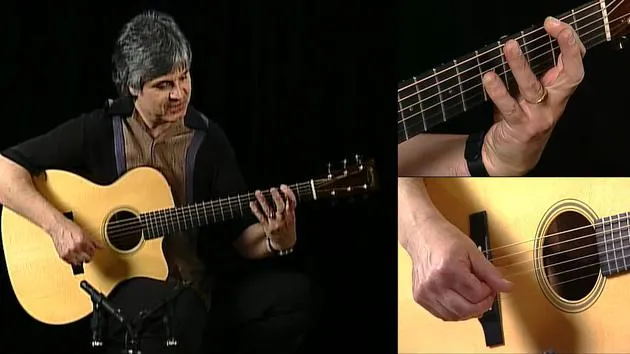
02. Cobalt Blue (lección)
Estás aquí10:18
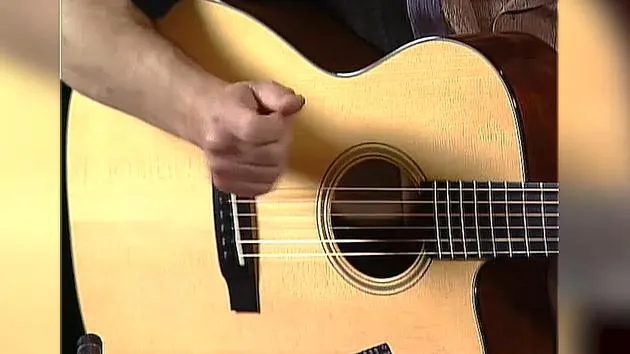
03. The White Pass Trail (interpretación)
4:58
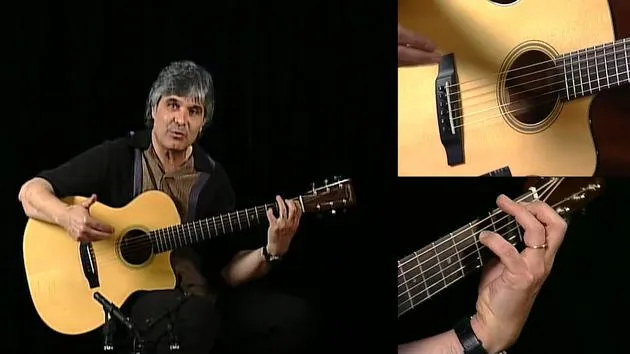
04. The White Pass Trail (lección)
10:17
05. Breaking Point (interpretación)
3:28
06. Breaking Point (lección)
8:35
07. Buffalo Nickel (interpretación)
3:41
08. Buffalo Nickel (clase)
10:29
09. Catch (interpretación)
3:31
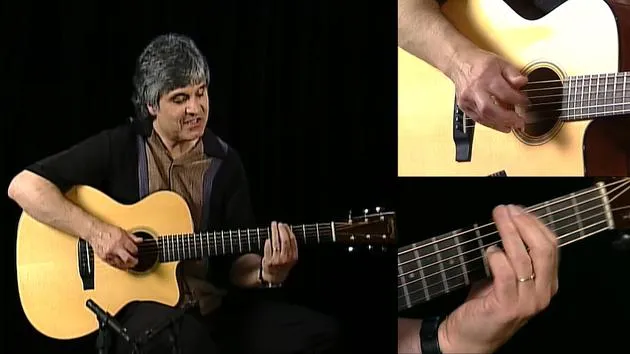
10. Catch (lección)
10:38
11. The 555 (interpretación)
2:49
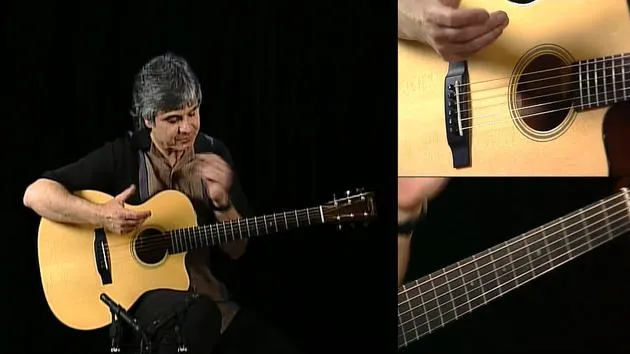
12. The 5.55 (lección)
10:44
Transcripción de la lección
Cobalt Blue Music Lesson
Introduction
So we're going to jump into Cobalt Blue, which opens up with this riff.
Riff Breakdown
- The first thing I do is hit it once with the right hand using the side of the thumb, a little thumb slap.
- With the left hand, I have a double stop hammer and pull:
- Hit the open string.
- Hammer on to the second fret on strings six and four.
- Pull off, then do the same on the third fret, using my pinky.
I'm kind of cheating a little bit because I'm really covering three strings with that.
The whole phrase then repeats to establish the feel.
Moving into the Verse
- I'm keeping the bass riff going on a single string while adding the melody on top.
- I start with a bend on the second string.
Technical Point
- I'm in Dad Gad tuning, so the string is a little looser, which gives me more flexibility.
- When I hit the fourth string, I bend it up just a little bit, not a full bend.
Chord Transition
- Now I'm moving to the V chord (the A chord).
- This part gets tricky because I'm holding down that note and doing more hammers and pulls.
- Important: When performing a hammer or pull-off, it's always a strong, precise move.
- A pull-off isn't just lifting your finger off; you really do pick the string with your left hand.
Transitioning Back
- Moving into that phrase and then back to the one chord can be tough because I'm doing hammers and pulls at the fifth fret.
- Let's back up into that and get this nice sus chord here.
Octaves
- Very important in Dad Gad tuning is the ability to get these octaves because you have 3D strings and 2A strings, allowing you to create different phrases.
Playing the Whole Phrase
- Let me play the whole phrase for you:
- From the one chord to the V chord and then back to the riff.
- The second time this happens, the phrase extends. Instead of just starting the phrase, I go further up the neck, introducing more octaves.
Getting Tricky
- Now we move right up to the 12th fret. It starts with a slide using my pinky.
- Harmonically, what's happening there is a thick line:
- Rather than playing a regular chord, I'm moving this thickened line with a sus4.
- For example, I have a G, an A, and a D.
Back to the Riff
- Keeping that thick line going, we return to the riff.
B Section
- Moving into the B section (bridge section), I have some chords from the B flat to the A, which is the flat six to the five.
- There's a little lick that comes in:
- Notice it's all hammers and pulls.
- More hammers with a 12th fret finger slap.
Transition to the Five Chord
- Now, I hammer on with my right hand using my first and second fingers.
- I still have the same riff going on but moved up to the V chord, then back to the melody.
Solo Section
- As I get to the solo section, I return to the opening riff.
- I add some percussion here, getting the coordination between the two.
Playing Octaves
- I head into some octaves for the solo.
- Then I play all three strings, starting with the bottom string.
Slowing Down
- I'll do that again slowly.
- From there, it goes back into the B section.
- Here, I do a little percussive thing and then back to the tune, slowing it down.
Turnaround
- You can see how the parts fit together. There's a little turnaround, which leads back to the riff at the end.
Augmentation Techniques
- I augment it by using an upstroke with the back of the thumbnail.
- This technique allows you to achieve both the rhythmic strumming with the right hand and the hammers and pulls with the left hand.
Questions
Any questions about that? I think we've pretty much covered all the bits.
Additional Comments
- Just a couple of notes on the harmonies.
- They aren't straight major or minor chords.
- Because Dad Gad has this kind of floating fourth, it allows chords that may not fully articulate as major or minor.
- For example, it's like a C add 2 over an E or an F chord, which consists of an F, a C, a D, and a G, there's no third in it.
This creates a nice floating, semi-jazzy feel to it.
That's Cobalt Blue for you!
12 lecciones
1h 22m de lecciones en vídeo estructuradas
Funciones de vídeo avanzadas
Ralentiza, repite un pasaje, sigue la partitura
Móvil, tablet y ordenador
Practica donde quieras
Garantía de satisfacción 100%
30 días de garantía de devolución
Conoce a tu gurú

Conoce a tu gurú
Laurence Juber se dio a conocer primero como guitarrista principal de Wings, la banda de Paul McCartney. Desde entonces ha construido una carrera como guitarrista fingerstyle, compositor y arreglista, trabajando en gran medida con la afinación DADGAD, que le valió el apodo de 'the Duke of DADGAD'.
Los lectores de Fingerstyle Guitar Magazine lo han votado Guitarrista del año, y la revista Acoustic Guitar lo ha incluido entre los mejores guitarristas, junto a una larga lista de álbumes en solitario y giras por todo el mundo.
En sus cursos enseña su técnica fingerstyle y la afinación DADGAD por la que es conocido, cómo combinar melodía, armonía y bajo en un arreglo para guitarra sola, y las piezas -como su emblemática 'Wooden Horses'- que lo reúnen todo.







