



The Crow's Nest
Laurence Juber repasa las técnicas detrás de su pieza de fingerstyle The Crow's Nest: el patrón de púa de movimiento perpetuo y su forma de rasguear con las uñas, en guitarra acústica.
Qué incluye el curso
14 lecciones (1h 33m) · 1 gratis
01. Enough Is Never Enough
8:12
02. Guitar Noir
5:34
03. The Crow's Nest
Estás aquí5:15
04. Maple Avenue Strut
9:05
05. The Ornament Waltz
10:38
06. Rufus
7:19
07. Highway 17
8:38
08. Being Here With You
4:51
09. Wooden Horses
7:42
10. Double Agent
7:01
11. Shebeg & Shemore
4:44
12. Around The Block
6:39
13. Portobello Road
6:28
14. Reflexiones finales
1:03
Transcripción de la lección
Lesson Overview: "Crow's Nest"
So next up on the album is a tune called Crow's Nest. For licensing reasons, I'm not able to give you an in-depth breakdown of the tune, but I will discuss some of the techniques involved.
Perpetual Motion Energy
- This tune has a kind of perpetual motion energy to it; it doesn't really stop very often.
- There's a basic pattern:
- You're picking out a melody with the thumb.
- Then, with the index and middle fingers, you're carrying the extra sixteenth notes that keep the momentum going.
For example, on a scale, that would be the approach.
Strumming Techniques
- There are places with strums and melodies that are harmonized, let's say here in thirds.
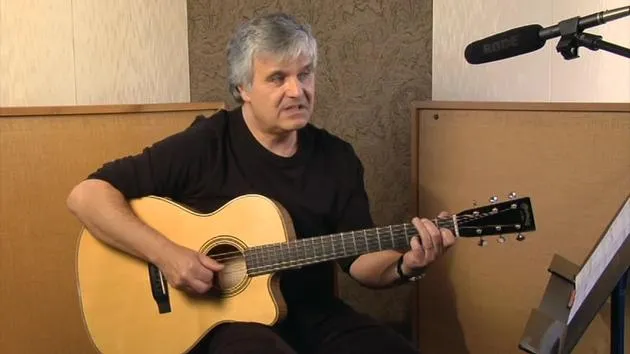
- When I strum, I use the backs of my fingernails for both up and down strokes:
- The upstroke comes with the back of the thumb.
I don't use my fingernails for much else, but I do for strumming.
Analyzing Chord Sequences
I recommend looking closely at some of the chord sequences because:
- Although there's a lot that really sits on a kind of drone, there are other spots, for example, the sequence starting at measure 17, where I have some progressions that follow chord sequences without fully articulating a chord.
Notable Measures:
- In measures 20 and 21, it transitions from 6/8 to 5/8 and then back to 4/4:
- 6/8: 1, 2, 3, 4, 5, 6
- 5/8: 1, 2, 3, 4, 5
- 4/4: 1, 2, 3
- It's tricky because you could think of it almost as 12/16:
- 1, 2, 3, 4, 5, 6, 7, 8, 9, 10, 11, 12
But I'm counting it instead as 1, 2, 3, breaking it down to half speed. You'll figure that out from the recording. Just observe what's going on with the harmonies.
Key Progressions
In measure 25, take note of these chord transitions:
- A minor to G over B
- G minor to D over A
- One of my favorite progressions is a diminished chord, in this case, a G sharp diminished in measure 26, transitioning to an A7B9 to D.
Pay attention to the underlying chords.
High Neck Technique
Another point of interest is in the bridge section, bottom system, measure 51:
- I'm moving to a G chord but playing it high up the neck.
- This G here on the fifth string is the same note as the open G string.
- What you get is a G but broken up with this perpetual motion concept.
Conclusion
Well, good luck with that one! It was originally written for guitar and string quartet, and I've adapted it for solo guitar. Pay attention to what's on the recording.
14 lecciones
1h 33m de lecciones en vídeo estructuradas
Funciones de vídeo avanzadas
Ralentiza, repite un pasaje, sigue la partitura
Móvil, tablet y ordenador
Practica donde quieras
Garantía de satisfacción 100%
30 días de garantía de devolución
Conoce a tu gurú
Conoce a tu gurú
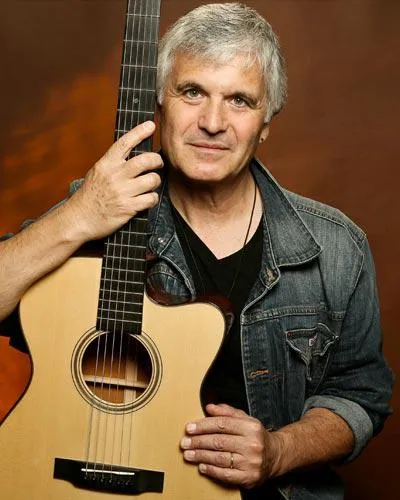
Laurence Juber se dio a conocer primero como guitarrista principal de Wings, la banda de Paul McCartney. Desde entonces ha construido una carrera como guitarrista fingerstyle, compositor y arreglista, trabajando en gran medida con la afinación DADGAD, que le valió el apodo de 'the Duke of DADGAD'.
Los lectores de Fingerstyle Guitar Magazine lo han votado Guitarrista del año, y la revista Acoustic Guitar lo ha incluido entre los mejores guitarristas, junto a una larga lista de álbumes en solitario y giras por todo el mundo.
En sus cursos enseña su técnica fingerstyle y la afinación DADGAD por la que es conocido, cómo combinar melodía, armonía y bajo en un arreglo para guitarra sola, y las piezas -como su emblemática 'Wooden Horses'- que lo reúnen todo.







