



Maple Avenue Strut
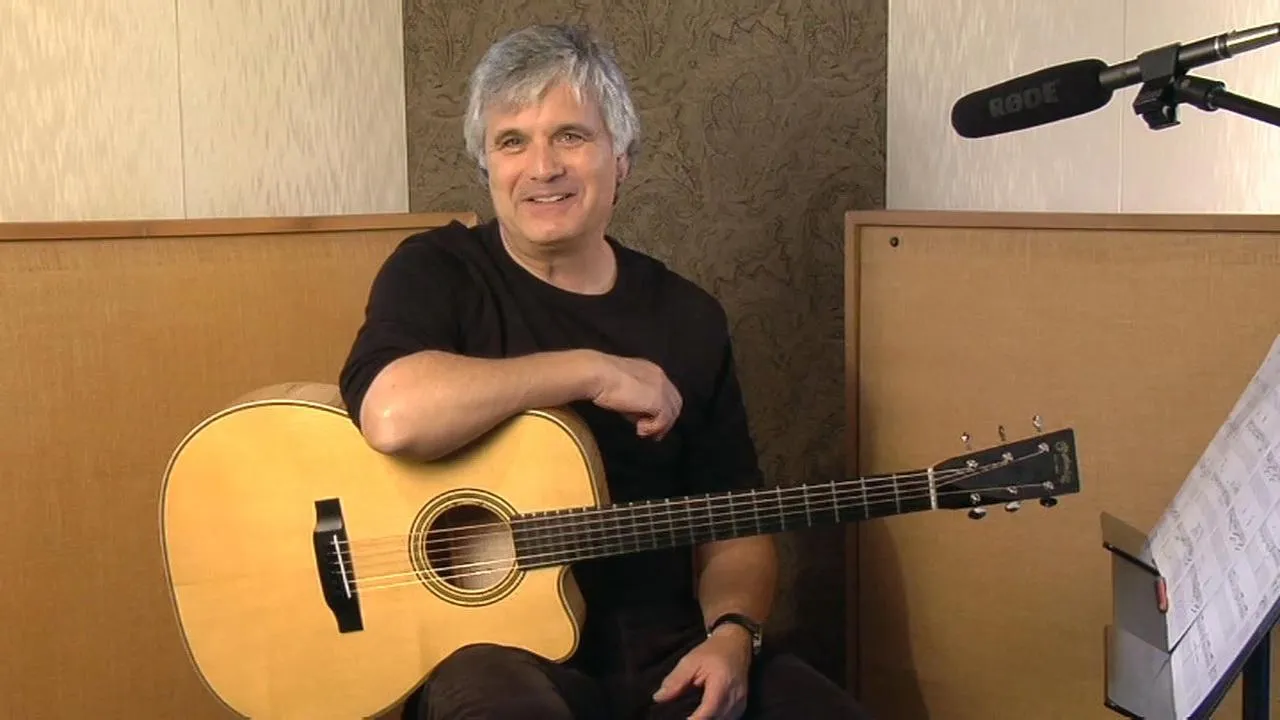
En esta lección, Laurence Juber te enseña a tocar su tema Maple Avenue Strut en la guitarra acústica.
Qué incluye el curso
14 lecciones (1h 33m) · 1 gratis
01. Enough Is Never Enough
8:12
02. Guitar Noir
5:34
03. The Crow's Nest
Lección gratis5:15
04. Maple Avenue Strut
Estás aquí9:05
05. The Ornament Waltz
10:38
06. Rufus
7:19
07. Highway 17
8:38
08. Being Here With You
4:51
09. Wooden Horses
7:42
10. Double Agent
7:01
11. Shebeg & Shemore
4:44
12. Around The Block
6:39
13. Portobello Road
6:28
14. Reflexiones finales
1:03
Transcripción de la lección
Maple Avenue Strut: Swing Tune Overview
Introduction to the Tune
So, Maple Avenue Strut is a swing tune. All the eighth notes are swung in the music, even though they're written out straight. That's just a convention.
- Intro: There's a little intro, and then it goes into the main section.
- Technique: Notice what I'm doing here. I got an E69. By the way, I'm in standard tuning, so you should recognize some of the shapes.
Playing Techniques
- E69 sliding up to a different voicing of E69.
- The whole thing is played with my thumb using all downstrokes, then doing some up and down strokes.
It's hard to slow down because it's one of those licks that happens quickly. You slide down at the right tempo.
Main Chord Progression
Now, heading into the tune at measure 13:
- I have an E6 chord. All the fingerings are indicated in the music, so pay attention to what's on the page.
- I'm hitting that chord with a slide into it, followed by an open string.
When I go to the A7 chord (the 4 chord in E):
- G sharp minor 7, flat 5 to a C sharp 7.
- Let's go through that slowly:
- From the last eighth of 16:
- F sharp minor
- E add nine over G sharp
- A major seven (different voicing)
- C nine over an E
- From the last eighth of 16:
Again, I'm bouncing off the open string there.
- G sharp minor 7
- G minor 7
Just moving down chromatically. Watch what happens here again, using the open string in the middle of a lick.
Repetition and Variations
When that section repeats the last time around, you'll find, like in measure 24, I occasionally use smaller notes, like cue notes, to indicate a strum that isn't necessarily a permanent part of the composition but helps keep the groove going.
This adds a little bit of rhythm here or there, which is always very important with this style.
Transitioning to the Bridge
Moving into the bridge at measure 25:
- I've got the same inside first inversion of a 9, followed by a lick.
- Most of these licks are improvised.
Now watch this diminished (augmented) in measure 32, just moving down on a whole tone scale. An augmented chord goes along with a whole tone scale.
Key Change and Chromatic Movement
I'm moving into the key of G at measure 33. It gets a little more rhythmic here.
Let's break it down in measure 35:
- Basically, the chords are moving down chromatically.
- I'm throwing in some rhythm stuff in the middle too to keep the momentum.
Page Turn and Sequence Review
Hang on, I got a page turn. Let me set that out. There we go.
- That's the sequence going from measures 41 through 48.
- Let me play that one more time. I'm sorry, one more time. And then back to the top.
We've covered all that.
Final Thoughts on Improvisation
The other thing to be aware of is that the last time around, it does a little extension and then returns to that intro figure.
When you're improvising over these chords, it's important to break it down into the basic chord sequence of:
- E
- A
- E
- C sharp
- F sharp
Notice the cyclo-fifth progression: C sharp going to F sharp, going to B, going to E.
In the middle section, over the A chord, I move onto a G section:
- I tend to get a little more chordal in that section.
This is so I'm not just playing post-bebop lines all the way through but breaking it up a bit.
Chordal Techniques
I could give you a whole video on chord solos, but not yet. I find that being able to play around the chords gives you a thicker line that maintains momentum and provides a larger texture than simply playing single lines.
For soloistic guitar stuff, it really helps fill things out quite a bit.
Conclusion
The last chord can give it a little bit of juice, and you can even extend it a little bit.
And that's Maple Avenue Strut!
14 lecciones
1h 33m de lecciones en vídeo estructuradas
Funciones de vídeo avanzadas
Ralentiza, repite un pasaje, sigue la partitura
Móvil, tablet y ordenador
Practica donde quieras
Garantía de satisfacción 100%
30 días de garantía de devolución
Conoce a tu gurú
Conoce a tu gurú
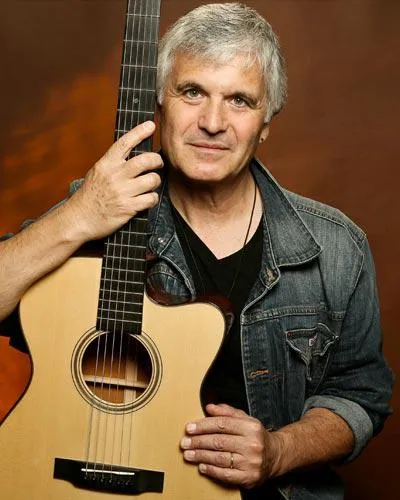
Laurence Juber se dio a conocer primero como guitarrista principal de Wings, la banda de Paul McCartney. Desde entonces ha construido una carrera como guitarrista fingerstyle, compositor y arreglista, trabajando en gran medida con la afinación DADGAD, que le valió el apodo de 'the Duke of DADGAD'.
Los lectores de Fingerstyle Guitar Magazine lo han votado Guitarrista del año, y la revista Acoustic Guitar lo ha incluido entre los mejores guitarristas, junto a una larga lista de álbumes en solitario y giras por todo el mundo.
En sus cursos enseña su técnica fingerstyle y la afinación DADGAD por la que es conocido, cómo combinar melodía, armonía y bajo en un arreglo para guitarra sola, y las piezas -como su emblemática 'Wooden Horses'- que lo reúnen todo.







