



Rufus
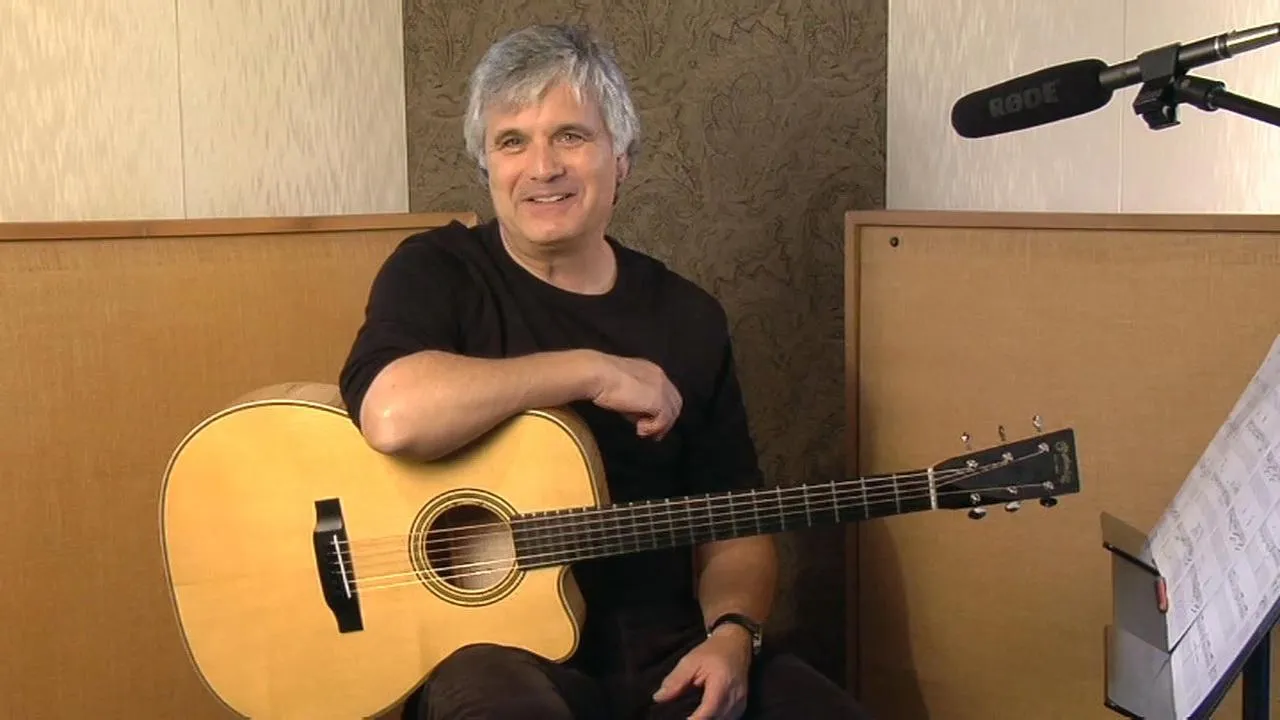
En esta lección, Laurence Juber te enseña a tocar su tema Rufus a la guitarra acústica.
Qué incluye el curso
14 lecciones (1h 33m) · 1 gratis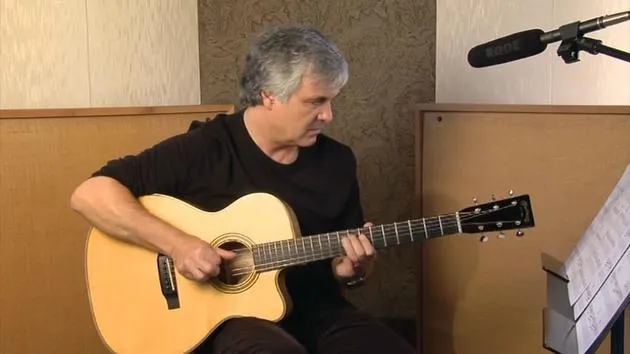
01. Enough Is Never Enough
8:12
02. Guitar Noir
5:34
03. The Crow's Nest
Lección gratis5:15
04. Maple Avenue Strut
9:05
05. The Ornament Waltz
10:38
06. Rufus
Estás aquí7:19
07. Highway 17
8:38
08. Being Here With You
4:51
09. Wooden Horses
7:42
10. Double Agent
7:01
11. Shebeg & Shemore
4:44
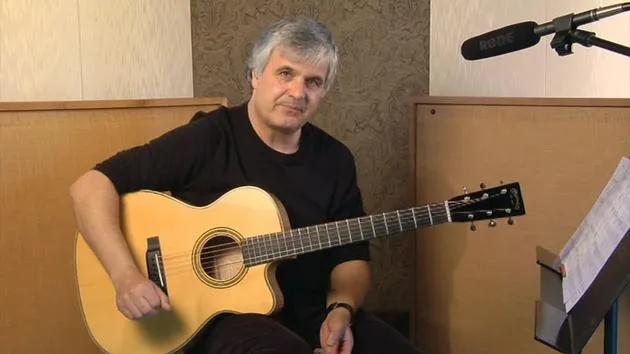
12. Around The Block
6:39
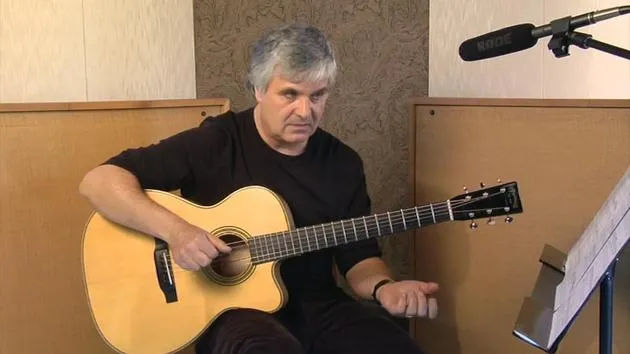
13. Portobello Road
6:28
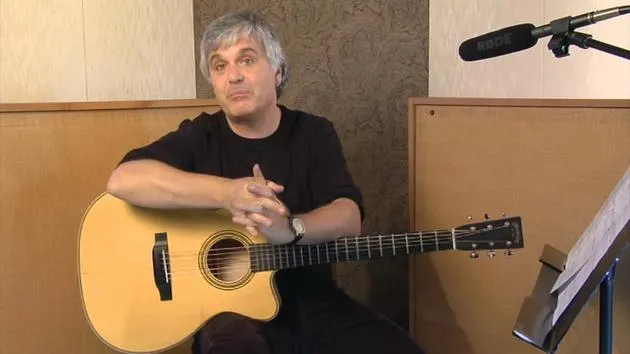
14. Reflexiones finales
1:03
Transcripción de la lección
Music Lesson: Key Changes and Riffs
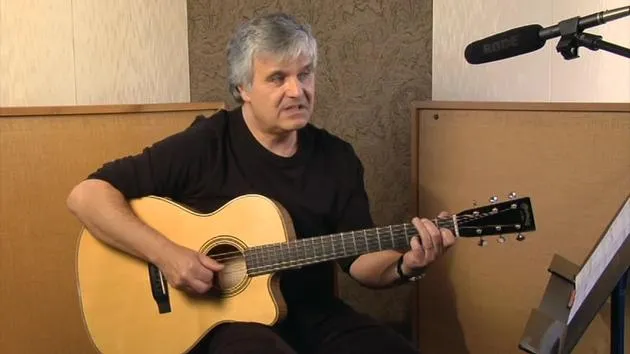
Okay, Rufus, I'm in DADGAD. This piece is actually in a couple of keys:
- Starts in E minor
- Ends up in C
Opening Voicing
The opening features a very rich E minor voicing:
- Voicing: Two open strings (E minor 9)
- Movement: Moves up one fret to the F6sus2
- Transition: The F6 slides back to the third fret version of an F.
Riff and Rhythm
Now we've got the riff, which I'm muting slightly.
- I'm also doing a little bit of a light backbeat just with my palm.
- Technique: It's really more than the palm; it's almost the weight of the fist.
This creates a combination of:
- Palm mute
- Groove backbeat
When the melody kicks in at 13, you can still hear the bass line underneath.
"Let me play that again."
Key Change
This is where I change key.
- New Chord: D minor 9
- Technique: Everything is played across the strings.
- Next Chord: E minor 7 flat 5
Notice that:
- There's a little inner voice happening.
- It then returns to the riff.
Chorus Dynamics
Observe how, when I play that chorus, the combination of:
- Staccato chords
- Sustained chords
- Backbeat slaps
gives the piece its groove and momentum.
Solo Section
The second time around the chorus repeats and goes into a riff section for solos.
Key Components to Note:
- Chords: E minor moving to an F
- Modality: This is really kind of a Phrygian mode with the E; the F being the minor second of the scale.
Additionally, I've got:
- The bluesy flat 5 (B flat on the E)
- When I go up to the F, I keep that bluesiness in there.
Remember:
- The B is also part of the E minor scale, so it remains within the E minor modality.
I'm sticking pretty close to this shape.
- Maybe I'll go to some octaves or something like that, but the key point is to watch out for how everything can happen in this position.
Conclusion
You don't need to go up the neck to play over these particular chords.
- Last time around: It just walks down to the D, goes back to the chorus, then to the sign, and plays through.
To bring it all together:
- After you've played the solo section, play through the melody once, then just the first two bars of the melody before you end it.
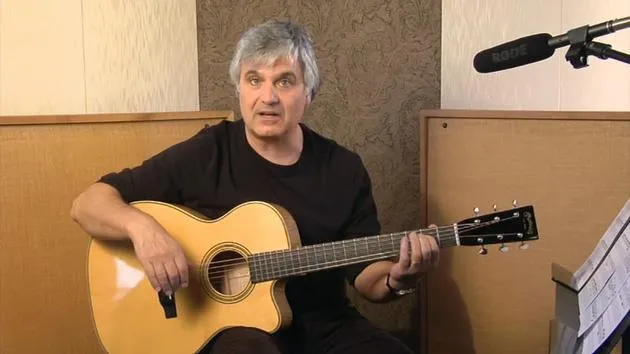
"And that's Rufus."
14 lecciones
1h 33m de lecciones en vídeo estructuradas
Funciones de vídeo avanzadas
Ralentiza, repite un pasaje, sigue la partitura
Móvil, tablet y ordenador
Practica donde quieras
Garantía de satisfacción 100%
30 días de garantía de devolución
Conoce a tu gurú
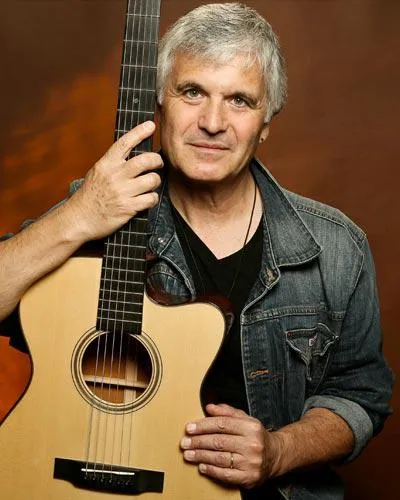
Conoce a tu gurú
Laurence Juber se dio a conocer primero como guitarrista principal de Wings, la banda de Paul McCartney. Desde entonces ha construido una carrera como guitarrista fingerstyle, compositor y arreglista, trabajando en gran medida con la afinación DADGAD, que le valió el apodo de 'the Duke of DADGAD'.
Los lectores de Fingerstyle Guitar Magazine lo han votado Guitarrista del año, y la revista Acoustic Guitar lo ha incluido entre los mejores guitarristas, junto a una larga lista de álbumes en solitario y giras por todo el mundo.
En sus cursos enseña su técnica fingerstyle y la afinación DADGAD por la que es conocido, cómo combinar melodía, armonía y bajo en un arreglo para guitarra sola, y las piezas -como su emblemática 'Wooden Horses'- que lo reúnen todo.







