



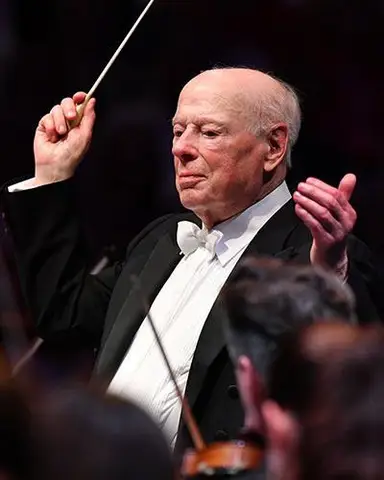
Andante - Bernard Haitnik ofrece su análisis y comentarios a Timothy Henty
Lesson time: (18min 49sec)
Course preview
This lesson is part of the course Brahms - Sinfonía n.º 3
Watch a preview of the full course below.
Lesson transcript:
Music Lesson: The Second Movement
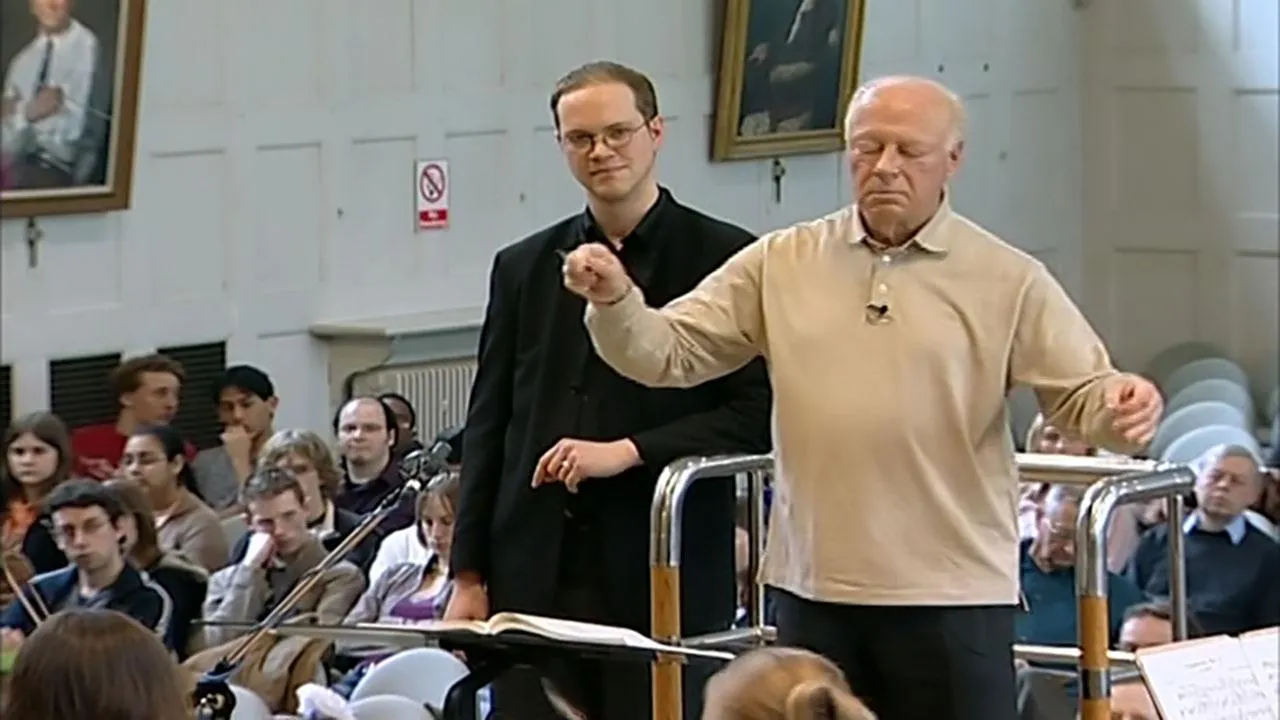
The second movement is purely chamber music. Totally different. Wonderful, tender, nearly Slavonic theme. Very close to Dvoř?k in a way. And they respected each other very much.
On Commitment and Atmosphere
It's hard to find the right words because it's okay. The tempo is good; it sounds okay. But I have a feeling that you don't have the commitment you had this morning.
- The first movement: is of course totally different. These slow movements or slower movements are always difficult to get the right atmosphere after an orchestra has played the first movement. And that really demands every inch of energy.
Expressing Emotion
Then... I don't know. May I try to show you what I should say, but can't?
- "Yes. Give me the beginning."
- You know, whatever you do, if you conduct with your right hand, with your left hand, or with your big toe, it's not that interesting.
Give a certain commitment, and I miss that a little bit. I know that in your head you have that commitment, and it has nothing to do with your glasses.
- "Now don't use the trick."
- Once more, but just make music. Chamber musicians love that tune. And you love it too. You want to give it the best you can.
You don't have to make faces or all sorts of contorted movements, but enjoy the music.
- "Yes."
- And I found it a bit jolly.
Engaging the Ensemble
Sorry. What's up?
- "Okay, Tim."
- You are neglecting a possibility which you have with your left hand. Here. Thanks.
Play once more.
-
Letter B.
- Yeah. Three, four. They love to be invited; they want you to be part of it, you know, and not just standing there.
-
"No, no, no. Let's do the upbeat into B then."
- It's a mixture of enjoying it and giving them hell. Yes, and a friendly face helps too.
-
"Yes."
- You were smiling, and all of a sudden the sun can show, you know.
The Art of Transitions
Once more, where are we? It talks about the art of transitions. Especially with Brahms, it has to be really unified.
- "When you start before C."
- Caesar. 1, 2, 3, 4, 5, 6, 7, 8.
Mr. Upbeat of the basses and the celli, don't lose here the line. It should be more diminuendo, and there should be more tension in a positive way.
Then the clarinet and the bassoon once more.
- "Could you play that?"
- Yes. That was the upbeat 3.
And piano, not pianissimo. Still piano and sound. Now the duomando starts.
- "And here, and now,"
- so that they don't come too late, that it really has... and yum... vam. Is that...
I mean, it's the same place, please.
-
"Well, very good, Tim."
- It sounds very beautiful.
-
"Okay."
- Yeah.
About the instructor
Con una carrera internacional como director que abarca más de cinco décadas, Bernard Haitink, nacido en Ámsterdam, es uno de los directores más celebrados de la actualidad. Nombrado director titular de la Chicago Symphony Orchestra a partir del inicio de la temporada 2006-7, ha dirigido muchas de las principales orquestas del mundo, incluidos más de 25 años al frente de la Royal Concertgebouw como director musical. Además, el señor Haitink ha ocupado anteriormente los cargos de director musical de la Staatskapelle de Dresde, la Royal Opera, Covent Garden, la Glyndebourne Festival Opera y la London Philharmonic. Es director laureado de la Royal Concertgebouw Orchestra, director emérito de la Boston Symphony Orchestra y miembro honorario de la Filarmónica de Berlín. Ha actuado con frecuencia como director invitado con la Filarmónica de Berlín, la Filarmónica de Viena, la Radio de Baviera, la London Symphony y otras orquestas destacadas. El señor Haitink ha grabado ampliamente para los sellos Phillips, Decca y EMI, incluidos ciclos completos de las sinfonías de Mahler, Bruckner y Schumann con la Concertgebouw y un extenso repertorio con las orquestas Filarmónica de Berlín y de Viena y la Boston Symphony Orchestra. Sus grabaciones más recientes son las sinfonías completas de Brahms y Beethoven con la London Symphony Orchestra en el sello LSO Live. Su discografía incluye también numerosas grabaciones de ópera con la Royal Opera y Glyndebourne, así como con la Orquesta de la Radio de Baviera y la Staatskapelle de Dresde. La grabación del señor Haitink de Jenufa de Janáček, con la orquesta, los solistas y el coro de la Royal Opera House, Covent Garden, recibió un premio Grammy a la mejor grabación de ópera en 2004. El señor Haitink ha recibido numerosos premios internacionales en reconocimiento a sus servicios a la música, entre ellos un título honorario de caballero y la Orden de los Compañeros de Honor en el Reino Unido, así como la Orden de la Casa de Orange-Nassau en los Países Bajos. Fue nombrado "Músico del año" de Musical America en 2007. En su curso de MusicGurus sobre la Sinfonía n.º 3 de Brahms, Haitink recurre a toda una vida en el podio para llevarte al corazón de la partitura —cómo modela su fraseo, su equilibrio, su tempo y su estructura—, ofreciendo una visión poco común de cómo uno de los grandes directores lee una sinfonía de Brahms y le da vida, tanto si eres director, músico de orquesta o un oyente apasionado. read more