



Allegro Con Brio - Bernard Haitnik ofrece su análisis y sus comentarios a Timothy Henty
Lesson time: (19min 49sec)
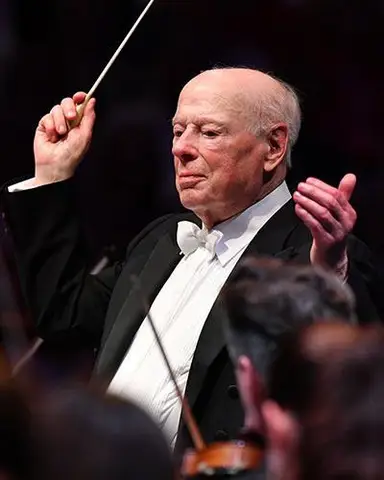
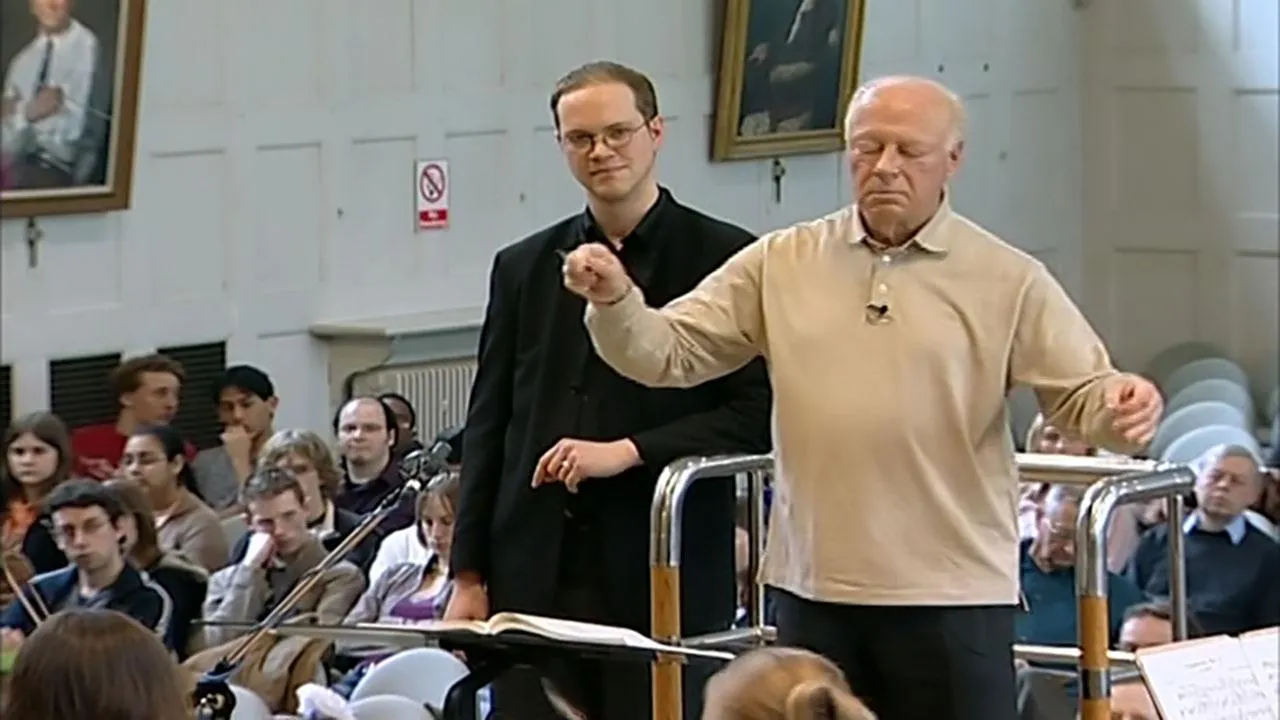
Timothy Henty dirige la orquesta a través del Allegro con brio mientras Bernard Haitink ofrece su análisis y sus comentarios.
Course preview
This lesson is part of the course Brahms - Sinfonía n.º 3
Watch a preview of the full course below.
Lesson transcript:
Music Lesson: Letter E
So this is letter E. Well, it's interesting. Sometimes you do things which I think, "What is he doing?" But it's okay. At the end, it was not okay. It was really not together anymore.
And it's one of these famous difficult places in the score. But I will come to that later.
Beginning at Letter E
The first one from the beginning, from letter E. Of course, you were nervous there, and I was surprised because you gave so many upbeats, and all of a sudden, they were together.
Yes, it's like old Furtw?ngler. They always said, "How can you play?" Because he is so to the orchestra. Well, we count till 11 and a half, then we start, but give a clear beat.
So do that once more:
- Try to be a bit more at rest in yourself.
- Here we are conducting here, and we give it to the orchestra.
But when we add to contort, that is dangerous. Yes. So try to be a little more static in a way, and give the energy there.
Example of Carlos Kleiber
A wonderful example was Carlos Kleiber, who... the music was coming from his arms, from his fingers. It was as if he was... it's incredible.
And that sort of feeling: This should not be too cramped. Give it to them. Yes, give it to the players. They need you; they need to get the impulse from you.
Revisiting Letter E
Yes, letter E again. Okay. Yes. I'm wondering. I still miss contact here. "Hey, what shall I do?" Yes, give me once letter E.
Sorry, I find it sometimes difficult to express myself, and I must do it. Sometimes I know the answer, yes. And it was not together because I didn't concentrate enough on you.
1, 2, 3, 4, 5, 6, 7 bars before G. I will make up for your lost time. And one. Of course, now I exaggerate, but it was more together than at the beginning.
Now try. I hope I made myself clear. I hope so. Yes. So do it. Keep control from E again.
Personal Question
I have a very personal question, and don't be upset: Do you need your glasses?
Yes, this comes up a lot. I do need them. I can kind of bump into people if I don't have my glasses. Is it still...? I have tried contact lenses, but they're quite uncomfortable.
Yeah, I understand that. I'm sorry that I mentioned it, but I have a feeling that the temples run away sometimes.
There they are. Okay. Shall I try flying blind for a bit?
Blind Flying
I would ask you to do some blind flying and not look at the score because you don't need it. You know it.
So I would say, close the score. There's a first time for everything.
And try: When you give these enormous things, not to pop your head too much. You are the boss, and you have to start.
And when you do this, that's not good.
Final Thoughts
I'm sorry about this; it's a very personal thing. Last night I was thinking about it: "Can I ask him yes or no?" And I said yes. I do it.
Okay. Good luck. Here's the orchestra.
Oboe. Well, how does it feel?
Actually, it feels amazing. Yes.
Yeah, actually, for me too because maybe you don't see them, but they see you as... which is very important.
But it's amazing.
May I quote you now? It is amazing, the difference.
Well, there you are. Thank you very much. Very good.
About the instructor
Con una carrera internacional como director que abarca más de cinco décadas, Bernard Haitink, nacido en Ámsterdam, es uno de los directores más celebrados de la actualidad. Nombrado director titular de la Chicago Symphony Orchestra a partir del inicio de la temporada 2006-7, ha dirigido muchas de las principales orquestas del mundo, incluidos más de 25 años al frente de la Royal Concertgebouw como director musical. Además, el señor Haitink ha ocupado anteriormente los cargos de director musical de la Staatskapelle de Dresde, la Royal Opera, Covent Garden, la Glyndebourne Festival Opera y la London Philharmonic. Es director laureado de la Royal Concertgebouw Orchestra, director emérito de la Boston Symphony Orchestra y miembro honorario de la Filarmónica de Berlín. Ha actuado con frecuencia como director invitado con la Filarmónica de Berlín, la Filarmónica de Viena, la Radio de Baviera, la London Symphony y otras orquestas destacadas. El señor Haitink ha grabado ampliamente para los sellos Phillips, Decca y EMI, incluidos ciclos completos de las sinfonías de Mahler, Bruckner y Schumann con la Concertgebouw y un extenso repertorio con las orquestas Filarmónica de Berlín y de Viena y la Boston Symphony Orchestra. Sus grabaciones más recientes son las sinfonías completas de Brahms y Beethoven con la London Symphony Orchestra en el sello LSO Live. Su discografía incluye también numerosas grabaciones de ópera con la Royal Opera y Glyndebourne, así como con la Orquesta de la Radio de Baviera y la Staatskapelle de Dresde. La grabación del señor Haitink de Jenufa de Janáček, con la orquesta, los solistas y el coro de la Royal Opera House, Covent Garden, recibió un premio Grammy a la mejor grabación de ópera en 2004. El señor Haitink ha recibido numerosos premios internacionales en reconocimiento a sus servicios a la música, entre ellos un título honorario de caballero y la Orden de los Compañeros de Honor en el Reino Unido, así como la Orden de la Casa de Orange-Nassau en los Países Bajos. Fue nombrado "Músico del año" de Musical America en 2007. En su curso de MusicGurus sobre la Sinfonía n.º 3 de Brahms, Haitink recurre a toda una vida en el podio para llevarte al corazón de la partitura —cómo modela su fraseo, su equilibrio, su tempo y su estructura—, ofreciendo una visión poco común de cómo uno de los grandes directores lee una sinfonía de Brahms y le da vida, tanto si eres director, músico de orquesta o un oyente apasionado. read more