



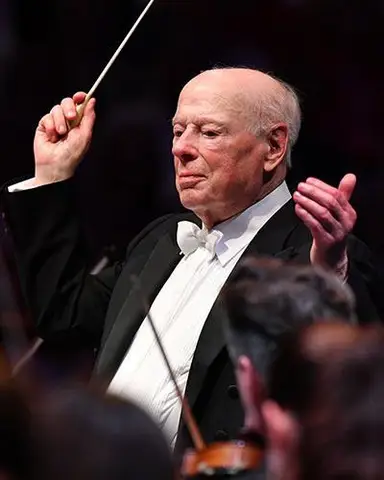
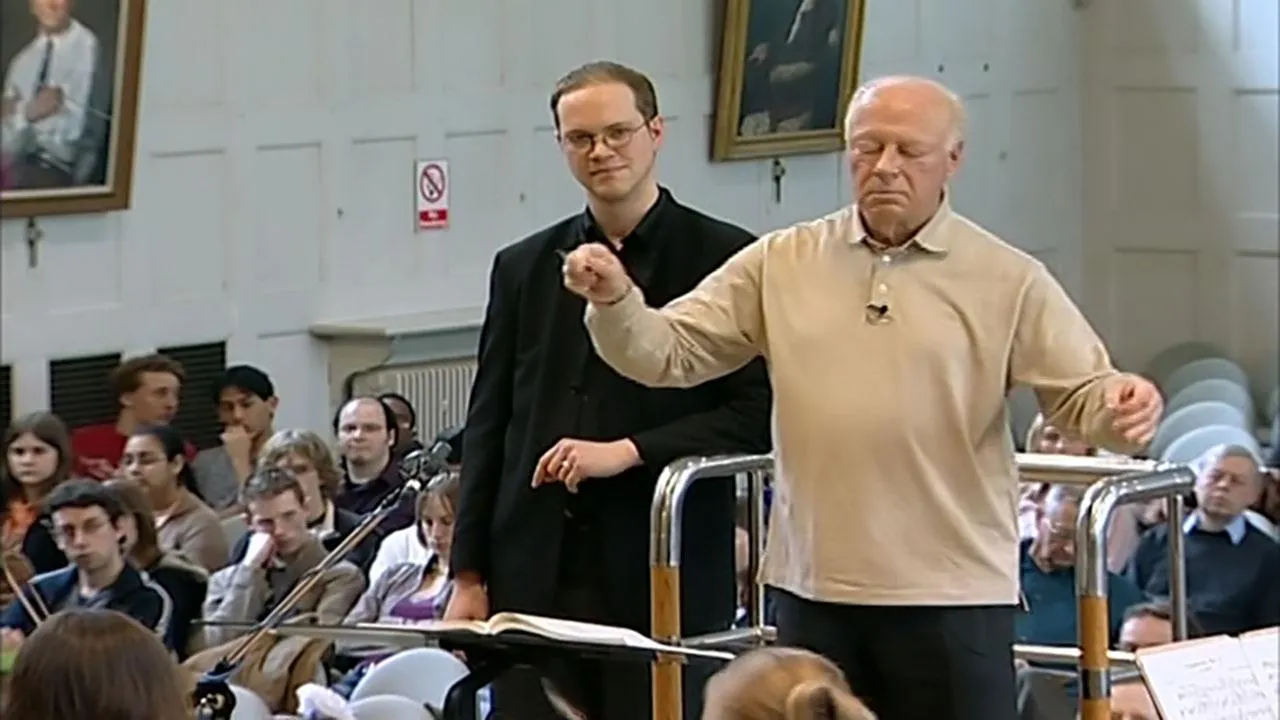
Allegro - Bernard Haitink da su análisis y feedback a Karim Said
Lesson time: (7min 52sec)
Course preview
This lesson is part of the course Brahms - Sinfonía n.º 3
Watch a preview of the full course below.
Lesson transcript:
Music Lesson
Instructor:
My fault. Very sorry. No, it was not very good. My fault. I said very sorry.
No, no, no. This was not together at all.
Very funny.
Discussion of Dynamics:
-
In the beginning, you give that, but it's sort of...
And then:
Pom, pom, pom, pom, yum, pom, pom, pom.That was good.
But then it gets louder and louder there. They think, "Well, you're not looking at us well, we play out."
Keep a check on them. Yes.
The more you play, the more there's a danger the piano will not be there.
So, do it once more.
I also forgot trombone. Very sorry. He will not hold it against you. With a bit of luck, once more.
Encouragement:
Yeah, okay, Karim, I'm sure you can.
And you want to have more pianist, more soto voce.
Questioning Techniques:
Yes. So, how?
Get something out of your box of ideas.
Yeah, but the danger is when you want it more pianissimo, that it also becomes slower.
So that's always one of the eternal problems of the conductor.
How can I get really pianissimo, but in tempo?
Feedback on Tempo:
Okay, okay, Karim.
Okay, good, good.
But it's getting slower and slower.
Yeah, getting slower.
Yeah. And you don't want that, or do you want it a little bit?
I want a little bit of space before the.
And then you can pick up.
Yeah, okay. The ones were the beginning.
Final Thoughts:
Okay. And I will keep my mouth shut.
Yeah, no, no, no, no. I'll keep my mouth shut.
It's a bit too slow. I need to...
Well, yes, yes, yes.
So it's very good in many ways, but sometimes you do things that I think, "My goodness, how can they keep it together?"
Because you are so busy, and you want everything, and I know you have it here.
It comes through and it's very impressive.
Oh, yeah.
But maybe I'm your most critical admirer.
Yeah, you do very well.
But you have to discipline yourself, and I'm sure you will do, because you are clever enough.
Concluding Remarks:
So, end of the slow.
Furtw?ngler could do that at the end of his life.
But when you start as a young man already with that, how slow will you be at the end of your life?
I would keep it a bit more in a classic shape.
Movement Insights:
The whole movement is from here?
No, the poco sostenuto is becoming a molto sostenuto.
And I found the beginning dangerously slow too.
But okay, that's a Lego.
It's not a Lego comrio that I buy from you. I mean, if that's your...
If you're convinced about that.
But in the fortissimo, keep a little bit more energy for yourself because you are so.
You are attacking them, and there's a danger that you lose the rhythm.
Yeah.
Okay. Well done.
Thank you.
Thank you.
About the instructor
Con una carrera internacional como director que abarca más de cinco décadas, Bernard Haitink, nacido en Ámsterdam, es uno de los directores más celebrados de la actualidad. Nombrado director titular de la Chicago Symphony Orchestra a partir del inicio de la temporada 2006-7, ha dirigido muchas de las principales orquestas del mundo, incluidos más de 25 años al frente de la Royal Concertgebouw como director musical. Además, el señor Haitink ha ocupado anteriormente los cargos de director musical de la Staatskapelle de Dresde, la Royal Opera, Covent Garden, la Glyndebourne Festival Opera y la London Philharmonic. Es director laureado de la Royal Concertgebouw Orchestra, director emérito de la Boston Symphony Orchestra y miembro honorario de la Filarmónica de Berlín. Ha actuado con frecuencia como director invitado con la Filarmónica de Berlín, la Filarmónica de Viena, la Radio de Baviera, la London Symphony y otras orquestas destacadas. El señor Haitink ha grabado ampliamente para los sellos Phillips, Decca y EMI, incluidos ciclos completos de las sinfonías de Mahler, Bruckner y Schumann con la Concertgebouw y un extenso repertorio con las orquestas Filarmónica de Berlín y de Viena y la Boston Symphony Orchestra. Sus grabaciones más recientes son las sinfonías completas de Brahms y Beethoven con la London Symphony Orchestra en el sello LSO Live. Su discografía incluye también numerosas grabaciones de ópera con la Royal Opera y Glyndebourne, así como con la Orquesta de la Radio de Baviera y la Staatskapelle de Dresde. La grabación del señor Haitink de Jenufa de Janáček, con la orquesta, los solistas y el coro de la Royal Opera House, Covent Garden, recibió un premio Grammy a la mejor grabación de ópera en 2004. El señor Haitink ha recibido numerosos premios internacionales en reconocimiento a sus servicios a la música, entre ellos un título honorario de caballero y la Orden de los Compañeros de Honor en el Reino Unido, así como la Orden de la Casa de Orange-Nassau en los Países Bajos. Fue nombrado "Músico del año" de Musical America en 2007. En su curso de MusicGurus sobre la Sinfonía n.º 3 de Brahms, Haitink recurre a toda una vida en el podio para llevarte al corazón de la partitura —cómo modela su fraseo, su equilibrio, su tempo y su estructura—, ofreciendo una visión poco común de cómo uno de los grandes directores lee una sinfonía de Brahms y le da vida, tanto si eres director, músico de orquesta o un oyente apasionado. read more