



Moll-Septakkorde & Quartakkorde in deinem Blues

Lesson time: (4min 36sec)
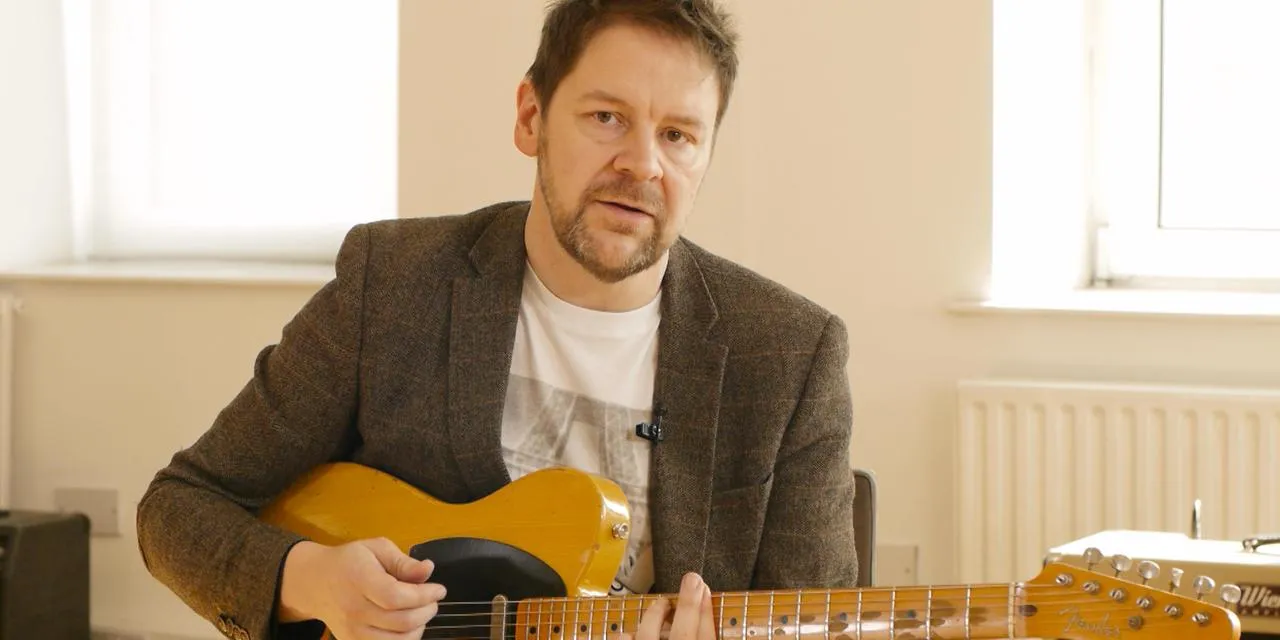
Ron Sayer wendet Voicings von Moll-Septakkorden und Quartakkorden über einer Blues-Tonleiter an, für einen Robben-Ford-gefärbten Sound, der Richtung Fusion tendiert.
Course preview
This lesson is part of the course Über den Tellerrand 2: Und raus mit dir!
Watch a preview of the full course below.
Lesson transcript:
Lesson: Exploring Quartal Harmony in a Blues Scale
Okay, this next lesson is a follow-on from our quartal harmony chords over a blues scale.
Recap
You may well remember that we played a scale with chord harmony in a blues scale. So what I'm going to do here is just show you something different you can do with that chordal harmony idea.
A Robin Ford Sounding Idea
This concept is very reminiscent of Robin Ford's style. Here's what you will do:
-
Use a Minor Seventh Chord
Move down to the chordal chord and translate that every place you play that particular chord. -
Example
- There's our first place to play it.
- Move up to the next note in the blues scale.
- Go up to the minor seventh, such as a C minor seven chord.
Fingering Technique
Every other place you play it, you can do that by laying your finger across where it's supposed to be in your pentatonic scale. In other words:
- Start on the Fifth Fret
- Move down so your first finger is over the D and G on the fourth fret.
- Use your third finger on the fifth fret for the B and E.
Movement Pattern
- Move it to the 8th fret, then down:
- 7th and 8th fret
- Up to the 10th
- Down to the 9th and 10th
- Up to the Blue Note (11th fret)
- Down to the 10th and 11th
- Up to the 12th
- Then to the 11th and 12th
- Up to the 15th
- And finally, the 14th and 15th
Returning to the Octave
You'll return to where you started, moving down to the third fret, then to the second and third frets.
Combining Techniques
This is something you can throw in along with those chordal chords, and obviously, with your ninth chords as well.
Conclusion
To round it off, have a listen to what you can do and how it sounds over a verma.
Ready, guys?
1, 2, 3, 4, SA.
About the instructor
Ron Sayer ist ein Gitarrist für Gitarristen auf der britischen Blues-Szene und Mentor von Spielern wie Oli Brown und Sol Philcox. Er wurde viermal für die British Blues Awards nominiert - für das Album 'Better Side', die Single 'Don't Make Me Stay' und seine Mitwirkung als Co-Autor bei Oli Browns 'Here I Am' - und hat den Preis als Guitarist of the Year gewonnen. In seinen Kursen schlüsselt er das Phrasing, den Ton und das Feeling hinter dem elektrischen Blues-Leadspiel auf. read more