



Weitere verminderte Septakkord-Arpeggien

Lesson time: (10min 32sec)
Course preview
This lesson is part of the course Über den Tellerrand 2: Und raus mit dir!
Watch a preview of the full course below.
Lesson transcript:
Diminished 7th Arpeggios Over Bars 9 and 10
Introduction
Okay, here's another lesson showing you how to use diminished 7th arpeggios over certain parts of the 12-bar blues. This time, we're going to focus on bars 9 and 10. In other words, we'll be using diminished 7th arpeggios over E and D when playing in A.
Concept Overview
The nice thing about this concept is that you can apply diminished 7ths over both of those chords. Here's what to remember:
- Use diminished 7ths over the third of each chord.
- When in E, start on the third of the E chord.
- When in D, start on the third of the D chord.
If you get them mixed up, the sound can become quite jarring. So, make sure you play them in the right order.
Application in the 12-Bar
Let's run through bars 9 and 10 so you can hear the interplay between D and E.
From the start:
- 2. 3. 4.
This shows a bit of what you can do. Now, I'll provide some examples for you to learn note for note.
Example 1: Diminished 7th Arpeggio Lick
Here's our first example of the diminished 7th arpeggio style lick over bars 9 and 10 (E and D).
-
Start by running up a diminished 7th arpeggio from the E string:
- Seventh fret on E
- Fourth fret
- Seventh fret to the fifth on A
-
Repeat this style of run up to D:
- E string: Seventh, fourth, seventh to fifth
- D string:
- Eighth fret up to sixth
- Ninth, sixth, ninth
-
When you reach the ninth fret on the D string, shift up one fret to start the diminished 7th arpeggio over D:
- Move to the 10th fret:
- 10th, 7th, 10th
- Move to the G string:
- 8th fret, 11th fret
- 8th fret, 11th to B string
- Jump up two frets to the 10th fret on B
- Go to the 13th fret on B
- Move to the 10th fret:
-
After that, you can return to an A minor pentatonic or blues scale based around that, ending up in fourth position pentatonic. For example:
Try playing something like this:
- (Play an example)
Let's hear this with some music underlying. You'll get a couple of bars of 8 before we transition into bars 9 and 10:
Now, let's try it one more time:
Example 2: Double Stop Diminished 7th Arpeggio
Here's the second example of a diminished 7th arpeggio style run over bars 9 and 10 (the E chord and the D chord).
As usual, I like to throw in a double stop whenever possible. This next lick will involve a double stop running from the fourth fret in minor third intervals.
- Start on the fourth fret.
- Change for the D chord as we did in the last lick.
- Instead of minor thirds, leap up to the 20th fret.
Playing Technique
I will be using hybrid picking, which involves:
- A pick between the thumb and first finger
- Using the second finger for plucking
Note: It's not necessary to use hybrid picking, but it adds a nice touch.
Playing Steps:
-
Start from the fourth fret
- Move up in minor third intervals:
- Fourth → Seventh → Tenth → Thirteenth → Sixteenth
- Leap to the 20th fret
- Move up in minor third intervals:
-
Move back down in minor third intervals:
- 17th → 14th → 11th → 8th → 5th
By ending up back on the fifth fret, we maintain our position in A minor.
Let's hear it with some music again.
Let's do it one more time for clarity:
That wraps up the lesson on using diminished 7th arpeggios over bars 9 and 10. Happy playing!
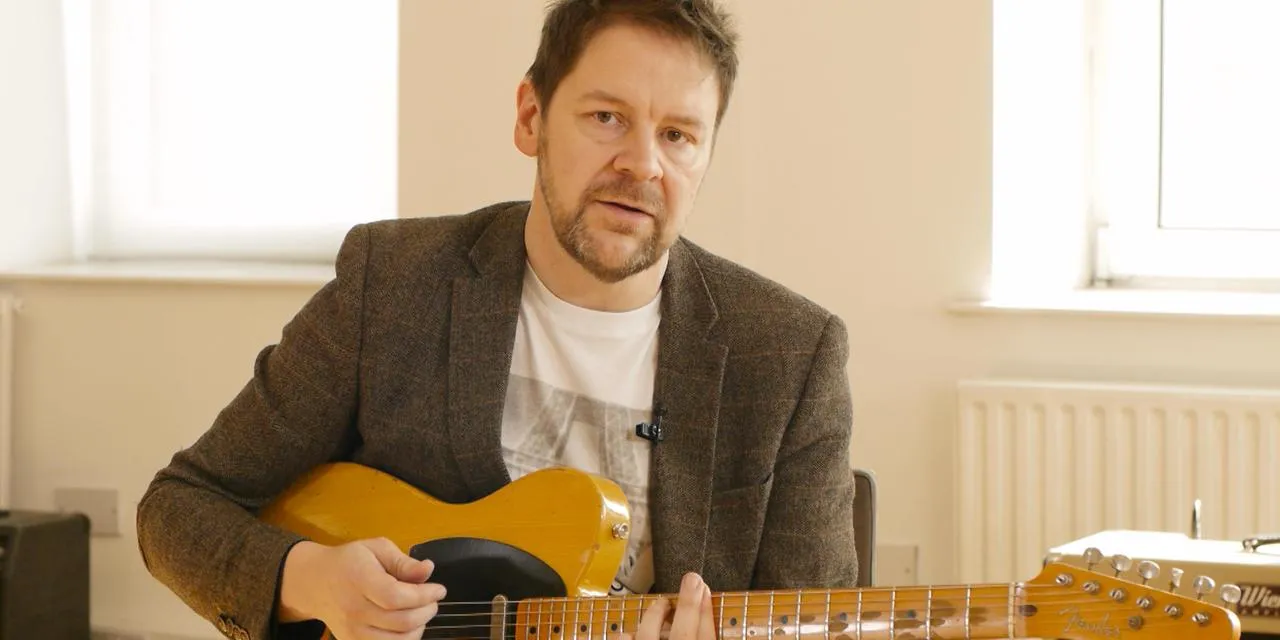
About the instructor
Ron Sayer ist ein Gitarrist für Gitarristen auf der britischen Blues-Szene und Mentor von Spielern wie Oli Brown und Sol Philcox. Er wurde viermal für die British Blues Awards nominiert - für das Album 'Better Side', die Single 'Don't Make Me Stay' und seine Mitwirkung als Co-Autor bei Oli Browns 'Here I Am' - und hat den Preis als Guitarist of the Year gewonnen. In seinen Kursen schlüsselt er das Phrasing, den Ton und das Feeling hinter dem elektrischen Blues-Leadspiel auf. read more