



Einführung in das Solospiel und die Parallelharmonie

Lesson time: (4min 0sec)
Course preview
This lesson is part of the course Spiele authentische Jazzgitarre
Watch a preview of the full course below.
Lesson transcript:
The Art of Solo Jazz Guitar
Hey, everyone.
We're here looking at the art of solo jazz guitar, by which I mean unaccompanied jazz guitar playing. It's a real challenge. We don't have the blessing of the left hand and the right hand that the piano players in jazz have. So, it's a real challenge.
Influential Guitarist: Joe Pass
And, of course, there's one guitarist that comes to mind pretty much straight away when we talk about unaccompanied playing, and that's the great American guitarist Joe Pass.
Joe Pass was a real master of juggling the elements here:
- Melody
- Harmony
- Rhythm
We're not blessed with having a rhythm section behind us, so Joe was the master of juggling chords with the improvising, perhaps playing a solo and accompanying himself with harmonies underneath.
He was also the master of moving into time and moving out of time. He has these wonderful rubato passages, by which I mean out-of-time passages. Often, he'll make a rubato introduction and then move slowly into tempo, into a swing feel, effortlessly and seamlessly. Then, he might move back into something; for an outro, perhaps, he would transition back into a rubato section.
He ties all of this together in such a way that it feels like music. It wouldn't feel like he was just studying a piece or reading some sheet music; he was truly making music with this.
Inspired by Joe Pass
I've been very inspired by a version he recorded of the jazz standard "April in Paris." I've kind of taken a few of his harmonic and melodic ideas and come up with my own little melody, which we're calling "November in Norway."
Analyzing the Harmonies
I guess we could start by looking at the harmonies that I've chosen to take here. Much in the same way that Django Reinhardt was using parallel chordal harmonies, Joe Pass does the same thing.
For example, in the very first phrase, the melody is:
And that last note falls on a C major chord, with the melody note being an E and the chord being a C. So, the melody is on the third.
What does Joe Pass do? He directly starts off with a parallel movement.
He thinks, "Okay, well, if the melody is chromatic, which it is F, D sharp, E," he simply moves the chords around that. So, you get:
- D flat major 7th
- B major 7th
- C major 7th
Whereas the original composer of this tune, Vernon Duke, didn't write those chords. He wrote something more like this, which is a 2-5-1.
Joe uses the more chromatic harmonies, which are very guitar-friendly, and I really love that approach.
Adding Melodic Passages
Moreover, he's always adding in little soloistic melodic passages in between each phrase of the melody. That's a hallmark of his style.
If you know a phrase which is based on a C major seventh chord, you might state a little bit of your own improv after playing the melody.
For instance, I've just added my own little phrase in there.
Then, I go back to the melody, and this time it doesn't resolve; it's just a II-V, which, again, Joe stays loyal to.
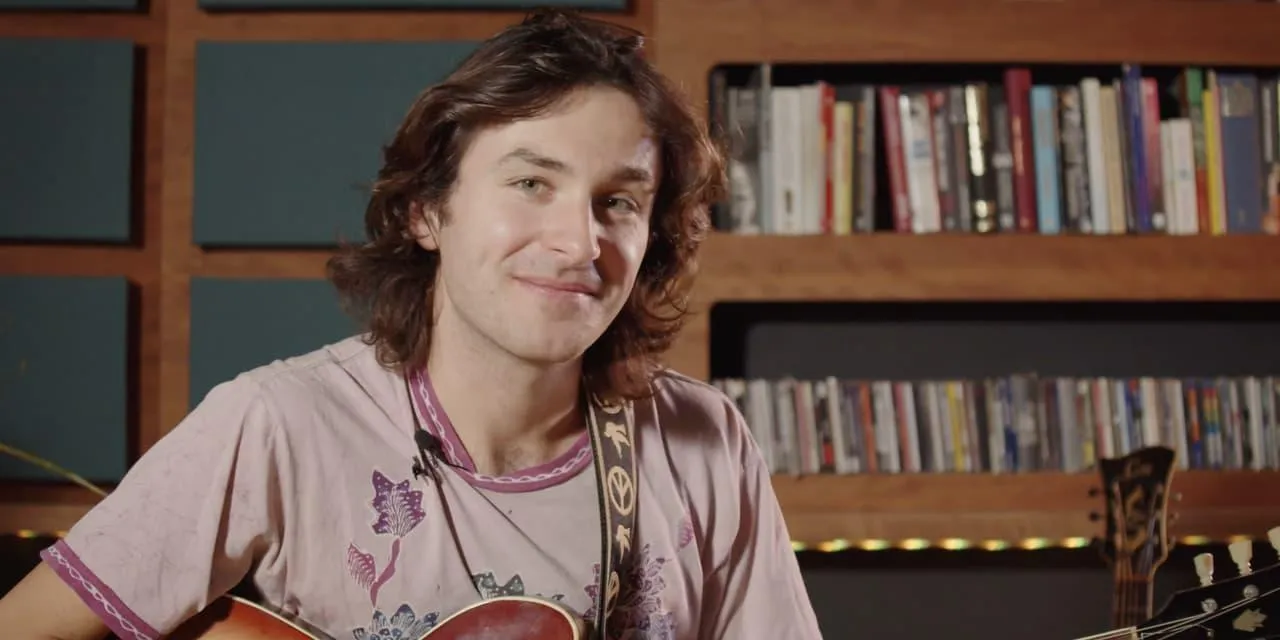
About the instructor
Rob Luft ist ein preisgekrönter Musiker aus London, der weithin als einer der herausragendsten und talentiertesten jungen zeitgenössischen Jazzgitarristen des Vereinigten Königreichs beschrieben wird. Von The Times als jemand gelobt, der 'in Zukunft Großes erreichen wird', gewann Rob 2016 den Kenny Wheeler Jazz Prize in Zusammenarbeit mit Edition Records und belegte 2016 den 2. Platz beim Montreux Jazz Guitar Competition. Sein Debütalbum 'Riser' erschien im Juli 2017 und erhielt in den europäischen Jazzmedien breite kritische Anerkennung. John Fordham schrieb im The Guardian, es sei ein 'sehr raffiniertes Debüt, doch angesichts von Lufts altweisen Leistungen seit seiner frühen Jugend hätten wir es kommen sehen müssen'. 'So jung und so talentiert!' - Jamie Cullum, BBC Radio 2 (UK) '...ein außergewöhnliches Talent!' - Julian Joseph, BBC Radio 3 (UK) 'Die Virtuosität der drei [Gitarristen Al di Meola, John McLaughlin und Paco de Lucia] erinnert an den 23-jährigen Londoner Rob Luft, der als neues "Wunderkind" gefeiert wird' - Spiegel Online (D) In Play Authentic Jazz Guitar öffnet Rob die harmonische Sprache, die Phrasierung und die Improvisationsinstinkte hinter diesem 'altweisen' Sound und zeigt dir, wie er wirklich über das Griffbrett denkt, damit du beginnen kannst, deine eigene Stimme im Jazz zu finden. read more