



Akkorde und Harmonie - Teil A

Lesson time: (11min 6sec)
Rob Luft schlüsselt die Rhythmusgitarren-Akkorde für den A-Teil von "Clouds" (angelehnt an Djangos "Nuage") auf und verwendet dabei die zeittypischen Sext- und Nonvoicings statt großer Septakkorde.
Course preview
This lesson is part of the course Spiele authentische Jazzgitarre
Watch a preview of the full course below.
Lesson transcript:
Harmony and Rhythm Guitar Lesson: "Clouds"
Here we are looking at the harmony and rhythm guitar for this track, which is based on Django Reinhardt's Nuage. We're calling it Clouds for obvious reasons.
Overview
- This is a track from the early 1940s composed by Django himself.
- He recorded it several times over his career, very famously in the key of F.
- We're going to look at a chord sequence very similar to Nuage in the key of F.
The chords would have been played by his brother Joseph, as Django himself only had these two fingers and was unable to play a lot of these four and five-note chords. So, we're inspired by Django's brother and the other rhythm guitarists of the era.
Chord Sequences
When studying chord sequences like this, the first thing to consider is that the major chords would never have had a seventh at this time.
- You would never hear the sound of F major 7, which has become so common in pop music and jazz music later on.
- Instead, you'd hear only the sound of a sixth or ninth, which comes from the pentatonic scale.
Examples of Chords
-
You'd hear chords like F major 6, or like this:
- (insert chord diagram)
-
If you wanted to add the 9th, you could use chords with the 6:9:
- F major 6:9 would look like this:
- (insert chord diagram)
You get lots of little chromatic movements where the guitarist of the era would literally just move the same chord around, fret by fret, chromatically, getting these sounds like:
(insert demonstration audio or visual)
This is reminiscent of the swing era of the 1930s and 40s.
The Chord Sequence
So moving to this chord sequence, the first chord is a kind of D flat seventh.
- D flat 7
- C seventh
- F major
Voicings
What voicings would these guys have used?
- Often they're playing sort of inversions.
- When I say inversion, I mean that the guitarist might not have a D flat in the bass but might have one of the other chord tones as the bass note.
For example, rather than a D flat, he might use an A flat as his bass note. In this case, an A flat was most likely:
- You get a chord like that: D flat 7 with the A flat in the bass.
- It then moves chromatically down to a C7 with a G in the bass, followed by the F6.
The guitarists at this time, Django included, often had very fast vibrato in the left hand, which created a gorgeous sort of shimmering chordal sound, almost like a tremolo arm in rock and roll music or in later styles.
You hear there, it creates this very full sound with this vibrato.
Tonic and Dominant Chords
Another interesting point is that rather than sitting for two bars on the tonic chord (the F major), the guitarists of the time would often alternate with the dominant chord, which would be a C7.
A typical color of the swing era is that rather than having a pure dominant seventh chord, you'd have a sharp five (the A flat), which resolves very nicely to the F major.
Cadences
You get these little passing tones, these dominant chords, especially when sitting for two bars on the tonic chord. You might have a quick passing dominant chord to resolve back to our tonic, creating:
- Tension resolution
- Tension resolution feeling, which is common in all music.
Symmetrical Voicings
The beautiful thing about this sharp five voicing is that it's symmetrical.
- It repeats every four frets, creating almost endless possibilities for accompaniment.
You can simply go:
- F major, C7, F major
- or C7 there.
In the last symmetrical voicing up there, you can move:
(insert audiovisual example)
Often, they'll even play within two beats. You get these lovely cascading dominant chords that are really reminiscent of that era.
The First Eight Bars
That's the first eight bars of the accompaniment part, which simply sound like this:
(insert demonstration audio)
Ninth Bar Transition
Now we're onto the ninth bar.
In the ninth bar, this chord sequence modulates to the relative minor. By this, I mean F major shares a lot of characteristics with D minor, which is the minor chord most closely related to F major.
So we call them related:
- F major is the relative major of D minor.
- D minor is the relative minor of F major.
Chord Progression
The only note that changes is the C of F major.
- The fifth of F major (C) becomes the root of D minor (D), and then you have the D minor chords.
This chord sequence takes advantage of that relation and modulates from F major to D minor.
II V I Progression
How does it do that? Like in most jazz, it does it with a II V I progression.
- Chord II (E half diminished)
- Chord V (A7)
- Chord I (D minor)
We get this II V I progression into D minor here.
- In the second half of the bar, I'll put in the dominant chord the same way that I did here with F major.
- I'll simply play an A7 in the second half of the first bar, creating resolution, tension, and resolution.
Voicings for A7
Another beautiful voicing is this A7.
- It's like an A7 sharp nine with a C sharp in the bass (the C sharp being the third).
This voicing is symmetrical again but repeats every three frets, giving you endless possibilities for alternating these two chords.
In the 1940s, guitarists used this to cycle between the dominant and the minor chord, yielding a sound like this:
(insert demonstration audio)
Next Four Bars
So these next four bars sound as follows:
(insert demonstration audio)
Secondary Dominants
We then move to the secondary dominant.
- Secondary dominant means chord II in relation.
- We're back to thinking about F major now, specifically a G seventh chord.
Something pretty standard of the era is that these guys were not so much using bar chords.
Typically, they'd think more in terms of four-note voicings, avoiding repeated notes:
- For example: G, D, B, F.
Chromatic Movement
In the second half of the bar, we'll just move down a semitone to create some of the chromatic movement that I mentioned earlier.
So you get this:
(insert chord diagram or audio)
In the second half of the second bar of that G7, we might invert it and put the B in the bass.
Then we move up to a C7.
We'll apply the same technique of moving up a semitone and then back down.
(insert sound demonstration)
Those bars, from 13 to 16, will sound like this:
(insert demonstration audio)
About the instructor
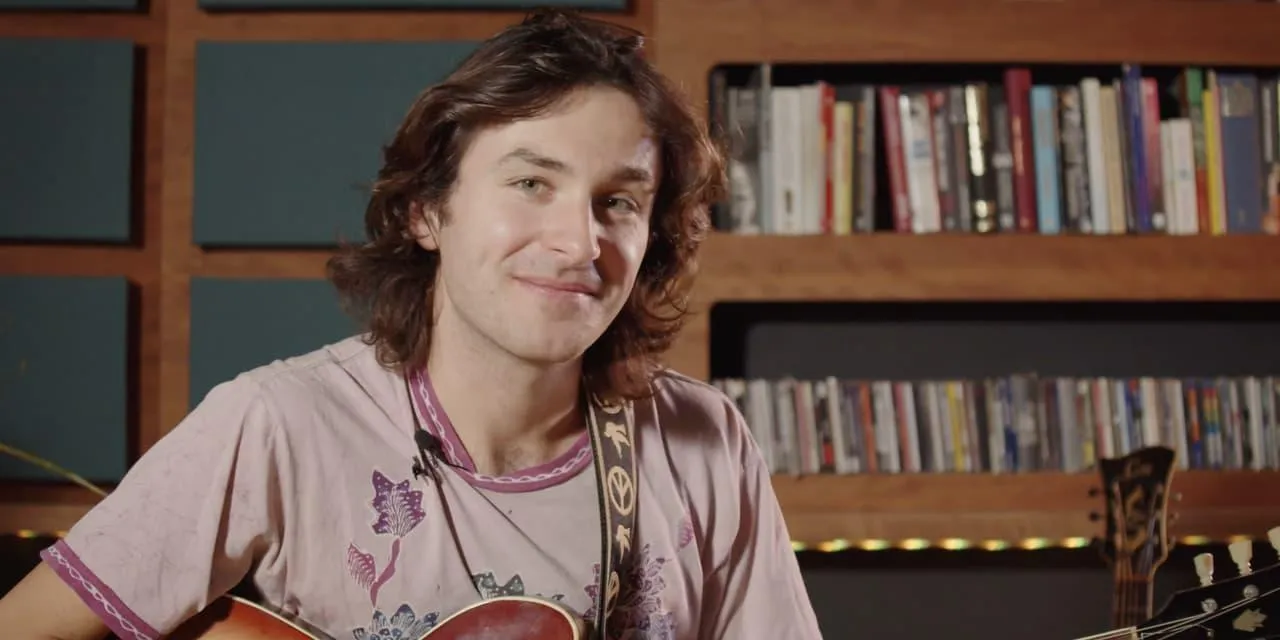
Rob Luft ist ein preisgekrönter Musiker aus London, der weithin als einer der herausragendsten und talentiertesten jungen zeitgenössischen Jazzgitarristen des Vereinigten Königreichs beschrieben wird. Von The Times als jemand gelobt, der 'in Zukunft Großes erreichen wird', gewann Rob 2016 den Kenny Wheeler Jazz Prize in Zusammenarbeit mit Edition Records und belegte 2016 den 2. Platz beim Montreux Jazz Guitar Competition. Sein Debütalbum 'Riser' erschien im Juli 2017 und erhielt in den europäischen Jazzmedien breite kritische Anerkennung. John Fordham schrieb im The Guardian, es sei ein 'sehr raffiniertes Debüt, doch angesichts von Lufts altweisen Leistungen seit seiner frühen Jugend hätten wir es kommen sehen müssen'. 'So jung und so talentiert!' - Jamie Cullum, BBC Radio 2 (UK) '...ein außergewöhnliches Talent!' - Julian Joseph, BBC Radio 3 (UK) 'Die Virtuosität der drei [Gitarristen Al di Meola, John McLaughlin und Paco de Lucia] erinnert an den 23-jährigen Londoner Rob Luft, der als neues "Wunderkind" gefeiert wird' - Spiegel Online (D) In Play Authentic Jazz Guitar öffnet Rob die harmonische Sprache, die Phrasierung und die Improvisationsinstinkte hinter diesem 'altweisen' Sound und zeigt dir, wie er wirklich über das Griffbrett denkt, damit du beginnen kannst, deine eigene Stimme im Jazz zu finden. read more