



Mahler's Third Symphony
Das steckt im Kurs
10 Lektionen (2h 21m) · 1 gratis
01. Breathing, part 1
Gratis-Lektion6:59
02. Rossini, William Tell and The Thievish Magpie
14:54
03. High Range Building
8:50
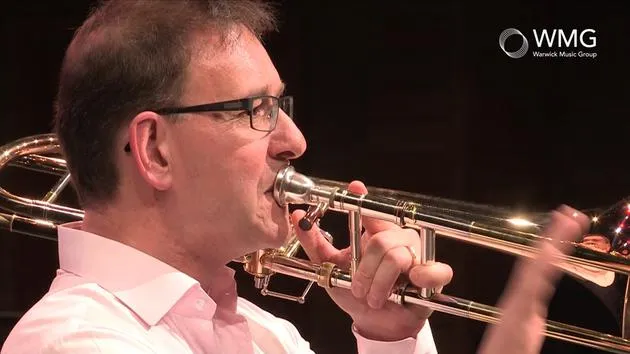
04. Detached Articulation
18:50

05. Mahler's Third Symphony
Du bist hier22:21
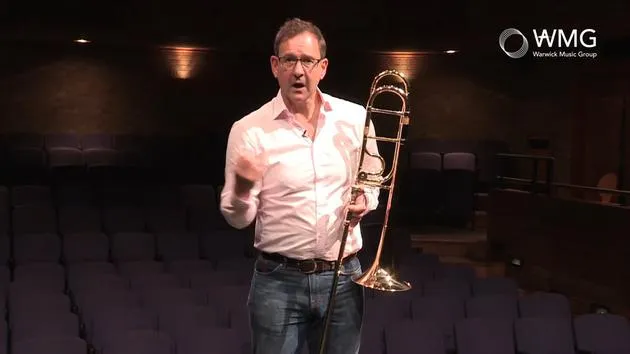
06. Mozart Requiem
13:41
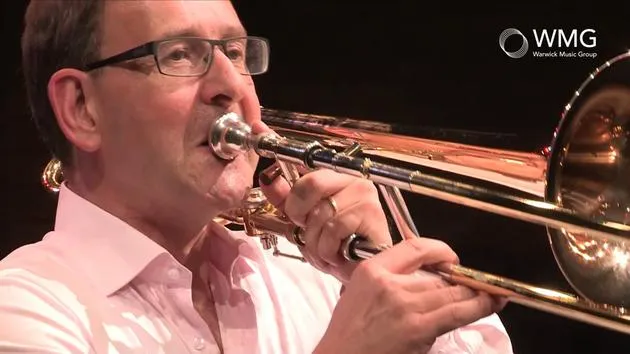
07. Ravel's Bolero
11:35
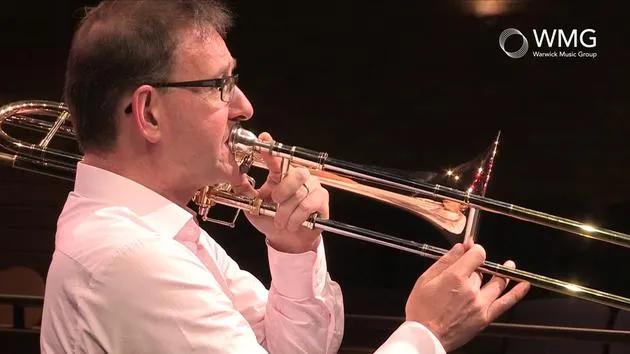
08. Legato
17:55
09. The Philosophy of Warm Up
14:04
10. Wagner, Ride of the Valkyries and Prelude to Act 3 of Lohengrin
12:20
Transkript der Lektion
Understanding Mahler's Third Symphony: A Trombone Perspective
Today, we will delve into perhaps our greatest solo in the orchestral repertoire: Mahler's Third Symphony. Let's get right down to business.
The First Note
The opening instruction, Biden gehalten turnen schall treke inner, means to lift the trombone bell in the air on the long notes. Contrary to common belief, it doesn't mean to play as loud as you can.
Preparing the Breath
To get the breath right for that note, we have to take the "Mahler 3 breath." It's almost unique, different from any breath we would take for pieces like Bolero or Berg's Three Pieces.
Sound Quality
We also need to focus on the quality of sound for these first couple of notes. Within every trombone, there is a wall. If we go through that wall, we enter the area of impurity.
Let me show you what I mean:
You hear that slightly electric sound where I'm touching the wall.
To prepare for Mahler 3, we practice that first note by going up to the wall but not going through it. If we breach that wall, we will produce impurity, and our sound won't improve.
Dynamic Control
So, that's the dynamic. I can play that note while maintaining a pure sound. For Mahler 3, we don't need to play incredibly loud; otherwise, we risk losing the melodic aspects.
As you can hear, this is not a cadenza. We cannot take our time and wallow in it at all. Mahler wrote "Trill" and "Nick Schleppen", don't drag the triplets.
"Move forwards. Nick True. Don't hold back."
I think he's trying to tell us something; it has to go, go, go, go, go.
The Importance of B Flat
The B flat is particularly important. It runs through all of Mahler. It's that expressive semitone. Intriguingly, it is the only note that doesn't appear in the chorale from Brahms' First Symphony.
Fascinatingly, the first movement of Mahler's Third Symphony is a parody of the last movement of Brahms' First Symphony. Even the beginning of Mahler's work is very similar to the Trombone Chorale in Brahms' piece.
Practicing Musicality
We would all like to go straight into it. In fact, that's a great way to practice to understand the musicality. We should understand the line before we actually play it at full dynamic.
However, Mahler took care to accent almost every note. Contrary to common belief, when Mahler wrote an accent, he didn't mean to play it long.
If you ask a clarinetist or violinist what an accent means, they will tell you it's just that, an accent.
Somehow, trombonists seem to have adopted the idea that it means to stretch the note. It does not; it's nevertheless an accent, and we must articulate the notes clearly while keeping the line moving.
Moving to the Next Section
Next, we encounter the ae natural, which appears three times. Normally, when something is repeated three times, it grows in intensity, the last instance is when you really mean it.
Don't start the first instance too loud. It says Wieder Schwer (again heavy), but it doesn't need to be full power just yet. We want the emotion of the weight, and then:
- Second Time: A little more; now we mean business.
- Semitone: Here, we let the audition panel know we're present.
Then, we move again, and only here do we stop.
Emotional Nuance
One of the most telling instructions from Mahler is where he writes sentimental. This is a clue to our emotional approach.
Before we discuss that further, let's address a common practicality. Many times when I'm teaching or in an audition, I hear that the second note doesn't speak, resulting in the infamous airball.
The key here is to think of it in two parts. If we think of it simply as a free solo, we lose the pulse, the impetus. When the timing with the air is off, we lose our chance.
Always think of it as bang bang and then it works.
Positive Articulation
Positive doesn't mean dead. Piano always means warm and positive, always a positive articulation.
Hairpins and Dynamics
Another important aspect of this solo are the hairpins: crescendos and decrescendos. These were also used in the Second Viennese School by composers like Webern, Berg, and Schoenberg, often conveying a sigh.
We must pay special attention to these every time they occur. The first solo is clearly sentimental and downcast, portraying a gloomy world. But then, the sun breaks through, there's hope.
With the second group, we have the crescendo followed by a diminuendo.
Timing and Bouncing
Here's the best way I can describe the timing: it's like a bouncing ball. When you bounce a ball, it goes da da da da da. If you reverse that, it's obvious where the next beat will fall.
Remember, that last note doesn't need to sound like Armageddon; it shouldn't be the end of the world. We follow with la da da da da, leading into the cor anglais.
Contemplating the Emotion
In general, the second part is more tragic and reflective than the first. Mahler reverses his earlier instruction to not drag the triplets. Here, it's rittenuto, we have to pull back, creating a much more dramatic effect.
If you look at the music, you'll see where Mahler has written various accelerandos back into tempo.
"Accelerando, then pesante and stop."
Clarity of articulation is paramount; everything I play must be present in the parts.
Transitioning Sections
When we transition to the next section, the SGTragen, the initial note needs to start with real passion, unlike the first solo, which started quietly.
Now, we need to sell the listener a bit of a dummy, make them think it's going to happen again, then we take a different direction, and the sun shines once more.
From there, the music continues similarly to the slow solo, completing another crescendo followed by a diminuendo: resigned.
In this context, the diminuendo serves more as an audition challenge than anything else, with the rest of the orchestra becoming more interesting.
Quintuplets in Mahler 3
The na de la dee motif runs throughout Mahler 3, comprised of these quintuplets.
Understanding quintuplets is crucial for the climax toward the end of the last movement, as it needs to be clear to make musical sense within the piece's overall scope.
Conclusion
Throughout my 30-year career in orchestras such as the Halle Orchestra, London Symphony, and Vienna Philharmonic, Mahler 3 has been a source of some of my most cherished moments.
It was a great honor and privilege to play this piece, and the insights I've shared result from years of experience on how to navigate it, practicing effectively, and preparing thoroughly.
I'm sure that if you follow the guidelines I've laid out here, it will significantly enhance your performance of Mahler 3.
10 Lektionen
2 Std. 21 Min. strukturierte Videolektionen
Erweiterte Videofunktionen
Verlangsamen, Passagen loopen, mitlesen
Handy, Tablet & Desktop
Üben, wo du willst
100 % Zufriedenheitsgarantie
30 Tage Geld-zurück-Garantie
Lern deinen Guru kennen
Lern deinen Guru kennen
Ian Bousfield steht seit über einem Vierteljahrhundert an der Spitze seines Fachs und brilliert in vielleicht mehr Facetten des Musikgeschäfts als jeder andere Posaunist bis heute. Seine Laufbahn umfasst das Mitwirken in zwei der anerkannt weltbesten vier Orchester, von denen eines als vielleicht größtes Opernorchester gilt, Auftritte als Solist auf höchstem Niveau mit Orchestern, Brass Bands und auf historischen Instrumenten, Soloaufnahmen bei Spitzenlabels, das Einspielen von Titelmelodien für Hollywood-Blockbuster sowie die Lehrtätigkeit an der Royal Academy in London.
Als Solist ist Ian unter anderem mit der Vienna Philharmonic, dem London Symphony, dem London Philharmonic, dem BBC Philharmonic, dem Halle Orchestra, dem Sapporo Symphony und dem Austin Symphony aufgetreten. Er hat mit folgenden Dirigenten gearbeitet: Riccardo Muti, Michael Tilson Thomas, Sir Neville Marriner, Kent Nagano, Ion Marin und Matthias Bamert, und EMI, Camerata, Chandos und Doyen zählen zu den Labels, für die Ian im Laufe der Jahre mehrere Soloaufnahmen gemacht hat. Die wohl beiden Höhepunkte von Ians Solokarriere bis heute waren die dreimalige Aufführung des Nino-Rota-Konzerts mit der Vienna Philharmonic und Riccardo Muti (2008) in Wien sowie beim Lucerne Festival und in Tokio und die Uraufführung von Jonathan Doves Stargazer, das für ihn geschrieben und ihm gewidmet wurde, mit dem London Symphony Orchestra unter Michael Tilson Thomas (2007). Er ist mit allen bedeutenden Brass Bands der Welt aufgetreten und hat mit vielen von ihnen aufgenommen. Als Solist ist er praktisch überall auf der Welt aufgetreten, und als Dozent ist es vermutlich einfacher, die Konservatorien und Festivals zu nennen, bei denen er nicht aufgetreten ist!







