



High Range Building
Das steckt im Kurs
10 Lektionen (2h 21m) · 1 gratis
01. Breathing, part 1
Gratis-Lektion6:59
02. Rossini, William Tell and The Thievish Magpie
14:54
03. High Range Building
Du bist hier8:50
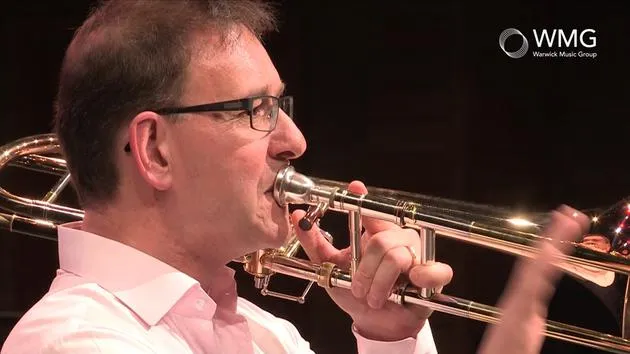
04. Detached Articulation
18:50
05. Mahler's Third Symphony
22:21
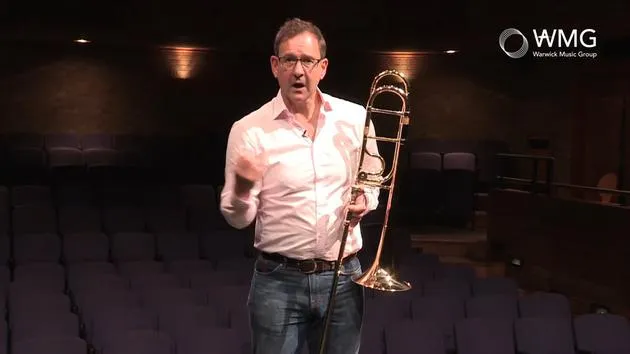
06. Mozart Requiem
13:41
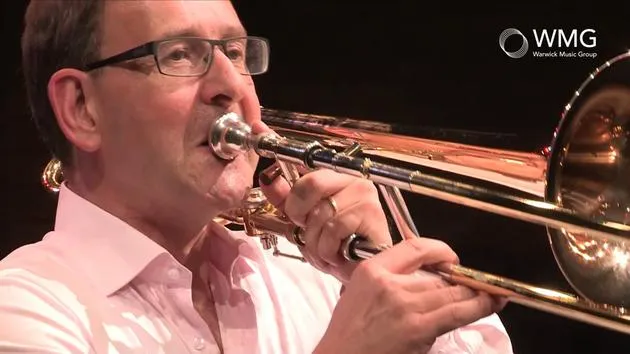
07. Ravel's Bolero
11:35
08. Legato
17:55
09. The Philosophy of Warm Up
14:04
10. Wagner, Ride of the Valkyries and Prelude to Act 3 of Lohengrin
12:20
Transkript der Lektion
Range Building in Music: A Comprehensive Lesson
In this video, I'd like to look at range building, something that's important to all of us.
What is Range Building?
Range building is something else that I title:
"The lips respond to the speed of the air and also high note entrances."
Range building is one of the things that I think is a concern to most students. Everyone wants to get higher, higher, higher, higher. We all love it. I'm as guilty as anybody.
The Bread and Butter Register
I'd really like to emphasize the point that I live in what I call the bread and butter register. That's where we earn our money.
- Look at the orchestral repertoire:
- That's where we work most of the time.
- To go higher than the B flat, I practice. I have to work to go lower than the bottom B flat. The same thing applies.
Stretching Our Borders
So, how do we stretch those borders?
- Mouthpiece Use: We have to be able to swoop around the register, going low and high on the same embouchure, just using the air differently.
- Open out, soften the airflow, and widen the airflow as we go low.
- Make it go faster as we swoop higher.
Importance of Scales
The other thing that is essential to range building is the ability to play scales.
"If you can't, well, then go away and learn a few scales."
- The German word for scales is "e ton".
- Later, it means "a tone ladder".
- Of course, we all know that we use ladders to climb up and down.
- So we really must know our scales. It's essential for range building.
The Practice Technique
The next thing that I do might sound quite strange. It's very superficial.
- Yes, I just did go from a low D flat to a top D flat.
- But if you listen very carefully, I'm not digging into the notes. It's very superficial, very, very light, very, very loose.
- Now, you don't have to go as low, or as high, with terrible slide technique, but with a wonderful use of air.
It's all incredibly relaxed. We just let the embouchure swoop low and swoop high.
Never Hurt Yourself
The important thing with growing our register is that:
- We never hurt ourselves.
- We never push.
- We never force.
Use the air:
"No, I wouldn't be proud to make a performance of that in public. But that's not what this is about. This is about improving."
Working with Air Speed
You may remember at the beginning of the video, I was going to talk about something called the lips respond to the speed of the air.
- That's what I'm practicing, where the lips respond to what I'm doing with the air.
- The faster the air comes through, the more the lips and the embouchure have to work to hold in position.
But that's the way it is.
- Too many people will try to play a top B flat and wonder why they can't go any higher.
- It's because we're overworking our embouchure.
Embouchure Functionality
The embouchure should never work harder than is necessary:
- Yes, we have to have it in position, but only loosely.
- The embouchure will react to the speed of the air.
- The faster the airstream goes through, the more the lips have to work.
Utilizing Flexibility Exercises
Of course, when we're working on building the register, we can play flexibilities. You'll find them in any book.
- Again, it's the airstream that's the important thing.
Very loose chromatics are also crucial:
- I said "very loose," didn't I? There's a reason for that.
- Because we don't want to break the airflow as soon as students start to get disciplined.
In order to build range, we must have this glissando air that I keep talking about.
Chromatic Practice
Chromatic of your choice is fine, but don't be frightened when you practice. You can say,
"When I do it this time, I'm concentrating on the airflow."
- It doesn't always have to come together with all of the individual parts of our technique working.
- Sometimes you can focus solely on the airflow right here.
What I do with these chromatics is:
- Go a semitone higher each time.
- Make a crescendo, then come down.
- But don't forget:
"If it hurts, it's wrong."
Avoiding Strain
Don't work your face too hard. Don't hurt yourself in range building. The non-specific high note is really, really important.
Learning from Masters
When I was young, one of my heroes was an English trombone player called Don Lusher.
- He played on a recording of Gordon Langford's Rhapsody for Trombone.
- There was a bit in the cadenza that went like this...
And that's actually how I learned to play high without realizing it, not the bit at the end, but the glissandos.
So many times, if I ask a student to play me a top C, they'll strain and panic.
- Then I say, "Just go from an F and say you just went up to a top F, or an E, or a D."
- And we go up there without realizing it.
The Method to Stretch Range
That's our way into gently stretching our range as we go higher. And always remember,
"Never practice your high register in isolation."
We must always start from the middle register, move up, and come down.
Conclusion
Otherwise, we're in danger of separating the high register off into a different embouchure, and then we can't fit it into the rest of our range.
So, there are a few insights into how I play high and develop my high register. If it's any reassurance to you, I have to constantly work on my high register too.
That's how I do it. That's my philosophy of how I approach range building in the high register. I hope there are some ideas here that help you and that you too can achieve the high register that you're looking for.
10 Lektionen
2 Std. 21 Min. strukturierte Videolektionen
Erweiterte Videofunktionen
Verlangsamen, Passagen loopen, mitlesen
Handy, Tablet & Desktop
Üben, wo du willst
100 % Zufriedenheitsgarantie
30 Tage Geld-zurück-Garantie
Lern deinen Guru kennen
Lern deinen Guru kennen
Ian Bousfield steht seit über einem Vierteljahrhundert an der Spitze seines Fachs und brilliert in vielleicht mehr Facetten des Musikgeschäfts als jeder andere Posaunist bis heute. Seine Laufbahn umfasst das Mitwirken in zwei der anerkannt weltbesten vier Orchester, von denen eines als vielleicht größtes Opernorchester gilt, Auftritte als Solist auf höchstem Niveau mit Orchestern, Brass Bands und auf historischen Instrumenten, Soloaufnahmen bei Spitzenlabels, das Einspielen von Titelmelodien für Hollywood-Blockbuster sowie die Lehrtätigkeit an der Royal Academy in London.
Als Solist ist Ian unter anderem mit der Vienna Philharmonic, dem London Symphony, dem London Philharmonic, dem BBC Philharmonic, dem Halle Orchestra, dem Sapporo Symphony und dem Austin Symphony aufgetreten. Er hat mit folgenden Dirigenten gearbeitet: Riccardo Muti, Michael Tilson Thomas, Sir Neville Marriner, Kent Nagano, Ion Marin und Matthias Bamert, und EMI, Camerata, Chandos und Doyen zählen zu den Labels, für die Ian im Laufe der Jahre mehrere Soloaufnahmen gemacht hat. Die wohl beiden Höhepunkte von Ians Solokarriere bis heute waren die dreimalige Aufführung des Nino-Rota-Konzerts mit der Vienna Philharmonic und Riccardo Muti (2008) in Wien sowie beim Lucerne Festival und in Tokio und die Uraufführung von Jonathan Doves Stargazer, das für ihn geschrieben und ihm gewidmet wurde, mit dem London Symphony Orchestra unter Michael Tilson Thomas (2007). Er ist mit allen bedeutenden Brass Bands der Welt aufgetreten und hat mit vielen von ihnen aufgenommen. Als Solist ist er praktisch überall auf der Welt aufgetreten, und als Dozent ist es vermutlich einfacher, die Konservatorien und Festivals zu nennen, bei denen er nicht aufgetreten ist!







