



Breathing, part 1
Das steckt im Kurs
10 Lektionen (2h 21m) · 1 gratis
01. Breathing, part 1
Du bist hier6:59
02. Rossini, William Tell and The Thievish Magpie
14:54
03. High Range Building
8:50
04. Detached Articulation
18:50
05. Mahler's Third Symphony
22:21
06. Mozart Requiem
13:41
07. Ravel's Bolero
11:35
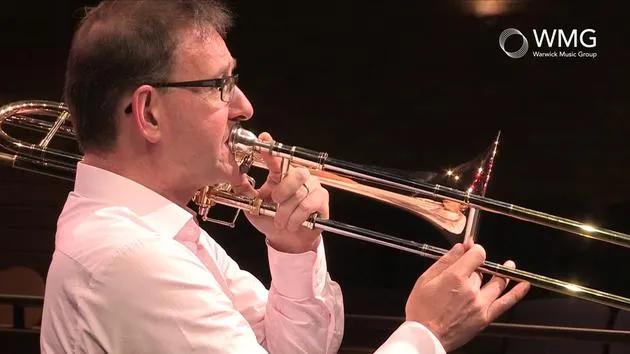
08. Legato
17:55
09. The Philosophy of Warm Up
14:04
10. Wagner, Ride of the Valkyries and Prelude to Act 3 of Lohengrin
12:20
Transkript der Lektion
Breathing in Brass Playing
In this video, I'd like to talk to you about one of the hottest topics in brass playing: breathing.
The Importance of Breathing vs. Blowing
- Everybody talks about it.
- Everybody places it as their number one importance.
- In fact, we hear many people saying the most important thing in brass playing is breathing.
Actually, I disagree. The most important thing in brass playing is blowing. But in order to do that, we have to get the air coming in correctly.
Breathing Technique
I'm not one of those people who discusses the diaphragm, positioning, or pushing out here and there. I don't like to keep it as physical as that.
- If we take the air in the way we want a note to sound, we'll breathe properly.
- For example, if we want a note to go like this, you can hear from the way the air comes in how the note is going to sound, as opposed to another style of breath.
You'll notice that both of those breaths are completely different.
Different Breaths for Different Pieces
- Mala 3 breath
- Bolero breath
- Berg three pieces breath
We have three completely different breaths. Basically, the focus of the breathing is in different places. You can think of it being at:
- This point,
- That point,
- Or this point.
This will bring the air in the way we want it to go out.
The Mechanics of Air
The most important thing is that the note begins with the air coming in. It starts here.
There is no single breathing method that fits every entrance we're going to play.
- Sometimes, the air will come in really fast, and then, bang!
- Other times, it's going to go exactly the way you'd speak, just think of it like that.
The most important thing is that the air must come in with no resistance.
- If you hear sounds like "uh" or anything similar, take it out.
- That's no good. We need it to come in completely without resistance.
A Helpful Breathing Example
Now, someone once showed me a fantastic example of how to breathe.
- If I keep talking until there's no more air left in my lungs and I hold that position, when I release it, my lungs automatically fill.
- This will work naturally and is a good way to understand how we actually breathe.
How Do We Release the Air?
This is very interesting. I'd like you to try this:
- Take a full breath of air in, hold it, and then release it.
- Now, did you have to blow the air out? No, you didn't.
The lungs want to exhale.
In many ways, having said that, blowing is more important than breathing, sometimes we don't even need to blow. This brings us to the subject of support.
The Concept of Support
There are two words that I don't like discussing in brass playing:
- One is diaphragm.
- The other is support.
Because what is support? To define it is very, very difficult.
Support is air pressure. It's a quantity of pressurized air within our body.
- Now, bear in mind that these are my words, my ways of explaining.
- I'm sure you can go and ask a doctor, and he'll tell you I'm talking nonsense. But these are my words and my thinking regarding breathing, and it works.
A Demonstration
If we take the air in and just let it release, there's no blowing involved. This is my default setting for how I actually play.
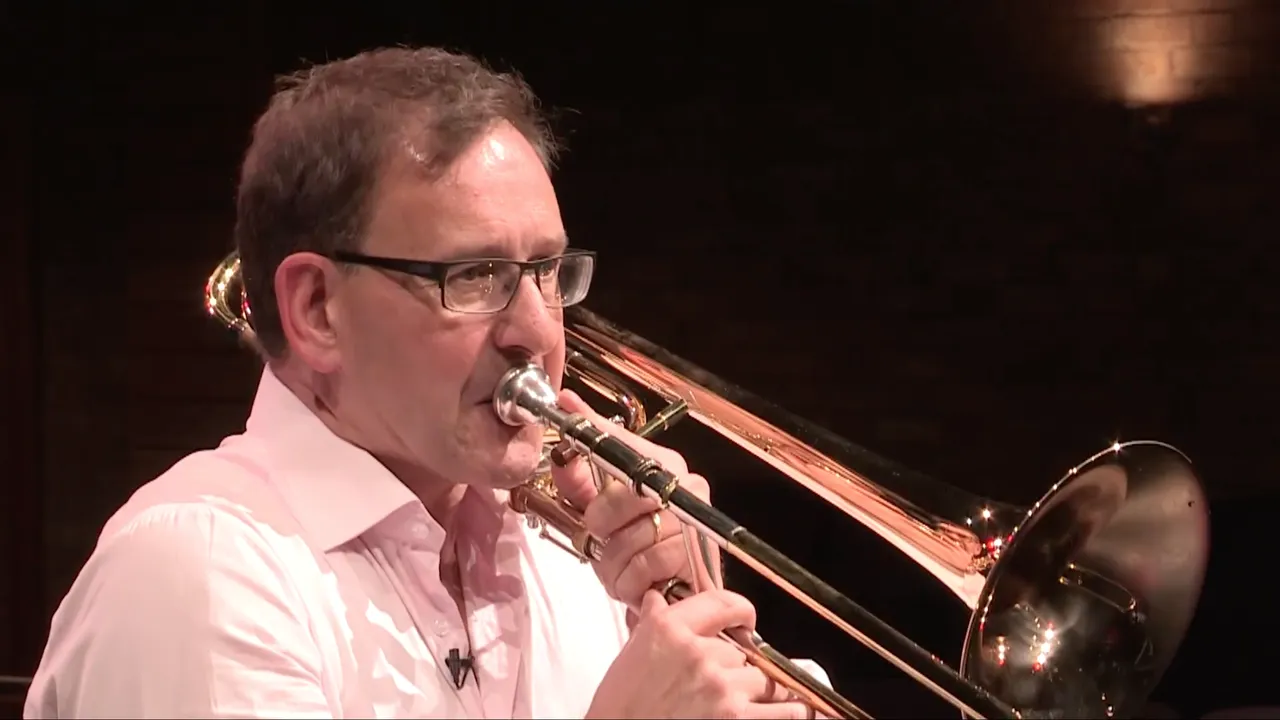
Here's the end of the second movement of the Davide concerto to show how air can just naturally exhale. There are no camera tricks here, so you can see how much air I apparently have if I just let my lungs exhale.
Mustn't do that too often, though. Not good for the blood pressure.
Overcoming Breathing Paralysis
There's one other thing that I'd like to discuss here:
I see so many students I work with who seem to be paralyzed by their breathing technique. Everything happens between here and here.
Let's not forget:
The objective of breathing is for the air to come out this way.
I see so many people, and it stops. The bottom line is we need to take air in, so it can come out through our lips and into the instrument.
Don't forget that. It sounds self-explanatory and simple, but it's often forgotten.
Don't be frightened when you're practicing breathing. Remember that breathing and blowing are linked.
10 Lektionen
2 Std. 21 Min. strukturierte Videolektionen
Erweiterte Videofunktionen
Verlangsamen, Passagen loopen, mitlesen
Handy, Tablet & Desktop
Üben, wo du willst
100 % Zufriedenheitsgarantie
30 Tage Geld-zurück-Garantie
Lern deinen Guru kennen
Lern deinen Guru kennen
Ian Bousfield steht seit über einem Vierteljahrhundert an der Spitze seines Fachs und brilliert in vielleicht mehr Facetten des Musikgeschäfts als jeder andere Posaunist bis heute. Seine Laufbahn umfasst das Mitwirken in zwei der anerkannt weltbesten vier Orchester, von denen eines als vielleicht größtes Opernorchester gilt, Auftritte als Solist auf höchstem Niveau mit Orchestern, Brass Bands und auf historischen Instrumenten, Soloaufnahmen bei Spitzenlabels, das Einspielen von Titelmelodien für Hollywood-Blockbuster sowie die Lehrtätigkeit an der Royal Academy in London.
Als Solist ist Ian unter anderem mit der Vienna Philharmonic, dem London Symphony, dem London Philharmonic, dem BBC Philharmonic, dem Halle Orchestra, dem Sapporo Symphony und dem Austin Symphony aufgetreten. Er hat mit folgenden Dirigenten gearbeitet: Riccardo Muti, Michael Tilson Thomas, Sir Neville Marriner, Kent Nagano, Ion Marin und Matthias Bamert, und EMI, Camerata, Chandos und Doyen zählen zu den Labels, für die Ian im Laufe der Jahre mehrere Soloaufnahmen gemacht hat. Die wohl beiden Höhepunkte von Ians Solokarriere bis heute waren die dreimalige Aufführung des Nino-Rota-Konzerts mit der Vienna Philharmonic und Riccardo Muti (2008) in Wien sowie beim Lucerne Festival und in Tokio und die Uraufführung von Jonathan Doves Stargazer, das für ihn geschrieben und ihm gewidmet wurde, mit dem London Symphony Orchestra unter Michael Tilson Thomas (2007). Er ist mit allen bedeutenden Brass Bands der Welt aufgetreten und hat mit vielen von ihnen aufgenommen. Als Solist ist er praktisch überall auf der Welt aufgetreten, und als Dozent ist es vermutlich einfacher, die Konservatorien und Festivals zu nennen, bei denen er nicht aufgetreten ist!







