



Detached Articulation
Das steckt im Kurs
10 Lektionen (2h 21m) · 1 gratis
01. Breathing, part 1
Gratis-Lektion6:59
02. Rossini, William Tell and The Thievish Magpie
14:54
03. High Range Building
8:50
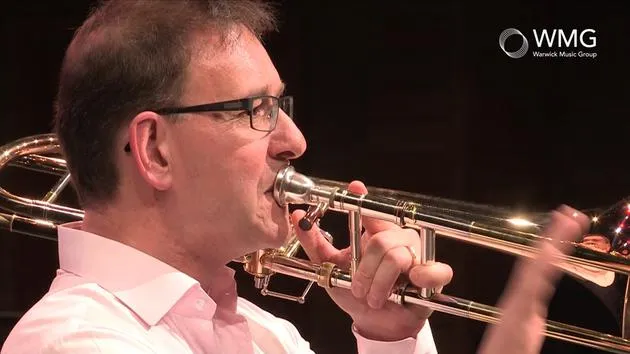
04. Detached Articulation
Du bist hier18:50
05. Mahler's Third Symphony
22:21
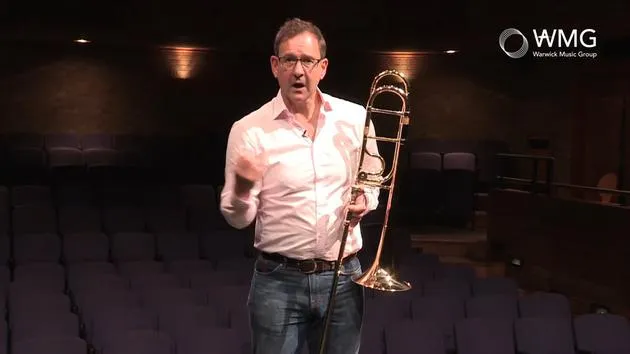
06. Mozart Requiem
13:41
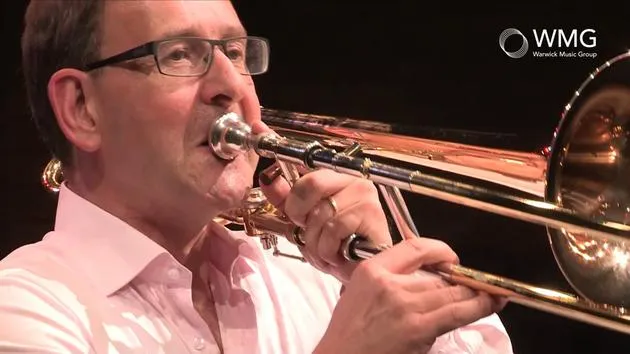
07. Ravel's Bolero
11:35
08. Legato
17:55
09. The Philosophy of Warm Up
14:04
10. Wagner, Ride of the Valkyries and Prelude to Act 3 of Lohengrin
12:20
Transkript der Lektion
: The tongue can effectively strike your tooth, but it must remain relaxed. If I'm honest, about two-thirds of my tooth is covered by my tongue when I play, but I'm not pushing.
Myth 2: Saying "Ta" for Articulation
- We're often taught to say "ta, ta, ta" or "da, da, ta". However, this causes the jaw to move.
- If we try to say "ta" without moving our chin, it doesn't work.
- Move away from vowel sounds and focus on relaxed contact. The sound should be a blend of P, N, D, and ta.
Importance of the End of the Note
- The clarity of the beginning of the next note depends on the embouchure's position at the end of the previous note.
- Often, the embouchure is affected by airflow , it can push the lips open when played, causing a lack of clarity.
- Critical Point: The aperture (the hole) must be maintained. If the embouchure tries to revert to its position as we articulate, we lose clarity.
Practicing Articulation Without the Trombone
- The combination of tongue and air can be practiced without the trombone:
- Think of blowing out a birthday candle , the goal is to get the air out effectively.
- Isolate the use of air and tongue in practice to enhance articulation without relying solely on the instrument.
Preparation is Key
- The clarity of articulation depends on ensuring the air is flowing correctly to create the note.
- Always have the embouchure fixed in position before playing. Speaking through the embouchure can help achieve ultimate clarity, ensuring the aperture is open and ready.
Summary of Articulation System
- The embouchure must be:
- Open and fixed at the beginning, middle, and end of the note.
- The tongue:
- Touches wherever needed, remains relaxed, and should not use the tip.
- Focus on direction of airflow when using the tongue.
Practical Exercise: Fast Articulation
When I joined the London Symphony Orchestra at 23, my biggest weakness was fast articulation. I spent several months working on this, starting with a series of exercises.
- Tip:
- Begin by ensuring the embouchure is fixed while developing your articulation system.
- Try the exercise for triple tonguing found in traditional etude books.
- Understand that clarity and legato can be challenging; playing with clarity and length is harder but essential.
The Slow Exercise
- Use a metronome to practice:
- Ensure the clarity of sound comes from consistent airflow through the instrument.
- The key to this practice is keeping the tongue relaxed.
Mastering Speed
- To achieve speed in articulation:
- Focus on the clarity at the beginning of the note while maintaining relaxed articulation.
- The airflow must be steady.
- As your skills progress, push through the discomfort , that's where growth happens.
Final Thoughts
In conclusion, the basics of detached articulation include:
- The embouchure must remain in position.
- The aperture must be set and stable.
- The tongue touches lightly and relaxed, without using the tip.
By mastering these elements, you will enhance your playing and develop clear, articulate sound on your instrument. Happy practicing!
10 Lektionen
2 Std. 21 Min. strukturierte Videolektionen
Erweiterte Videofunktionen
Verlangsamen, Passagen loopen, mitlesen
Handy, Tablet & Desktop
Üben, wo du willst
100 % Zufriedenheitsgarantie
30 Tage Geld-zurück-Garantie
Lern deinen Guru kennen
Lern deinen Guru kennen
Ian Bousfield steht seit über einem Vierteljahrhundert an der Spitze seines Fachs und brilliert in vielleicht mehr Facetten des Musikgeschäfts als jeder andere Posaunist bis heute. Seine Laufbahn umfasst das Mitwirken in zwei der anerkannt weltbesten vier Orchester, von denen eines als vielleicht größtes Opernorchester gilt, Auftritte als Solist auf höchstem Niveau mit Orchestern, Brass Bands und auf historischen Instrumenten, Soloaufnahmen bei Spitzenlabels, das Einspielen von Titelmelodien für Hollywood-Blockbuster sowie die Lehrtätigkeit an der Royal Academy in London.
Als Solist ist Ian unter anderem mit der Vienna Philharmonic, dem London Symphony, dem London Philharmonic, dem BBC Philharmonic, dem Halle Orchestra, dem Sapporo Symphony und dem Austin Symphony aufgetreten. Er hat mit folgenden Dirigenten gearbeitet: Riccardo Muti, Michael Tilson Thomas, Sir Neville Marriner, Kent Nagano, Ion Marin und Matthias Bamert, und EMI, Camerata, Chandos und Doyen zählen zu den Labels, für die Ian im Laufe der Jahre mehrere Soloaufnahmen gemacht hat. Die wohl beiden Höhepunkte von Ians Solokarriere bis heute waren die dreimalige Aufführung des Nino-Rota-Konzerts mit der Vienna Philharmonic und Riccardo Muti (2008) in Wien sowie beim Lucerne Festival und in Tokio und die Uraufführung von Jonathan Doves Stargazer, das für ihn geschrieben und ihm gewidmet wurde, mit dem London Symphony Orchestra unter Michael Tilson Thomas (2007). Er ist mit allen bedeutenden Brass Bands der Welt aufgetreten und hat mit vielen von ihnen aufgenommen. Als Solist ist er praktisch überall auf der Welt aufgetreten, und als Dozent ist es vermutlich einfacher, die Konservatorien und Festivals zu nennen, bei denen er nicht aufgetreten ist!







