Einen Valve Blow Bend in einer Melodie einsetzen (My Romance)

Mit
PT GazellIn dieser Lektion lernst du “My Romance”, das den Valve Blow Bend am 6. Loch verwendet. Das ist die große Septime in 2. Position, gerade gespielt wie in der bereitgestellten Tabulatur.
Das steckt im Kurs
10 Lektionen (0h 50m) · 1 gratis
01. Wie wir unsere Bending-Technik fokussieren und verfeinern
5:35
02. Die Valved Bends verstehen
Gratis-Lektion4:59
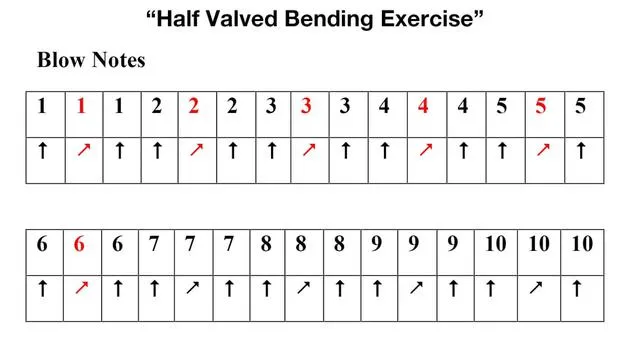
03. Eine weitere Half-Valve-Bending-Übung
5:09
04. 3 Bending-Übungen mit Ventil
4:45
05. Bends mit und ohne Ventile nutzen, um das ganze Instrument zu erkunden
3:54
06. Einen Valve Blow Bend in einer Melodie einsetzen (My Romance)
Du bist hier6:05
07. Die zusätzliche Emotion der Gazell-Methode nutzen
6:59
08. Moll in der 5. Position als Alternative zu Moll in der 3. Position
5:07
09. Lerne das Thema des Songs „Sugar“ in der 5. Lage in Moll
3:40
10. Ein Solo für „Sugar“ lernen und wie du den ganzen Song spielst
4:11
Transkript der Lektion
Lesson Four: Using a Valved Blow Bend in Melody
Welcome back everybody!
Introduction
This is lesson four. In this lesson, we're going to learn how to use a valved blow bend inside a melody. The name of the tune is called My Romance, and you've got a PDF with a tab of the song.
Key Point
- The six blow bend is marked in red so that you remember it's a blow bend.
Demonstration
I'm going to play this very straight. In other words, I'm not going to do any ornamentation, vibrato, or emotional shading. I'm just going to play the melody so that you guys can hear what it sounds like, follow along on your tab, and hear what the six blow bend sounds like used inside a melody.
Importance of the Six Blow Bend
This is important stuff because:
- Once you start to get familiar with the six blow bend and how it sounds, you're going to remember where it is on the harmonica.
- The six blow bend is our major seventh in second position.
- That particular note is really important in so many melodies, especially in songs from this genre.
Note:
- That note is not on a Richter tuned harmonica in that second octave.
- It fits in so many melodies.
So, I thought it would be a great idea to go ahead and do this as an example. Again, I'm going to play this very straight, and then we'll move on from there.
Playing the Melody
Here is My Romance; this is our intro. And here we go.
(Plays melody)
Okay, great! So that was My Romance. As you can see, I played it with no ornamentation.
Syncopation and Execution
- I tried to play everything right on the beat.
- I aimed for a very syncopated feel, just like you're looking at on the tab.
The important thing here was the six blow bend so that you could hear what that sounds like.
"It's this note, guys, that note."
I strive to make my valved bends sound just like my regular notes or conventional bending. That's the whole secret behind a nice, rounded, even sound.
Technique Reminder
When playing on the diatonic harmonica, remember:
- Our valved bending happens more towards the front of the mouth.
- It uses a very compressed, narrow stream of air to hold a single reed on a bend.
Tongue Positioning
- Da oo is a good way to think about it.
- When we make our mouth do that, that's kind of what we're looking for on the stream, whether it's exhaling or inhaling.
Example:
- Ah oo: Notice how narrow my mouth gets and how my lips move forward.
What I mean by this is: make the bend happen further forward in your mouth rather than further back.
Adjusting Sound
We still need to move our tongue, arch our tongue, and lower our jaw a little bit in order to change the curve of air so that the note changes, but the actual bending itself happens more towards the front of the mouth.
Next Lesson
In the next lesson, I'm going to come back and play the same tune again, but this time I'm going to add ornamentation and some emotion, and you'll see the difference.
10 Lektionen
0 Std. 50 Min. strukturierte Videolektionen
Erweiterte Videofunktionen
Verlangsamen, Passagen loopen, mitlesen
Handy, Tablet & Desktop
Üben, wo du willst
100 % Zufriedenheitsgarantie
30 Tage Geld-zurück-Garantie
Lern deinen Guru kennen
Lern deinen Guru kennen
PT Gazell hat sich seine Stellung als Meister der diatonischen Mundharmonika erarbeitet. Nach Jahren als gefragter Begleit- und Studiomusiker für einige der größten Namen Nashvilles entdeckte PT das Half-Valving, und seine Musik erreichte buchstäblich neue Höhen.
Kein anderer Spieler verbindet seine Phrasierung, seinen melodischen Stil, seine Stückauswahl und seine Improvisationsfähigkeiten so wie er - am Ende ist es ein ganz eigener Stil. Mit seinem eigenen Signature-Instrument, der von Seydel gefertigten diatonischen Gazell Method, beweist PT, dass die Mundharmonika zu weit mehr fähig ist, als die meisten von uns glauben.
Genieß es!
In seinen Kursen unterrichtet PT das Half-Valving direkt aus erster Hand, damit du mit der Gazell Method starten, gedämpfte (valved) Bends meistern und sie in deine eigenen Songs einbringen kannst.