



Rhythmus und die rechte Hand
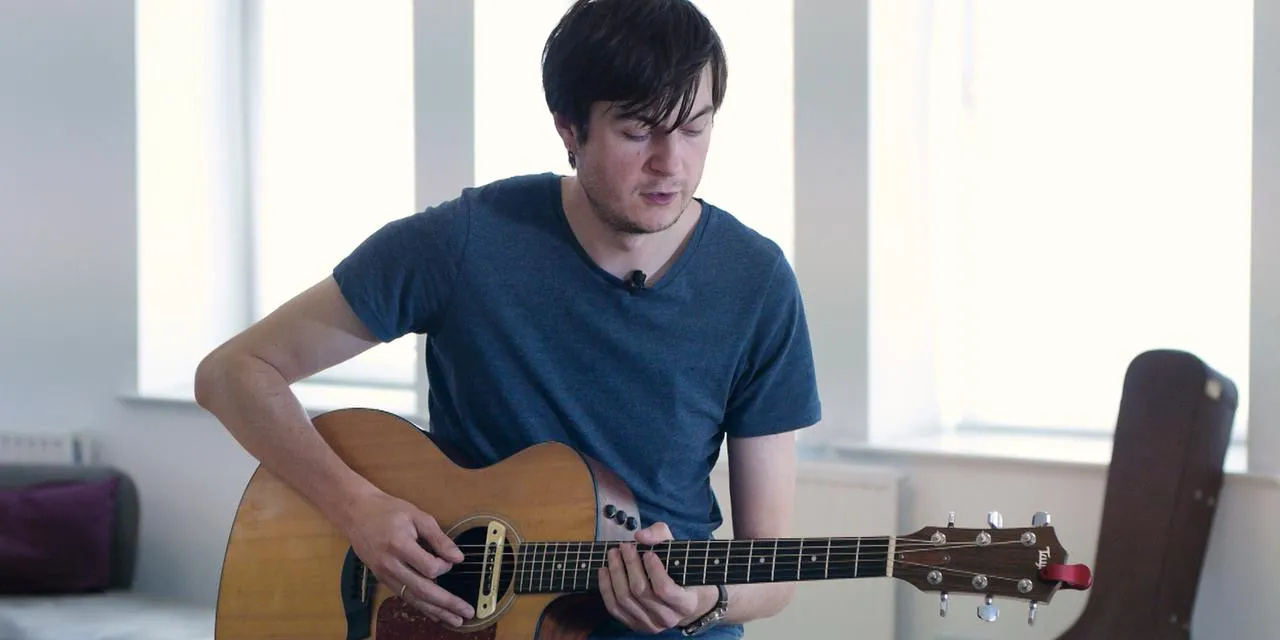
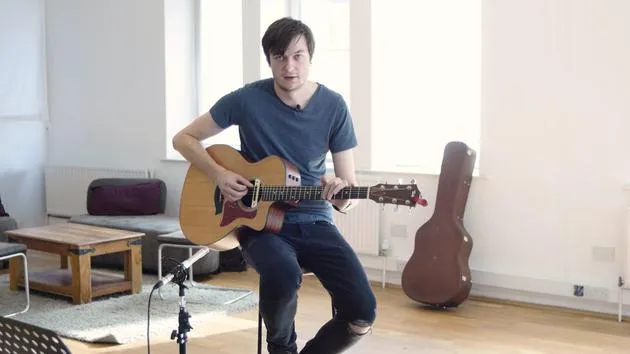
James richtet den Fokus auf die Schlaghand und baut von Vierteln aus Achtelmuster, Ghost-Strums und Sechzehntel über einer gleichbleibenden e-Moll-Form auf.
Das steckt im Kurs
14 Lektionen (2h 12m) · 1 gratis
01. Stimmen
13:34
02. Erste Schritte
Gratis-Lektion9:58
03. Grundtechnik
9:01
04. Offene Akkorde
6:24
05. Akkordfolgen
7:57
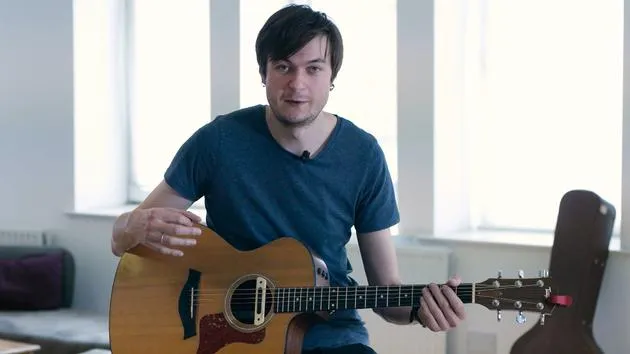
06. Rhythmus und die rechte Hand
Du bist hier11:56
07. REM - Everybody Hurts
9:01
08. Bryan Adams - Run To You
3:23
09. Palm Muting
3:16

10. Legato
8:47
11. Michael Jackson - Beat It
5:23
12. Bending
15:36

13. Barré-Akkorde
11:35
14. Zusammenfassung - AC/DC Back In Black
16:56
Transkript der Lektion
Music Lesson: Rhythm and the Right Hand
Introduction
Hey, guys! So today's lesson is going to be all about rhythm and the right hand. Okay?
We've previously looked at a bunch of open chords with the left hand and how to focus solely on the left hand while doing something straightforward with the right hand. Now, we're flipping that around.
Lesson Focus
We are going to look at our right hand while keeping the left hand in a straightforward static shape. For this whole lesson, we're going to be using E minor and nothing else with the left hand. It's all about the right hand.
Up until now, when we've been working on our chord progressions, we stuck to a simple quarter note rhythm with the right hand. This was great for practicing open chord changes. Now that you've got those together a little more, we are going to build up the right hand.
Eighth Notes Introduction
The first thing we need to introduce is eighth notes. This means we're going to cram double the amount of notes into the space where we only had four before. So, now we're going to have eight.
Here's how it looks:
- Quarter notes: 1, 2, 3, 4
- Eighth notes: 1 and 2 and 3 and 4 and
What I'm doing here is simply doubling the speed of my right hand and using upstrokes in between those downstrokes.
- Tip: There's no need to change your picking angle. Keep your right hand nice and relaxed. Make sure the movement comes from your wrist, not from your arm.
- Common Mistake: Avoid digging into the strings too much, especially on the upstrokes. Let your pick glide over the strings.
Practice Exercise
The first exercise worth practicing is going between quarter notes and eighth notes. Start with quarter notes, then switch to eighth notes back again.
- Pro Tip: Grab a metronome, set it nice and slow, and practice this.
Soon, you may find this exercise boring. What we want to do is combine those rhythms to create more interesting strum patterns.
Strum Patterns
Let's fret the E minor chord. For our first combined strum pattern:
- First half: beats one and two will be downstrokes.
- Second half: we'll do eighths.
Pattern Example:
- 1, 2, 3 and 4
Now we have more interesting diversity in rhythms.
Additional Patterns
Let's look at a second pattern that combines those rhythms.
Second Pattern:
- Counting: 1 and 2, 3 and 4
- Downstrokes are the counted beats (1, 2, 3, 4), while the upstrokes are off beats (the "and").
Both of these patterns are much more interesting than what we've been doing before.
Ghosting Technique
Now, let's take it a step further and introduce what's called ghosting.
We've actually been ghosting without realizing it. For instance, when we played two downstrokes in a row, we had to move our pick up over the strings without strumming them, technically ghosting an upstroke.
Now we will miss downstrokes in our patterns.
First Ghosting Pattern:
- We will play straight eighth notes but miss out beat three.
- Counting: 1 and 2 and 3 (miss) and 4
The idea is that if you mute the audio, my right hand would appear to be strumming eighth notes.
Why Ghosting?
- We maintain beat one as a downstroke. If we stop and start, it feels awkward and disrupts the natural flow.
Try With E Minor:
- 1 and 2 and 3 (miss) and 4
Really interesting sound, right? These types of patterns are prevalent in popular music.
More Ghosting Patterns
I've written out a couple more patterns:
- Second Ghosting Pattern: Miss out beat two and beat four (which is an upstroke).
Try not to overthink this technique. Relax your right hand, allowing it to feel like it's strumming consecutive eighth notes.
Practice:
- 2, 3, 4 (with the E minor chord)
Final Ghosting Pattern
Here is the third and final ghosting pattern. This time, we will miss out beat two and beat three, which results in consecutive upstrokes.
Counting:
- 1 (down), 2 (miss), 3 (miss), and 4
Transitioning to 16th Notes
Before moving on, let's relax the right hand. It should feel like it's doing consecutive eighth notes.
Now, we introduce 16th notes.
Counting: 1e and a, 2e and a, 3e and a, 4e and a
Exercise: Do quarter notes -> eighth notes -> sixteenths: 1e and a, 2e and a, 3e and a, 4e and a
In this pattern:
- The downstrokes occur on both counted beats and off beats.
- The off beats (the "ands") have upstrokes.
Ghosting with 16th Notes
The ghosting technique applies here as well. Keep your right hand relaxed, moving through the strum pattern, and introduce ghosting for 16th notes.
E Minor Example:
- Play a 16th note pattern now for demonstration.
Conclusion
You can see that although I'm only picking certain accents, my right hand is moving consistently.
If you can apply a strum pattern like that to any of the nine open chords, you can play hundreds of songs!
Spend some time really getting to know your right hand and those changes in subdivisions. Start applying the progressions we've looked at today to the earlier chord progressions.
Good luck, and I'll see you next time!
14 Lektionen
2 Std. 12 Min. strukturierte Videolektionen
Erweiterte Videofunktionen
Verlangsamen, Passagen loopen, mitlesen
Handy, Tablet & Desktop
Üben, wo du willst
100 % Zufriedenheitsgarantie
30 Tage Geld-zurück-Garantie
Lern deinen Guru kennen

Lern deinen Guru kennen
James verfolgt seit seinem Abschluss an der Academy of Contemporary Music im Jahr 2007 eine erfolgreiche Karriere als hauptberuflicher Musiker. Seither hat er mit Künstlern und Produzenten von Stereophonics, Ronnie Dunn, Scissor Sisters und vielen anderen zusammengearbeitet. Außerdem komponiert er Musik für Fernsehen und Film, etwa für den Fernsehspot 'Music Pieces' von Sony Walkman und den Trailer zum Film Albatross.
Er bezeichnet sich selbst als eine Art Purist, einen Musiker für Musiker, und diese Herangehensweise an seine Kunst hat die Aufmerksamkeit großer Unternehmen und TV-Produzenten geweckt. Dank seiner natürlichen Vielseitigkeit als Künstler ist James in Sendungen wie 'Geordie Shore' und sogar in Werbespots der British Heart Foundation zu hören. Wie er selbst sagt: „Das beste und häufigste Kompliment, das ich bei Sessions für Kunden bekomme, ist, dass ich das spiele, was für die Musik 'richtig' ist. Oft läuft alles auf Schlichtheit hinaus.“
„James ist das Wahre. Großartiger Spieler, umwerfender Ton, und ich würde ihn ohne zu zögern für jedes Projekt empfehlen. Rock on, James!“ - Joey Sykes (Meredith Brooks / Will Champlin / The Babys)
In Foundations of Rock Guitar Technique gibt James genau diese Philosophie weiter und zeigt dir, wie du eine solide, musikalische Rockgitarrentechnik aufbaust und das spielst, was für den Song 'richtig' ist.







