



Stimmen
Das steckt im Kurs
14 Lektionen (2h 12m) · 1 gratis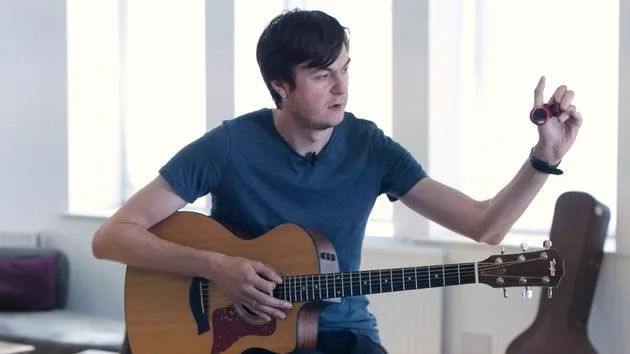
01. Stimmen
Du bist hier13:34
02. Erste Schritte
Gratis-Lektion9:58
03. Grundtechnik
9:01
04. Offene Akkorde
6:24
05. Akkordfolgen
7:57
06. Rhythmus und die rechte Hand
11:56
07. REM - Everybody Hurts
9:01
08. Bryan Adams - Run To You
3:23
09. Palm Muting
3:16
10. Legato
8:47
11. Michael Jackson - Beat It
5:23
12. Bending
15:36

13. Barré-Akkorde
11:35
14. Zusammenfassung - AC/DC Back In Black
16:56
Transkript der Lektion
Guitar Tuning Lesson
Hey, guys! Today's lesson is going to be all about how to tune the guitar.
Importance of Tuning
It's really, really important to get into the habit of regularly tuning the guitar, pretty much every time you pick it up to play. We want to make sure that it's "bang on" tune!
Vulnerable Parts
The tuning pegs on the top are one of the most vulnerable parts of the guitar. They're really sensitive to:
- Getting knocked as you put it in the car
- Changes in temperature
So even if you think, "Yeah, last time I played it, it was in tune," it may not still remain in tune. It's crucial that we regularly check it.
Know Your Strings
If you're new to the guitar, it's essential to know the names of each of the strings. The way in which you are usually directed to a note on the guitar is by the name of the string.
Standard Pitch of Open Strings
Let's go through the standard pitches of the open strings on the guitar:
- E - The thickest string (lowest pitch)
- A
- D
- G
- B
- E - The top string
A very quick reference point: If your top and bottom strings sound like they're the same note (they are in different octaves), then that's a rough indication that those two notes are in tune.
Helpful Mnemonics
To remember the notes of the strings, here are a couple of popular methods:
- "Elephants and Donkeys Grow Big Ears"
- "Eddy 8 Dynamite Goodbye Eddy"
Make sure this information is known absolutely off by heart without even thinking about it!
Learning to Fret Chords
When fretting a chord, you're directed to where to place your fingers by saying something like, "Right, we're going to place our specific finger on the third fret of the B string." Knowing the string names will significantly speed up your learning process.
Tuning Methods
If your guitar is out of tune or you're unsure, the easiest method is to use an electronic tuner.
Types of Tuners
- Headstock tuner - like the one I have here.
- Guitar pedals - that you plug into.
- Smartphone apps - many free options available.
Key Settings on Tuners
- Look for a number around 440 ? this is called the reference pitch.
- Make sure it says A = 440 to tune your instrument to standard tuning.
Some tuners come with different modes for various instruments, so ensure it's on the guitar setting or a chromatic setting.
Tuning Technique
When tuning with an electronic tuner:
- Pluck one string at a time. Avoid plucking the next string while the previous string is still ringing, as it confuses the tuner.
- Mutate the last string before moving on to the next one.
Demonstration
Now, let's go through the strings again. For example, when tuning the E string:
- If I pluck it, and the pitch settles, it should be in the middle of the tuner.
- Detuning it slightly may show D sharp, which means I need to tune it back up to E.
Continue tuning the other strings in the same way:
- A string
- D string
- G string (may be ever so slightly sharp)
- B string
- Thin E string
Tuning by Ear
If you don't have an electronic tuner, you can still tune the guitar by ear.
Reference Point
Make sure the low E is as close to an E as possible by ear. Once you're happy with that, you can tune the guitar to itself using one of two common methods.
Method 1: Fifth Fret Technique
- For the bottom E string, fret the 5th fret and pick. It should match the open A string.
- Repeat for the A string (5th fret = open D string).
- For the D string (5th fret = open G string).
- For the G string, fret the 4th fret and match it to the open B string.
- Finally, for the B string, fret the 5th fret and match it to the open E string.
Method 2: Natural Harmonics
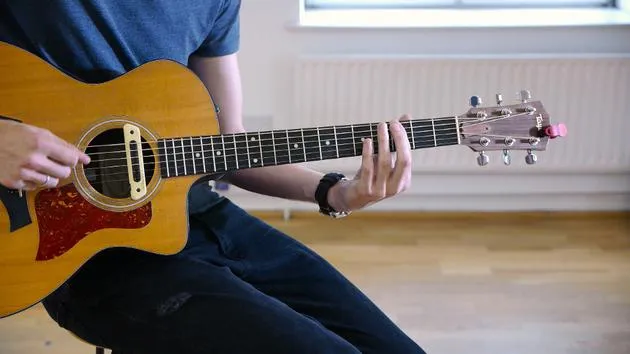
If you're more advanced, you can use natural harmonics. This involves hovering above the metal of the fret rather than pushing the string onto the fretboard.
- Match the 5th fret harmonic on the bottom E string with the 7th fret harmonic on the A string.
- Repeat with the A and D strings, D and G strings. For G, use the 4th fret harmonic matching with the B string's 5th fret harmonic.
- Finally, match the 5th fret harmonic on the B string with the 7th fret harmonic on the E string.
Altered Tunings
What are Altered Tunings?
An altered tuning is any tuning where one or more strings differ from standard tuning. One of the most common is drop D.
Drop D
To achieve drop D, lower the E string to a D:
- Use your electronic tuner or match it by ear with the existing D string.
- You can verify this with harmonics: the 12th fret on the original D string matches the 5th fret on your new D string.
Conclusion
I hope this has helped you gain some confidence in how to tune the guitar, one of the most essential lessons. On the accompanying PDF, you'll find details on other common alternate tunings, such as:
- E flat tuning: Each string lowered by a semitone.
- Dadgad tuning: D A D G A D, a popular folk tuning.
Practice getting your guitar "bang on" tune, either using an electronic tuner or your ears, and then we can get onto some playing!
See you next time!
14 Lektionen
2 Std. 12 Min. strukturierte Videolektionen
Erweiterte Videofunktionen
Verlangsamen, Passagen loopen, mitlesen
Handy, Tablet & Desktop
Üben, wo du willst
100 % Zufriedenheitsgarantie
30 Tage Geld-zurück-Garantie
Lern deinen Guru kennen

Lern deinen Guru kennen
James verfolgt seit seinem Abschluss an der Academy of Contemporary Music im Jahr 2007 eine erfolgreiche Karriere als hauptberuflicher Musiker. Seither hat er mit Künstlern und Produzenten von Stereophonics, Ronnie Dunn, Scissor Sisters und vielen anderen zusammengearbeitet. Außerdem komponiert er Musik für Fernsehen und Film, etwa für den Fernsehspot 'Music Pieces' von Sony Walkman und den Trailer zum Film Albatross.
Er bezeichnet sich selbst als eine Art Purist, einen Musiker für Musiker, und diese Herangehensweise an seine Kunst hat die Aufmerksamkeit großer Unternehmen und TV-Produzenten geweckt. Dank seiner natürlichen Vielseitigkeit als Künstler ist James in Sendungen wie 'Geordie Shore' und sogar in Werbespots der British Heart Foundation zu hören. Wie er selbst sagt: „Das beste und häufigste Kompliment, das ich bei Sessions für Kunden bekomme, ist, dass ich das spiele, was für die Musik 'richtig' ist. Oft läuft alles auf Schlichtheit hinaus.“
„James ist das Wahre. Großartiger Spieler, umwerfender Ton, und ich würde ihn ohne zu zögern für jedes Projekt empfehlen. Rock on, James!“ - Joey Sykes (Meredith Brooks / Will Champlin / The Babys)
In Foundations of Rock Guitar Technique gibt James genau diese Philosophie weiter und zeigt dir, wie du eine solide, musikalische Rockgitarrentechnik aufbaust und das spielst, was für den Song 'richtig' ist.







