



Barré-Akkorde
Das steckt im Kurs
14 Lektionen (2h 12m) · 1 gratis
01. Stimmen
13:34
02. Erste Schritte
Gratis-Lektion9:58
03. Grundtechnik
9:01
04. Offene Akkorde
6:24
05. Akkordfolgen
7:57
06. Rhythmus und die rechte Hand
11:56
07. REM - Everybody Hurts
9:01
08. Bryan Adams - Run To You
3:23
09. Palm Muting
3:16
10. Legato
8:47
11. Michael Jackson - Beat It
5:23
12. Bending
15:36
13. Barré-Akkorde
Du bist hier11:35
14. Zusammenfassung - AC/DC Back In Black
16:56
Transkript der Lektion
Music Lesson: Understanding Barre Chord Shapes
Hey, guys!
Today's lesson is going to be all about barre chord shapes.
Introduction to Barre Chords
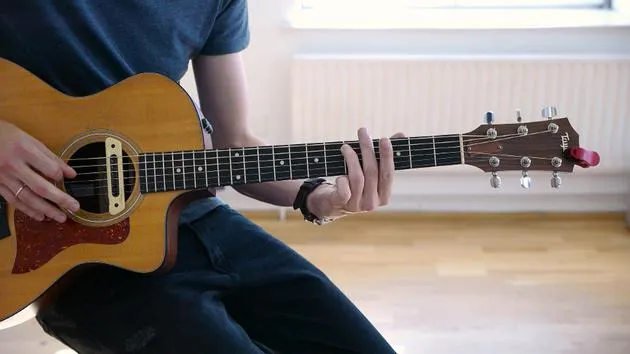
So far, the chords we've looked at have been known as open chords, which are a combination of fretted notes and open strings.
Barre chords are chord shapes that rely on no open strings whatsoever and only fretted notes.
- Important: This involves barring a finger across one or more strings.
We're going to look at the four most common barre chord shapes:
- Two major shapes
- Two minor shapes
The great thing about barre chords is that once you learn these four shapes, you can play any major and minor chord all over the guitar.
- Unlike open chords, where we had a specific shape for D minor, a different shape for A minor, and yet another for E minor, with barre chords, we simply change the position of where we're playing the chord while keeping the shape the same.
Note: They can be a little tricky to master initially, so we will look at the technique behind playing them.
A Major Barre Chord
Let's start with A major as a barre chord.
-
Barring the Strings
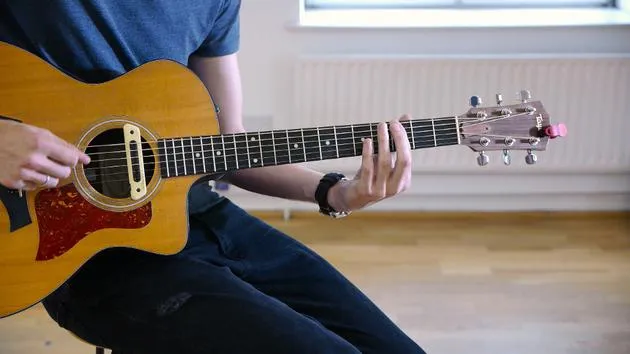
- We're going to take our first finger and bar all six strings.
- It's essential to ensure your first finger has enough strength for all strings to ring out.
-
Common Pitfalls
- Avoid piling on pressure with the second finger; this can hinder access to other fingers.
- Do not overshoot the bar; your finger should be parallel to the frets.
-
Finger Placement for A Major
- For the A major chord:
- 2nd finger: 6th fret of the G string
- 3rd finger: 7th fret of the A string
- 4th finger: 7th fret of the D string
- For the A major chord:
Visualizing the Move:
- When you play an open E major chord with the second, third, and fourth fingers, you can move that shape up to create A major.
- Moving the A Major Shape
- This shape is completely movable:
- Move it up two frets for G major
- Move down two frets for F major
- Move it up for B major
- This shape is completely movable:
A Minor Barre Chord
Now, let's look at how to turn A major into A minor.
- Simply remove the second finger.
- Ensure your first finger still covers the E string and the top three strings (G, B, E).
Root Note Reminder
- The root note for all these chords is on the low E string.
- E.g., to play C major, find C on the low E string (8th fret) and apply the chord shape accordingly.
D Minor and D Major Barre Chords
Next, we will explore barre chords where the root note is on the A string.
D Minor Chord Shape
- Bar from the A string downwards (no need to bar the E string).
- Use the tip of your finger to mute the E string.
Finger Placement for D Minor
- 2nd finger: 6th fret of the B string
- 3rd finger: 7th fret of the D string
- 4th finger: 7th fret of the G string
Equivalent D Major Barre Chord
- To create D major, use a similar barring technique.
- Consider barring with your little finger across the D, G, and B strings on the 7th fret.
Practice Exercise: Pachelbel's Canon
As a practice exercise, we can use Pachelbel's Canon.
Sequence of Chords:
- Start with D major.
- Move to A major.
- Change to B minor (A minor shape, moved up).
- Move down to F# minor.
- Transition back to G major.
- Return to D major.
- Back to G major.
- End with A major.
Slow Playthrough
Let me play that for you real slowly to practice moving between all four barre chord shapes.
Conclusion
I hope this lesson was useful for you, and I look forward to seeing you in the next lesson!
14 Lektionen
2 Std. 12 Min. strukturierte Videolektionen
Erweiterte Videofunktionen
Verlangsamen, Passagen loopen, mitlesen
Handy, Tablet & Desktop
Üben, wo du willst
100 % Zufriedenheitsgarantie
30 Tage Geld-zurück-Garantie
Lern deinen Guru kennen
Lern deinen Guru kennen
James verfolgt seit seinem Abschluss an der Academy of Contemporary Music im Jahr 2007 eine erfolgreiche Karriere als hauptberuflicher Musiker. Seither hat er mit Künstlern und Produzenten von Stereophonics, Ronnie Dunn, Scissor Sisters und vielen anderen zusammengearbeitet. Außerdem komponiert er Musik für Fernsehen und Film, etwa für den Fernsehspot 'Music Pieces' von Sony Walkman und den Trailer zum Film Albatross.
Er bezeichnet sich selbst als eine Art Purist, einen Musiker für Musiker, und diese Herangehensweise an seine Kunst hat die Aufmerksamkeit großer Unternehmen und TV-Produzenten geweckt. Dank seiner natürlichen Vielseitigkeit als Künstler ist James in Sendungen wie 'Geordie Shore' und sogar in Werbespots der British Heart Foundation zu hören. Wie er selbst sagt: „Das beste und häufigste Kompliment, das ich bei Sessions für Kunden bekomme, ist, dass ich das spiele, was für die Musik 'richtig' ist. Oft läuft alles auf Schlichtheit hinaus.“
„James ist das Wahre. Großartiger Spieler, umwerfender Ton, und ich würde ihn ohne zu zögern für jedes Projekt empfehlen. Rock on, James!“ - Joey Sykes (Meredith Brooks / Will Champlin / The Babys)
In Foundations of Rock Guitar Technique gibt James genau diese Philosophie weiter und zeigt dir, wie du eine solide, musikalische Rockgitarrentechnik aufbaust und das spielst, was für den Song 'richtig' ist.







